

Quick Summary
AI software development costs in 2026 range from $25,000 to $300,000 or more, depending on complexity, data requirements, and the type of solution being built. Data preparation, infrastructure, tooling, and engineering are the four biggest cost drivers businesses must plan for in AI projects.
Key Takeaways:
-
- Data preparation is the most underestimated cost and often determines overall project success
- AI tools and licensing range from $3,000 to $15,000 per month, including LLM API token costs and compute
- Generative AI systems can cost up to $500,000, while simpler AI agent-based systems start from $1,000
- Annual maintenance adds 15 to 20 percent of initial development costs for ongoing upkeep
- Industry compliance requirements in healthcare and finance significantly increase the total project cost
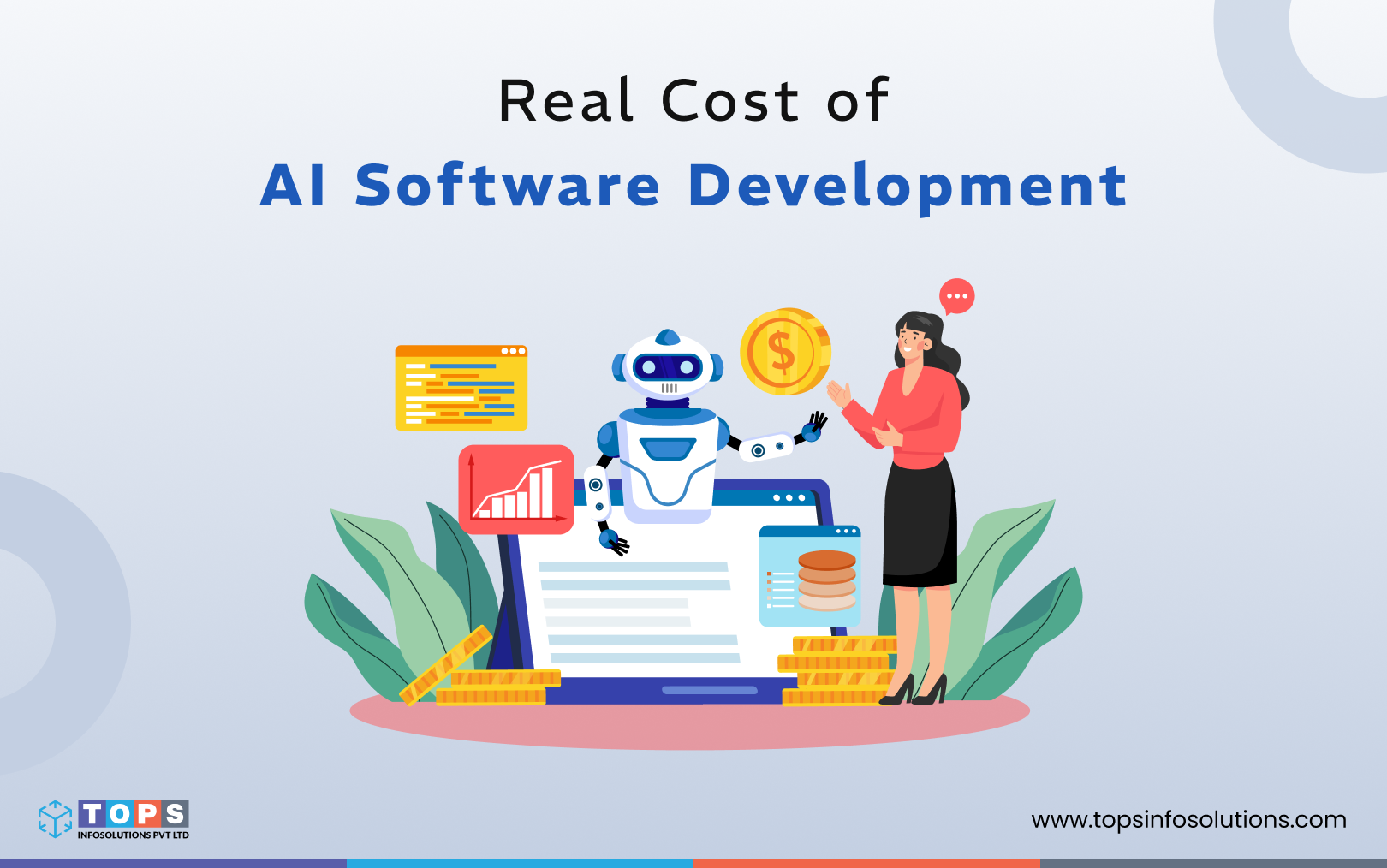
Let’s ask the difficult question: What is the actual cost of AI in software development?
Everyone keeps saying AI is essential for modern development. You hear it in every webinar, meetup, and product pitch.
It all sounds exciting. Yet, the pricing side of it remains unclear.
Considering that numerous AI-related technologies are new, there’s still complexity involved with their expenses.
It’s not as straightforward as you’d think. The location, the type of solution, and the skills of developers all play a crucial role in defining the overall cost of AI software development.
In this article, you’ll find a clear cost breakdown of areas involved in building AI-driven software. You’ll also get a better view of the cost factors in an AI project, so planning your next project feels far less uncertain.
Key Takeaways
- Cost of AI development projects typically range from $25,000 to $300,000+, depending on complexity, scale, and data needs.
- Data preparation, tooling, infrastructure, and engineering effort form the biggest cost buckets in any AI build.
- The type of AI solution, such as chatbots, recommendation engines, or automation systems, has a direct impact on the budget.
- Industry rules, customization needs, and team expertise shape how much time and resources your project will require.
What is AI in software development?
AI in software development refers to the use of machine learning models, automation tools, and systems. They enhance the functionality of applications and streamline the development process for teams.
Some of the core AI technologies that developers use while building software can include generative AI, predictive analysis, and applied AI. Instead of relying only on fixed rules, these systems learn from data, adapt over time, and help businesses create smarter and more efficient products.
Importance of accounting for AI software development costs
When you’re dealing with something as complex and daunting as AI, you can easily overstep the costs. Because there’s still confusion. About whether the solution is for you. Does it actually improve your processes? Does it fall into your budget?
A lot of businesses might simply be jumping on the bandwagon or “trying something new” to improve productivity. The teams are not in the loop about the investment and often don’t realize the resources that go into buying and training tools. It’s critical to account for these costs for the following reasons:
-
Supports predictable delivery
AI components introduce variable costs, especially with compute and third-party tools. Tracking these early helps teams decide how much experimentation they can afford and ensures development timelines stay on track. Leaders can also have realistic expectations based on the resources they allot.
-
Helps teams align features with real budgets
When everyone is in the loop about the actual costs of data preparation, training, and tooling, it becomes easier to prioritize features that deliver value without breaking financial limits.
-
Encourages smarter decision-making
Architecture influences long-term expenses. Understanding these cost paths early leads to cleaner designs, better scaling strategies, and fewer reworks in the future.
Core Cost Categories in AI Software Development
For most software development companies, the costs of AI in software development can range from $10,000 to $100,000. The key influences that define these costs are data requirements, infrastructure, AI tools, sophistication, and ongoing maintenance needs.
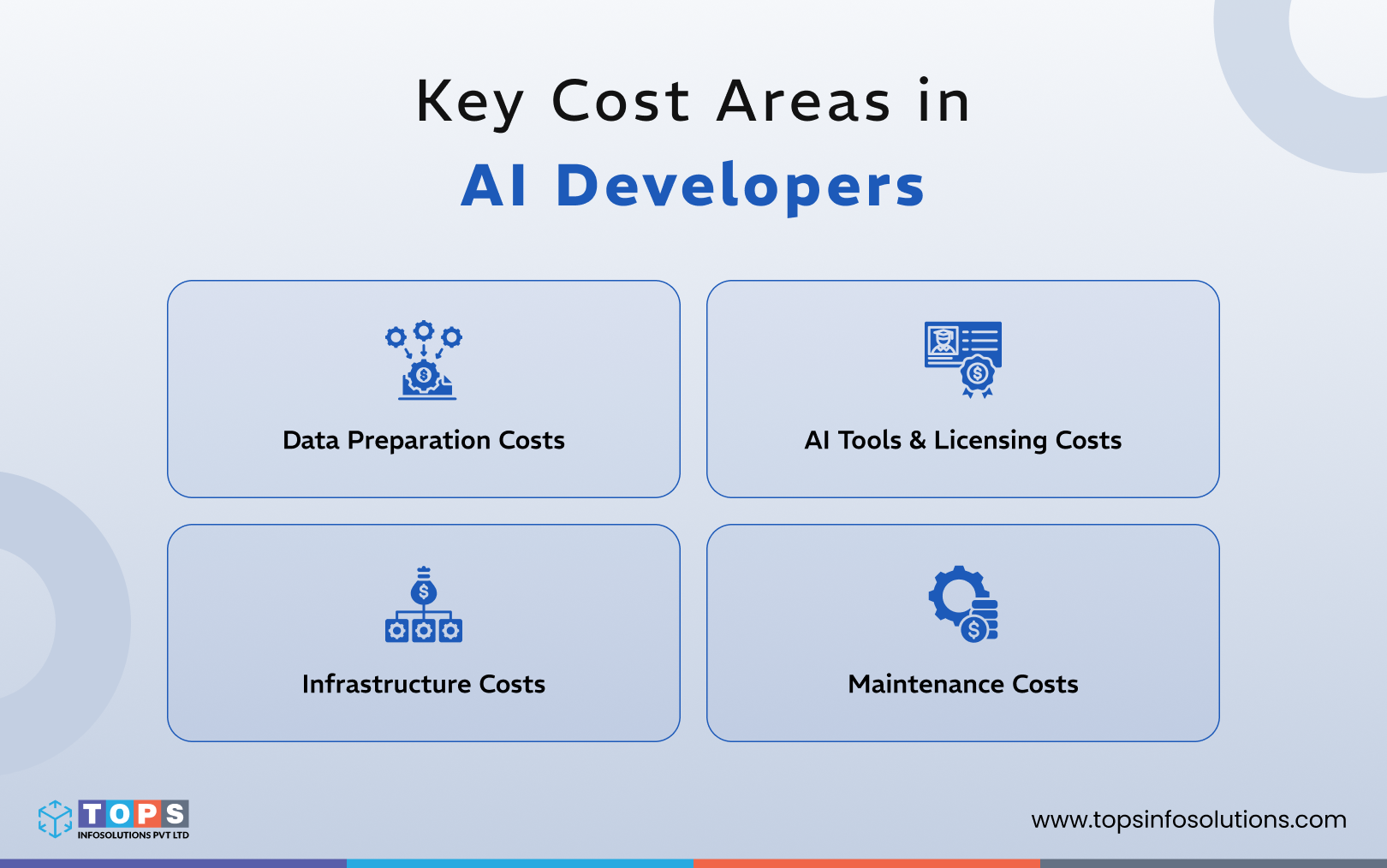
Data preparation costs
Data is the fuel on which AI functions, and it’s often the cost that most businesses underestimate. Having or collecting the data is not a challenge. However, most data arrives in scattered formats and carries errors.
Engineers need to spend considerable time cleaning and sorting data before it can be put to good use. You may also need to purchase datasets that can range from $1000 to $100,000. Additionally, this task involves engineer salaries, data analyst time, storage fees, and any third-party tools used for data cleaning.
AI Tools and Licensing Costs
Depending on your model use, infrastructure, and tooling, AI tools can cost anywhere between $3,000 – $15,000+ per month.
-
Platform subscriptions
For generative AI, you need paid versions of LLM tools like ChatGPT, Gemini, and Claude. These typically use token-based billing. For example, using GPT 5.1 costs anywhere between $1.25 and $10 per million tokens, depending on how much of your usage is input or output. Most real workloads fall in the middle, landing around $4–$6 for every million tokens.
-
Developer productivity tools
Tools like Cursor, GitHub Copilot, or Replit AI speed up development but come with seat-based licenses. For a team of 5–10 devs, this can easily run into a few hundred dollars monthly.
-
Model hosting and fine-tuning platforms
If you fine-tune or host your own models (on platforms like Hugging Face or cloud GPUs), you pay for GPU compute, storage, and inference.
-
Governance and monitoring tools
You need to maintain the quality, safety, and compliance of your solution, and it will be an ongoing activity. You’ll need auditing, logging, and drift monitoring tools, and they typically cost $500-$1000 per month.
Infrastructure Costs
The cost of AI development depends largely on whether you opt for an on-premises or a cloud solution. GPU instances are costly, and training or frequent inference can push monthly usage into thousands.
Cloud solutions offer scalability, but they do have ongoing subscription costs. On-premises infrastructure requires high investment, though it can save money in the term term. Moving data between services or handling high API traffic adds transfer and bandwidth fees. The overall cloud costs of infrastructure can range from $2000-$12,000.
Integration and Engineering Costs
AI doesn’t work in isolation. It needs to work with ERPs, IoT systems, CRMs, or legacy platforms. When bringing AI into your existing systems, engineering costs vary a lot. Estimates hover between $5,000 and $70,000+, depending on scope. Some additional costs include security & compliance, and talent.
-
Backend development
Building APIs, business logic, and middleware to call your AI models can cost anywhere from $5000-$50,000 based on your architecture.
-
Frontend work
Adding AI-driven UI components or dashboards typically adds $10K–$80K if you’re building from scratch.
Maintenance Costs
Lastly, you need to account for the regular training and monitoring of the solution. For example, for every major update, you’re going to incur additional dollars. Performance monitoring consumes around $500-$5000 per month, and so does algorithm refinement. You’ll also need to run security audits and bug fixes, which are around 15-20% of initial development costs annually.
Key Factors That Influence AI Development Costs
While there isn’t a definite number on how much AI development costs, we do have a list of factors that influence an accurate estimate. Every company, every industry, and every scale is different. Your solution will be dependent on what, why, and how you want to achieve an outcome assisted by AI. Let’s take a look at factors that affect the AI development costs:
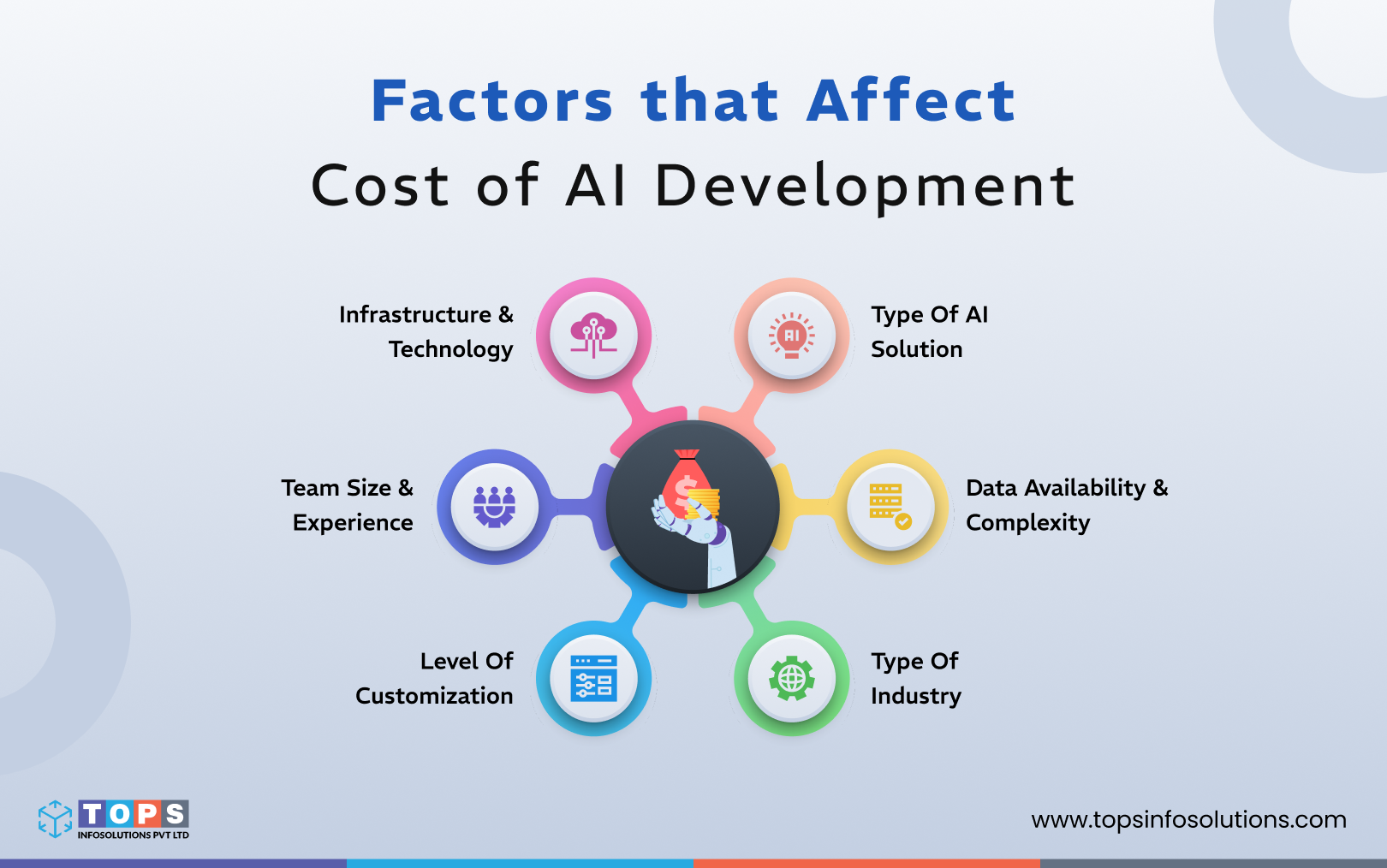
Type of AI solution
AI comes in all types and forms. The kind of solution you choose has a direct impact on data needs, model complexity, infrastructure, and the amount of engineering involved. Some of the solutions you may consider are:
-
Predictive analytics models
Predictive analytics operate on tons of structured historical data. The cost associated with this is shaped by the amount of preprocessing required and the frequency of model retraining as new data arrives.
-
Generative systems (text, images, or code)
Generative AI tools provide token-related pricing. They rely on heavy inference and can become expensive when usage spikes.
-
Agent-based systems
A single-agent or a multi-agent process requires orchestrated, memory tools, vector databases, and multi-step reasoning loops. Costs in agentic AI increase rapidly due to tooling, integrations, and the need for meticulous monitoring.
-
Recommendation engines
These systems rely heavily on user behavior data. Costs rise when datasets are messy or require ongoing updates. You also need solid storage and retrieval tools because they depend on fast access to embeddings and past interactions.
For every type of AI solution, the ranges are as follows:
| Parameters | Approximate costs |
|---|---|
| Predictive analysis | $30,000 – $200,000 |
| Generative systems | $20,000 – $500,000 |
| Agent-based systems | $1,000 – $300,000 |
| Recommendation engines | $5,000 – $300,000 |
Data availability and complexity
Your scale of the project determines the amount of data you’ll need. The higher the amount of data, the higher the cost. But let’s say you already have clean, structured data and don’t need to purchase new sets. In that case, the AI development cost is cheaper. If you need to collect, clean, and label data, the costs go up.
A simple example is that a generic FAQ chatbot doesn’t need high investment, but a complex, AI-trained healthcare AI solution that accesses patient records will cost more since it needs manual labeling.
Type of Industry
The type of industry will determine the use case of the AI solution, which impacts the cost. Each sector comes with a different level of complexity, compliance needs, and data readiness. Here are a few examples that show how this influences the solution budget:
- Healthcare: AI in healthcare has high costs due to strict compliance checks, sensitive data handling, and long validation cycles. Even a simple triage or diagnostic model needs careful testing. Besides, the stakes in healthcare are high. You need significant manual input for inspection and accuracy.
- Finance and banking: Fraud detection or credit scoring systems require high accuracy and audit trails, which push both engineering time and infrastructure costs upward.
- Retail and e-commerce: Solutions are usually cheaper because data is more accessible. Recommendation engines, customer segmentation tools, and demand forecasting models can be built faster, too.
- Manufacturing: Computer vision and predictive maintenance solutions depend on specialized hardware and large labeled datasets, which increases the budget.
Level of customization
Every added layer of tailoring needs more time, testing, and specialized engineering. Off-the-shelf models keep expenses low since teams only adjust prompts or basic workflows.
Custom models, on the other hand, demand deeper data prep, feature design, and fine-tuning. You also need an experienced AI developer who works for longer hours to build the solution.
Here are a few ways customization shifts the budget:
- Minor tweaks: A chatbot that only needs brand-specific responses stays affordable since the core model remains untouched.
- Moderate adjustments: A recommendation engine tailored to niche buying behavior takes more effort because the model must learn from unique patterns.
- Heavy customization: A predictive model for risk scoring in insurance becomes expensive due to domain complexity, longer training cycles, and extensive validation.
Team size and experience
Circling back to the scale of the solution, if you’re looking to build a highly sophisticated AI solution that automates your business processes or even streamlines internal communication, you’ll need a bigger team, paid tools, and experienced developers – everything that shoots up your costs.
The balance between expertise and workload often decides how quickly the project reaches production. Smaller teams with AI development skillsets are affordable but may stretch the timeline because members juggle multiple tasks. On the other hand, experienced teams ensure faster execution and stronger architecture decisions, but their salaries can reach premium levels.
Infrastructure & technology
Strong infrastructure choices influence the long-term cost of any AI project. Companies that need real-time results usually spend more on compute and managed services. Smaller workloads stay on the lower end of the spectrum. The right stack cuts waste and boosts reliability, while poor choices inflate both engineering time and ongoing bills.
How Our Expertise Helps Companies Make Smarter AI Investments
Every choice you make, from data preparation to infrastructure, shapes the final cost and the long-term value of the solution. When these pieces come together with the right strategy, AI becomes far more predictable and far more effective.
If you are exploring an AI app development company for your own products or want guidance on picking the right approach, our team can help you shape a solution that fits your goals and budget. Feel free to reach out to discuss your project or learn what a tailored AI roadmap could look like for your business.

Frequently Asked Questions (FAQs)
AI software development typically costs between $25,000 and $300,000 or more. Simple AI agent-based tools can start from $1,000, while complex generative AI systems can exceed $500,000 depending on data needs, infrastructure, and customization.
The four core cost categories are data preparation, AI tools and licensing, infrastructure, and engineering and integration. Each varies significantly based on project complexity, compliance requirements, and the level of customization needed.
Data preparation involves cleaning, structuring, and sometimes purchasing datasets, which can cost between $1,000 and $100,000. Scattered or poor-quality data significantly increases the time and cost required before any AI model can be built.
Monthly AI tool and licensing costs typically range from $3,000 to $15,000 and include LLM API token billing, developer productivity tools, model hosting and GPU compute, and governance and monitoring platforms.
Yes. Healthcare and finance projects cost more due to compliance, validation cycles, and audit trail requirements. Retail AI projects are generally cheaper because of more accessible and less regulated data.
Yes. Off-the-shelf AI solutions are more cost-effective for standard use cases. Custom AI models require significant time for fine-tuning, data preparation, and specialized engineering, all of which increase the total cost substantially.
Annual maintenance typically runs 15 to 20 percent of the initial development cost and covers algorithm refinement, bug fixes, security audits, and model performance monitoring to keep the system accurate over time.
Businesses can reduce AI development costs by starting with an MVP, using existing AI models, improving data quality early, and focusing only on high-impact use cases before scaling.
TOPS Infosolutions provides transparent cost planning across data preparation, tooling, infrastructure, and engineering, helping businesses build AI systems that align with real budgets and avoid over-engineering before core functionality is validated.