




Having a breakthrough idea isn’t enough.
Turning that very idea into a Minimum Viable Product (MVP) takes focus and quick learning cycles.
Many teams are aware of this, yet they remain entangled in lengthy development cycles, unclear feature decisions, and endless rounds of testing.
This is where AI MVP development is gaining ground. Recent studies show that high-performing software teams using AI tools have seen 16 to 30 percent improvements in team productivity and faster time to market.
The role of AI in modern MVP development centers on providing data-driven insights that help teams determine what to build, accelerate prototyping, and shape an MVP that aligns with market expectations.
In practice, what does that mean?
Let’s take a look at the AI MVP development process and why it’s the need of the hour for software developers.
Why AI Matters for MVP Development
Using AI isn’t a matter of ‘if’ anymore but ‘when’. A report suggested that the AI adoption rate amongst software development teams has reached 97.5% across companies of all sizes.
While some may still be in the experimenting stage, others are finally at a stage where they’re reaping the real benefits of using AI in MVP development. Let’s take a look at why it’s gaining traction.
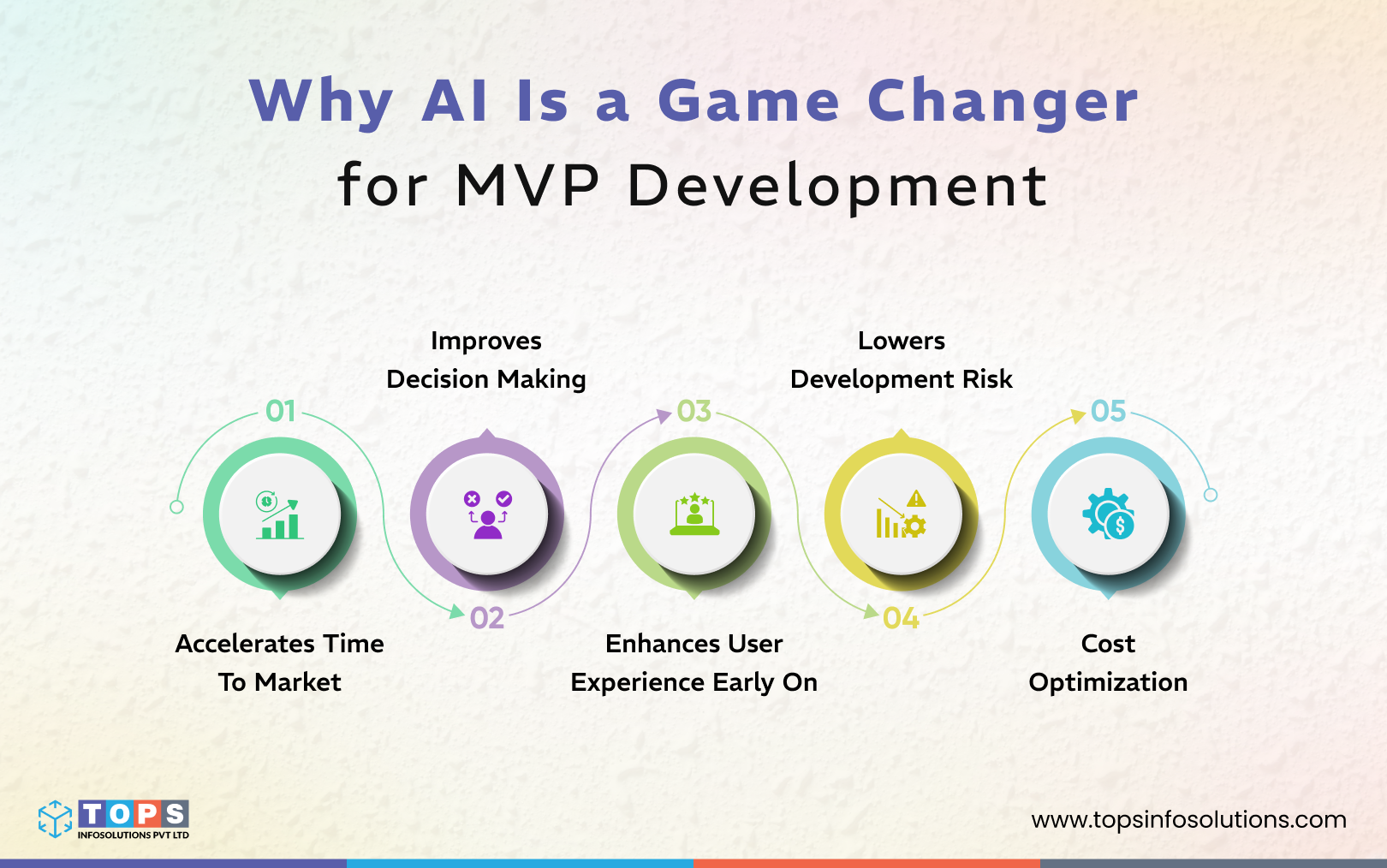
1. Accelerates Time to Market
While it’s not wise to spend ample time on a prototype or an MVP, teams still lose weeks writing boilerplate code or running repetitive tests. With AI in MVP development, those tasks move faster.
For instance, a team building a travel booking MVP can generate UI screens and basic booking logic with AI tools in a few hours instead of several days. This cuts development time, lets teams ship sooner, and opens the door to real user feedback.
2. Improves Decision Making
AI is a great technology for gathering data. Data that gives you user reviews, analyzes market trends, and even compares competitor features. If you’re using AI use cases in MVP development, the process is backed by powerful insights rather than gut feelings.
For example, imagine a fitness app startup thinking about which workouts to prioritize. AI can study patterns and social chatter to learn which type of workout gets the most engagement. This reduces uncertainty and guides the roadmap with evidence rather than opinion.
3. Enhances User Experience Early On
Every user judges products by how they feel. Even if the feature set is small, there’s still room for smart onboarding and tailored recommendations that make the MVPs more engaging.
One of the benefits of using AI in MVP development is the ability to personalize without heavy engineering. With generative AI, you can customize your MVP to suggest content/products according to personalized journeys, modify interface layouts, and provide flexible onboarding pathways. It helps you enhance user experience with minimum efforts.
4. Lowers Development Risk
The point of MVP is to avoid the risks of uncertainty. You’re constantly aiming for the tool to be feasible, scalable, and for the idea to land with users. With AI, teams can simulate user behavior, predict performance issues, and generate synthetic data for testing before the real data arrives.
For example, picture a logistics startup validating a routing feature. Instead of waiting months for real delivery data, they can simply generate sample routes and test the logic to uncover weak spots and keep surprises to a minimum.
5. Cost Optimization
At the MVP stage, the budget is already tight, so every hour and tool choice matters. AI MVP development services can trim costs by automating repetitive coding, generating UI variations, and running quick usability checks without a full design team.
With AI, you can automate client assistance, decrease QA duration, and test flows. Less manual effort, fewer iteration loops, and faster feedback translate into lower spend during the riskiest phase of building a product.
Steps of AI-Enabled MVP Development
While AI is widely prominent in software development, you still need to use it at the right stages at the right time to ensure optimized use and control costs. Let’s take a look at the process in detail:
1. Discovery and Validation
Discovery is a process you have to follow, regardless of whether you’re moving forward with AI or not. You need clarity on the problem that the MVP will address, and for that, you require market awareness and strong product instincts. A clear research foundation is essential for anyone learning how to build an AI MVP because it reduces incorrect bets later in the cycle.
How AI fits
- Scan reviews and product discussions to surface real user pain points
- Research copilots summarize market reports and competition data
- Sentiment analysis reveals emotional triggers around specific workflows
Useful tools: ChatGPT, Notion AI, MonkeyLearn
2. Design and Prototyping
In designing, you move to creating user journeys, wireframes, and clickable prototypes from the validated ideas. This is mainly for teams to visualize how the MVP will function and gather feedback from early stakeholders.
Design and prototyping make user behavior tangible. Many product teams rely on the best AI MVP tools to generate interface variations or evaluate usability patterns faster than traditional methods.
How AI fits
- Text-to-UI tools produce wireframes from natural language descriptions
- AI layout assistants offer multiple visual variations for A/B exploration
- Usability tools evaluate contrast, spacing, and visual hierarchy
Useful tools: Galileo AI, Figma AI
3. Development and Engineering
During development and engineering, prototypes evolve into functional MVP software. Teams define tech stacks, build architecture, secure integrations, and add core features.
Incorporating AI coding assistants and automated documentation makes this stage faster, especially for teams following an AI MVP development guide that focuses on short learning loops rather than perfect architecture.
How AI fits
- AI coding copilots handle repetitive logic and CRUD layers
- Debugging assistants surface issues earlier in the build
- Test generators create unit tests to improve confidence
Useful tools: GitHub Copilot, Cursor, Tabnine
4. Quality Assurance and Testing
Quality assurance checks if the MVP behaves correctly, performs smoothly, and connects with user expectations. Teams run through functional tests, usability sessions, and device checks.
AI use cases in MVP development show up strongly here because behavior analytics and clustering can reveal what users find confusing without needing hours of manual review. This makes validation loops quicker and more actionable.
How AI fits
- AI generates test data and structured test cases
- Behavioral analytics highlight friction points during navigation
- Feedback clustering organizes user comments into clear themes
Useful tools: Testim, Mabl
5. Launch and Iteration
This is where you bring the MVP into the hands of real users. Product teams watch usage patterns, measure engagement, collect feedback, and tweak the solution based on insights. The feedback shapes the plan for the whole solution.
You gain insights into the user experience, satisfaction level, and how the solution addresses core customer issues, among other things. AI tools help forecast retention trends and segment users by engagement level. This has a direct impact on the eventual cost to launch an AI MVP since better insights reduce waste in scaling.
How AI fits
- AI analytics reveal product adoption and feature drop-offs
- Predictive models estimate churn and lifetime value
- Personalization engines adapt experiences by segment
Useful Tools: Mixpanel, Amplitude, Gainsight
Challenges of Integrating AI in MVP Development
In every process that you involve AI, you need to understand the challenges that come with it. Although the use of AI is widespread, its actual implementation is still in an experimental stage. Let’s learn some top bottlenecks you may encounter in the AI MVP development process.
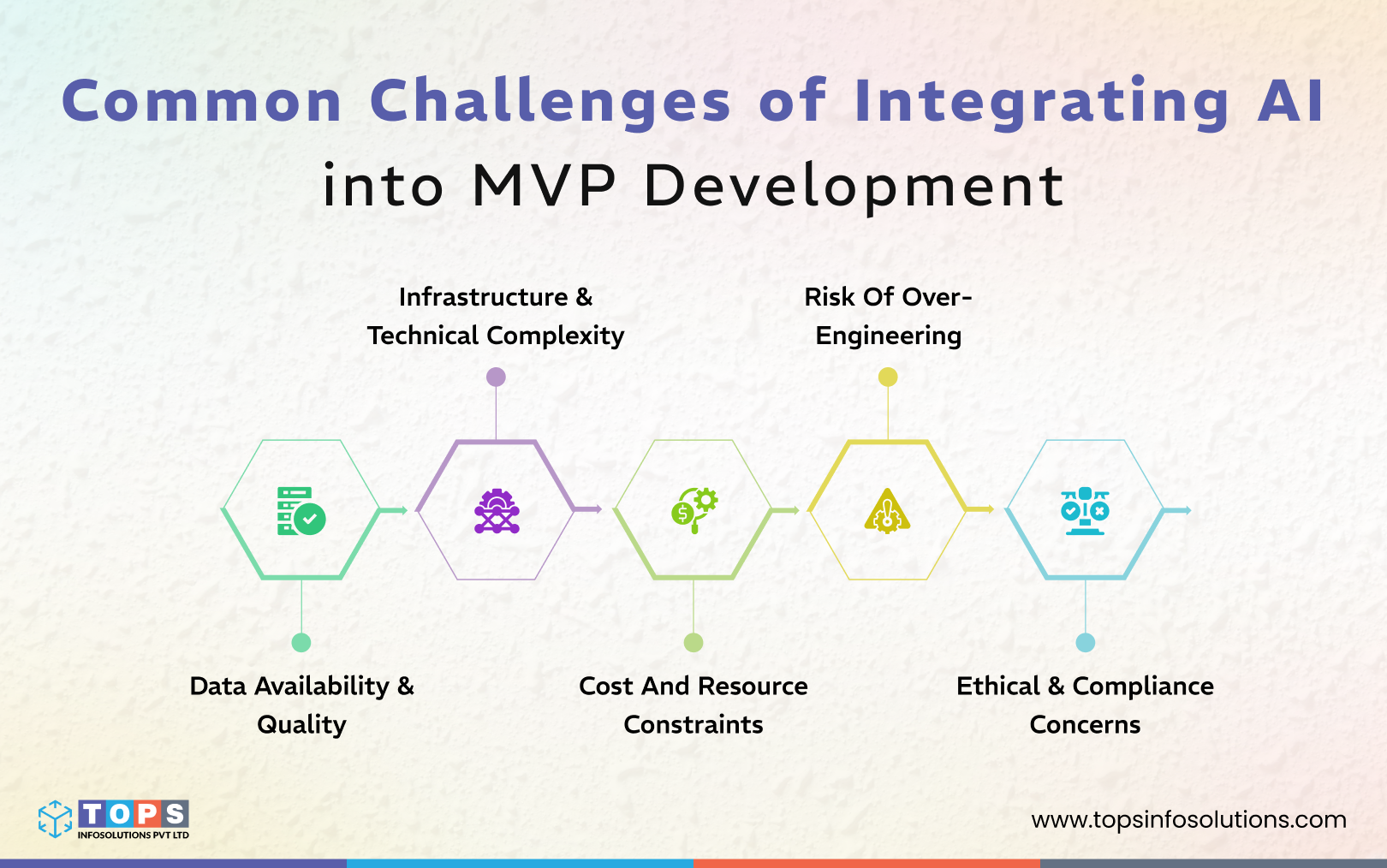
1. Data Availability and Quality
Early-stage products rarely have enough data to train reliable models. The problem isn’t getting access to big data but data that is clean, structured, and domain-relevant.
A health-tech MVP may collect symptom logs from users, but the dataset might be too small to produce accurate predictions at launch. Teams either use public datasets, synthetic data, or delay certain AI capabilities until after user adoption improves.
- Quick Fix: Start with a narrow use case and identify the minimum viable dataset. Consider synthetic data or public datasets to fill early gaps while planning long-term data pipelines.
2. Infrastructure and Technical Complexity
Building even a small AI MVP requires storage, compute, and deployment environments. Teams must manage things like model hosting, versioning, containerization, and inference latency.
It can feel heavy for companies without prior ML engineering experience. Setting up scalable infrastructure becomes even harder when experimenting with multiple architectures or integrating with legacy systems.
- Quick Fix: An MVP development company can help you build infrastructure with managed cloud services, unified ML platforms, or AutoML tools that simplify heavy lifting. This lets your team focus on validation instead of wrestling with infrastructure and integration challenges.
3. Cost and Resource Constraints
While in the long run, AI helps you save costs, initially, you have to bear the costs of investment that can burn your pockets. AI MVP development can involve expensive GPU workloads, specialized AI developers, and prolonged experimentation cycles.
Budget overruns happen when teams try to build enterprise-level infrastructure or train custom models too early. This issue hits startups the hardest, since they need fast validation to attract funding.
- Quick Fix: Work with teams that understand cost ceilings and reduce the chances of failure. An AI MVP development company relies on pre-trained models, smaller controlled experiments, and serverless compute for pay-as-you-go scaling. This keeps spending aligned with validation rather than full production.
4. Risk of Over-Engineering
With MVP, teams sometimes fall into the trap of turning research into a full product before validating demand. It’s difficult to keep control of the project, and instead, teams add every possible feature, build complex AI workflows (just because they’re gimmicky), or chase accuracy benchmarks that do not improve business performance.
Over-engineering delays time to market and increases burn. It also hides whether users actually care about the core value proposition.
- Quick Fix: Define one primary success metric and freeze scope around it. Ship a simple AI workflow first, then iterate through real-world feedback.
5. Ethical and Compliance Concerns
AI systems must align with privacy regulations, fairness expectations, and domain-specific compliance rules. Industries like healthcare, finance, and HR introduce approval hurdles that slow down development.
Teams must also consider bias, consent, storage limitations, and explainability to avoid future legal or reputational risks. Ethical concerns can be intimidating during early experimentation.
- Quick Fix: Involve compliance and domain experts early. Start with a controlled pilot, document decisions, and choose transparent model types where possible.
Partner with TOPS for Faster AI MVP Development
AI has changed how software teams validate ideas, shape user journeys, and evolve their products. An MVP that once took months can now move through research, prototyping, and testing in far less time. The output feels more aligned to market demand, and teams waste fewer cycles on assumptions that do not hold up during validation.
If you plan to build an AI MVP and need a partner who understands discovery, rapid validation, and production scaling, TOPS is a solid choice. We help founders and enterprises move from concept to launch-ready MVPs with structured execution, practical tooling, and a focus on user value. Share your idea, and we will help you plan the next steps.