Table of Contents
RAG: Definition, Benefits, and Use Cases for Industries
AI isn’t perfect.
And most people realize that after using it for a while.
Ask your AI assistant for your latest pricing policy or this quarter’s sales numbers, and there’s a good chance it will give you outdated or generic information. Sometimes, even totally inaccurate answers.
Confident but still wrong.
That’s the catch. When the data that makes up AI is outdated or incomplete, the answers fall flat. So how do you fix that gap?
Three words: Retrieval Augmented Generation.
RAG as a service gives AI access to the right information at the right time. It’s what keeps the responses relevant and actually useful.
Let’s break down what it is and why it matters.
What is RAG in AI?
Retrieval-Augmented Generation is a method to enhance a Large Language Model’s (LLM) output by referencing an internal knowledge source beyond its original data. RAG retrieves relevant and latest information from sources such as documents and vector databases. It helps the AI agents or Generative AI to provide contextually relevant answers.
As LLMs became popular, users quickly noticed a problem with fact-checking in AI. AI researchers coined the term RAG in a 2020 paper for the most practical way to make enterprise AI trustworthy.
How does RAG work?
- Retrieve: When a user asks a query, the system searches your internal sources such as PDFs, databases, or CRM and pulls the most relevant information.
- Augment: The retrieved content is added as context to the model’s prompt. This gives AI fresh knowledge to work with for a more precise response.
- Generate: The model creates responses using both its language skills and the supplied data, resulting in accurate, current, and personalized answers for your business.
Benefits of RAG in AI: How and Why RAG Has Become Crucial for Businesses
Here’s where RAG really proves its worth, in the everyday challenges teams face at work.
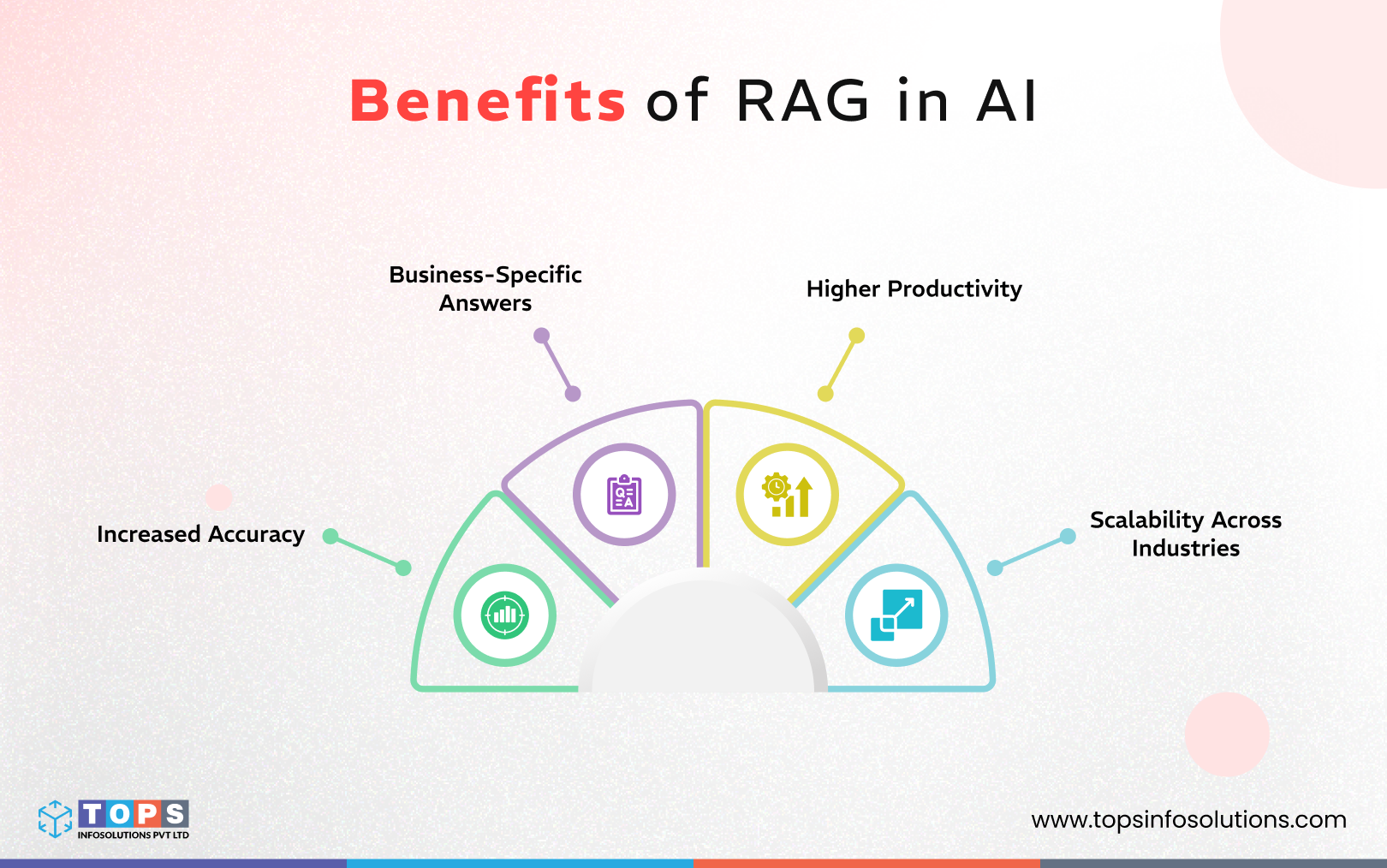
1. Increased Accuracy
Hallucinations are a recurring problem with AI. Hallucinations occur when AI doesn’t know the exact answer to your question. Instead of being transparent, it will guess a response instead. This can lead to misinformation and inaccuracy.
RAG changes this by pulling information directly from the latest documents and systems before generating a response. The results are based on official documents, not on probability.
For example, instead of guessing your refund policy, a RAG-powered assistant retrieves the exact policy from your knowledge base and answers correctly every time a customer asks for it.
2. Business-specific Answers
While generative and agentic AI are smart, they don’t know your company, its workflows, pricing rules, or internal terminology. One of the benefits of RAG is that it gives these AI models access to your organization-specific data. The answers reflect how your business actually operates and provide responses that have context and specific insights that users are looking for.
Imagine a sales rep asking, “What’s the discount approval process for enterprise deals?” With RAG, the assistant pulls your internal SOP and gives a step-by-step answer that matches your process.
3. Higher Productivity
Employees spend a surprising amount of time searching for information from old emails, shared drives, and multiple dashboards.
RAG turns all that scattered knowledge of the organization into a single, searchable place. Employees get every piece of information at their disposal, just ask questions and move on, instead of spending time on tasks that are trivial.
4. Scalability Across Industries
The benefits of RAG in AI are not limited to a single use case. Once the retrieval pipeline is set up, the same foundation can support multiple teams and workflows. You’re not starting from scratch every time.
The same system that powers a customer support chatbot can also help sales find product details, finance retrieve reports, or HR answer policy questions. You simply connect new data sources and define new use cases.
Use Cases for RAG in Various Industries
Anywhere we use AI to answer questions, search knowledge, or support decisions, RAG helps elevate those interactions, making them more accurate.
That said, every industry uses it a little differently, and you’ll find different use cases for RAG in various industries. Let’s look at how to implement RAG in real-world scenarios across sectors.
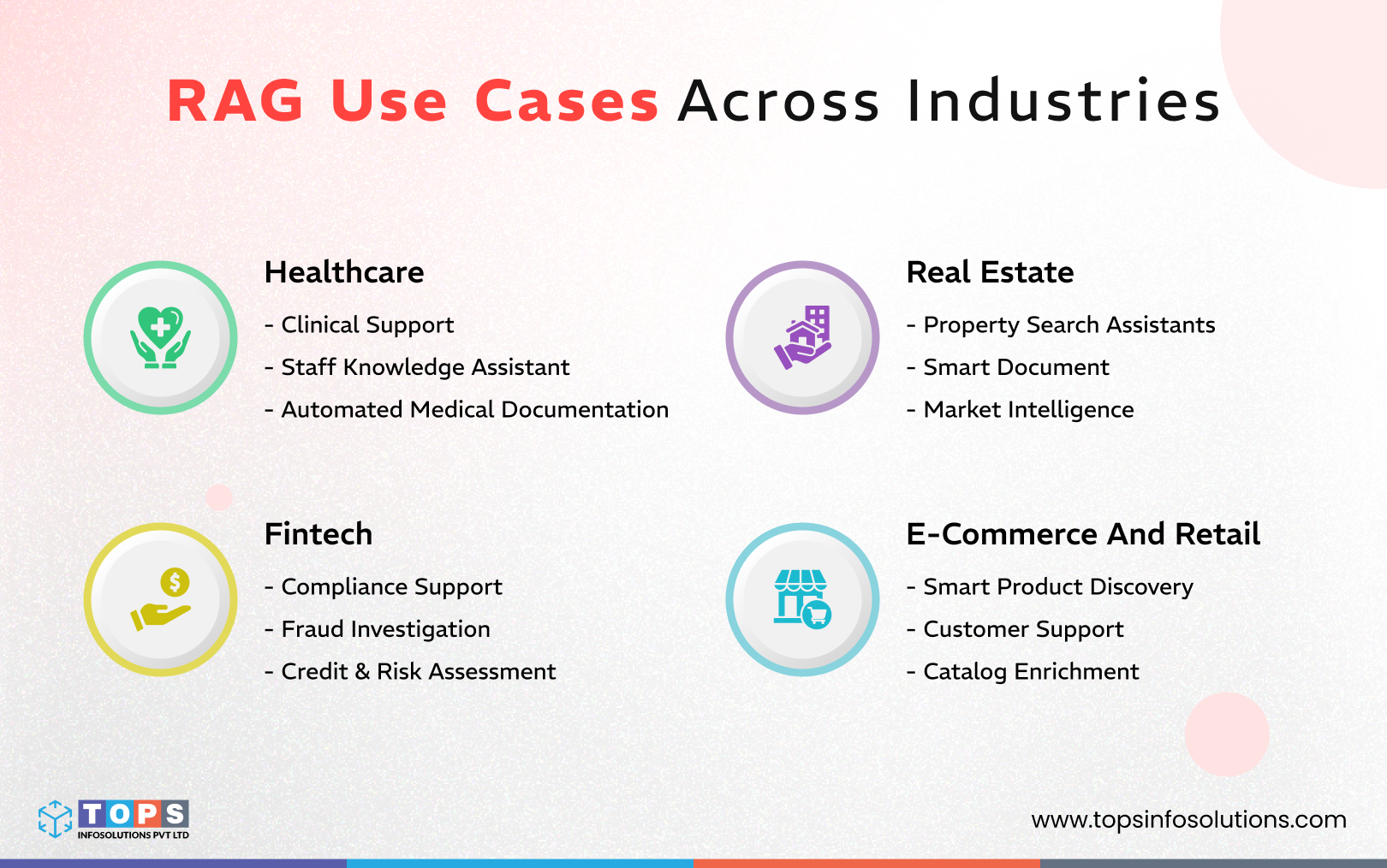
RAG in Healthcare
1. Clinical decision support
Medical information is high-stakes information. Instead of relying solely on AI, RAG can help medical professionals make clinical decisions by giving them access to information for diagnostics, patient management, and treatment planning. It can fetch details like relevant patient history, recent studies, and clinical guidelines.
2. Medical knowledge assistants for staff
Real-time knowledge in the medical field can significantly bring about a positive change in healthcare workflows.
Another use case of RAG in healthcare is that doctors, nurses, and administrators can pose queries for hospital protocols, treatment guidelines, and drug information through a chat-style interface. Instead of going through manual to manual, they get instant and reliable answers.
3. Automated medical documentation
Say you’re building an AI agent in healthcare that verifies information against central records and conducts professional evaluations of patients. RAG can help you integrate relevant data so the agent can review medical documents, extract details, and streamline AI-powered clinical coding and documentation workflows by validating them against Electronic Health Records.
RAG in Real Estate
1. Property search assistants
With property search, buyers get as specific as they can. Say, they search for something like “Show me 3 BHK homes under $500k near good schools with low commute time.”
If you’re wondering how to use RAG in real estate, consider an autonomous RAG-powered AI agent that can actively search, understand, and synthesize information from across your company’s knowledge base. The best part is RAG-powered assistant understands these natural language queries, which makes property discovery faster and far more personalized.
2. Smart document handling
The real estate industry is flooded with paperwork. I’m talking about lease agreements, contracts, disclosures, and compliance documents. These documents are often long and hard to interpret.
RAG in real estate helps you extract important information like clauses, summarize terms, and answer questions in simple terms. Agents and clients can quickly understand things like notice periods, penalties, or payment terms without manually scanning dozens of pages.
3. Market intelligence
Accurate pricing depends on historical trends and current market conditions. RAG connects these data points and turns them into actionable insights.
You can pose questions like “What’s the average sale price for similar properties in this area over the last 6 months?” Instead of a generic answer, you’ll get one that is backed by thorough research and backed by latest industry data.
RAG in Fintech
1. Compliance and regulatory support
Non-compliance in finance can result in hefty fines, and nobody wants to be in that situation. It is also crucial to note that financial institutions constantly deal with evolving regulations, internal policies, and audit requirements. It’s often hard to keep up.
In this case, having just generative AI or AI agents that aren’t backed with latest updates can only do so much and provide half-baked information. A RAG-powered assistant that has access to the latest data can instantly retrieve relevant guidelines and compliance checklists.
2. Fraud investigation
To prevent fraud, teams often have to piece together information from multiple systems, such as transaction logs, user activity, past cases, and so on. The process is essential but also slow.
RAG in fintech helps investigators query all that data at once. AI assistants can summarize user activity over the past month or draw patterns from suspicious transactions. The same approach also powers AI automation in loan management, where lenders assess borrower risk, verify documents, and speed up approvals. This shortens investigation time and helps teams act before losses escalate.
3. Credit scoring & risk assessment
To assess the credibility of the customer, you need to evaluate the customer’s history and external financial data. Gathering all this information manually can slow down approvals and increase the chance of oversight.
RAG in fintech helps consolidate these data points and surface the most relevant information instantly. Analysts or loan officers can ask, “Summarize this applicant’s risk profile” or “Flag any high risk indicators based on our policy,” and receive responses with real customer data and internal guidelines.
RAG in E-commerce and Retail
1. Intelligent product discovery
RAG elevates the recommendation engine as it helps answer customer queries about product features, specifications, and compatibility by retrieving relevant details from a product catalog or review database. It also retrieves similar or complementary products based on purchase history and customer queries.
2. Customer support automation
Customer support queries in e-commerce aren’t always straightforward. Customers can have oddly specific queries relating to their orders, exchanges, issues with delivery, and issues with products. To provide on-point answers, you need to have access to customer orders and transaction details.
With RAG, you can integrate your chatbot to internal systems so that they can fetch answers directly from order systems and internal policies. Customers get precise updates like “Your order ships tomorrow” or “Your return window ends on March 10,” instead of generic replies.
3. Catalog and content enrichment
RAG is used by e-commerce companies to generate content summaries and product descriptions by retrieving data from the product catalog and other sources. It also pulls details from past listings, supplier sheets, and technical specs to generate rich, consistent product content.
When Should You Consider RAG as a Service?
While you’ll find ample custom RAG development services everywhere, you need to stop and have a deep evaluation of whether you want to simply jump on the AI bandwagon or actually have processes that can benefit from this technology. Just because AI is popular, it still isn’t for everyone. How do you know if it is for you? Let’s find out.
1. You want AI without heavy infrastructure management
The cost of AI development is one of the first concerns teams consider. And fair enough. Implementing AI systems from scratch can mean expensive GPUs, long training cycles, and dedicated ML teams to keep things running.
RAG takes a lighter approach in terms of infrastructure. Instead of training or fine-tuning large models, it works by connecting an existing model to your data. You only need to focus on well-organized data and a retrieval layer to make it searchable.
2. You’re starting with a clear pilot use case
A Gartner report noted that 39% of AI projects struggle because they start without a well-defined problem to solve. Businesses jump into technology first and only later ask how it creates value for them or how it aligns with the broader objectives.
Before you opt for a RAG development partner, check if your workflows actually need it. If your organization struggles with scattered knowledge, slow search, and inconsistent answers, RAG can make a noticeable difference. Think about industries like healthcare organizations, fintech, and enterprise teams with large document stores or complex systems.
But if you’re a small startup where communication is already fluid and most answers are just a message or quick call away, RAG as a service may not make much of a difference — just yet.
3. You already have structured or semi-structured data sources
While AI relies on data, RAG takes it up a notch and feeds on internal information too. Before adopting RAG, take a closer look at your internal knowledge. Is it organized and reasonably clean? Because RAG can only retrieve what actually exists.
If your documents live in scattered folders, outdated files, or inconsistent formats, the system will struggle to deliver reliable answers. On the other hand, if you already have structured or semi-structured sources like CRMs, ERPs, helpdesk tools, knowledge bases, or well-maintained document repositories, you’re in a great position to get started. The cleaner the data, the better the output.
4. Teams spend too much time searching for information
Sometimes the biggest RAG opportunity is hiding in plain sight. You see your teams constantly digging through emails, shared drives, dashboards, or long documents just to find a single answer. This is a clear signal: Knowledge exists, but it’s hard to access. In such cases, small delays add up. Productivity stalls and deadlines slip.
If you time and again witness this in your company, it’s time to consider Retrieval Augmented Generation Company. RAG changes that dynamic by democratising knowledge within your organization. Teams don’t have to ask ten people to get a piece of information that helps them move forward with their tasks.
5. You operate in a regulated or high-risk environment
If regulations and compliance dictate what you do, it is essential to have a data source that is reliable and quick to access for your teams. Incorrect information can lead to compliance issues, and generic AI isn’t enough for that.
You need answers that are traceable and source-backed. RAG retrieves information from approved internal systems and can even show references for every response. That makes audits easier and reduces risk.
Conclusion: Looking for a RAG as a Service Company?
RAG is the most practical way to make AI useful. It is solving real business problems across industries. The key is to build it the right way, with clean data, the right architecture, and use cases in mind.
That’s where the right Retrieval Augmented Generation services make all the difference.
TOPS is one of the top Retrieval Augmented Generation companies. We design and deploy RAG solutions tailored to your workflows, systems, and industry needs. If you’re looking for a small pilot or planning an organization-wide rollout, we can assist you from idea generation to production with less complexity.
If you’re ready to turn your business knowledge into smarter, more reliable AI, let’s talk.