Table of Contents
RAG in Healthcare: Building Accurate and Compliant AI Systems
AI failures are inconvenient in most industries. But in healthcare, they carry real consequences.
An incorrect recommendation can erode patient trust. Or, an incomplete clinical insight can impact patient safety and trigger compliance concerns.
Healthcare leaders cannot rely on AI systems that generate answers based purely on probability. They need systems grounded in verified, current information.
This is where Retrieval Augmented Generation, or RAG in healthcare, becomes essential.
What Is RAG in Healthcare?
Retrieval Augmented Generation in healthcare is an AI solution that first retrieves verified medical information and then generates responses based on pre-fed data. Instead of relying on a generic language model, it generates every answer in real, up-to-date clinical knowledge, patient records, or approved guidelines.
Here’s how RAG in healthcare works:
Step 1: Define trusted sources
You first connect the AI system to approved data such as clinical guidelines, internal protocols, research papers, and permitted patient records.
Step 2: User submits a query
A user can be a clinician, administrator, or staff member asking a question relating to treatment, documentation, or operations.
Step 3: Retrieve relevant information
The system searches only the approved knowledge base and pulls the most relevant content.
Step 4: Generate a grounded response
The language model generates an answer using the retrieved information as context, reducing hallucinations and outdated suggestions.
Key Healthcare AI Challenges RAG Helps Solve
What RAG-as-a-service essentially does is combine a large language model’s generative AI with an organization’s own trusted data.
While a generative model answers based on patterns learned during training, which can be outdated or too general, RAG changes this by injecting relevant, real-time information from approved sources.
Let’s check out some challenges RAG helps solve in healthcare:
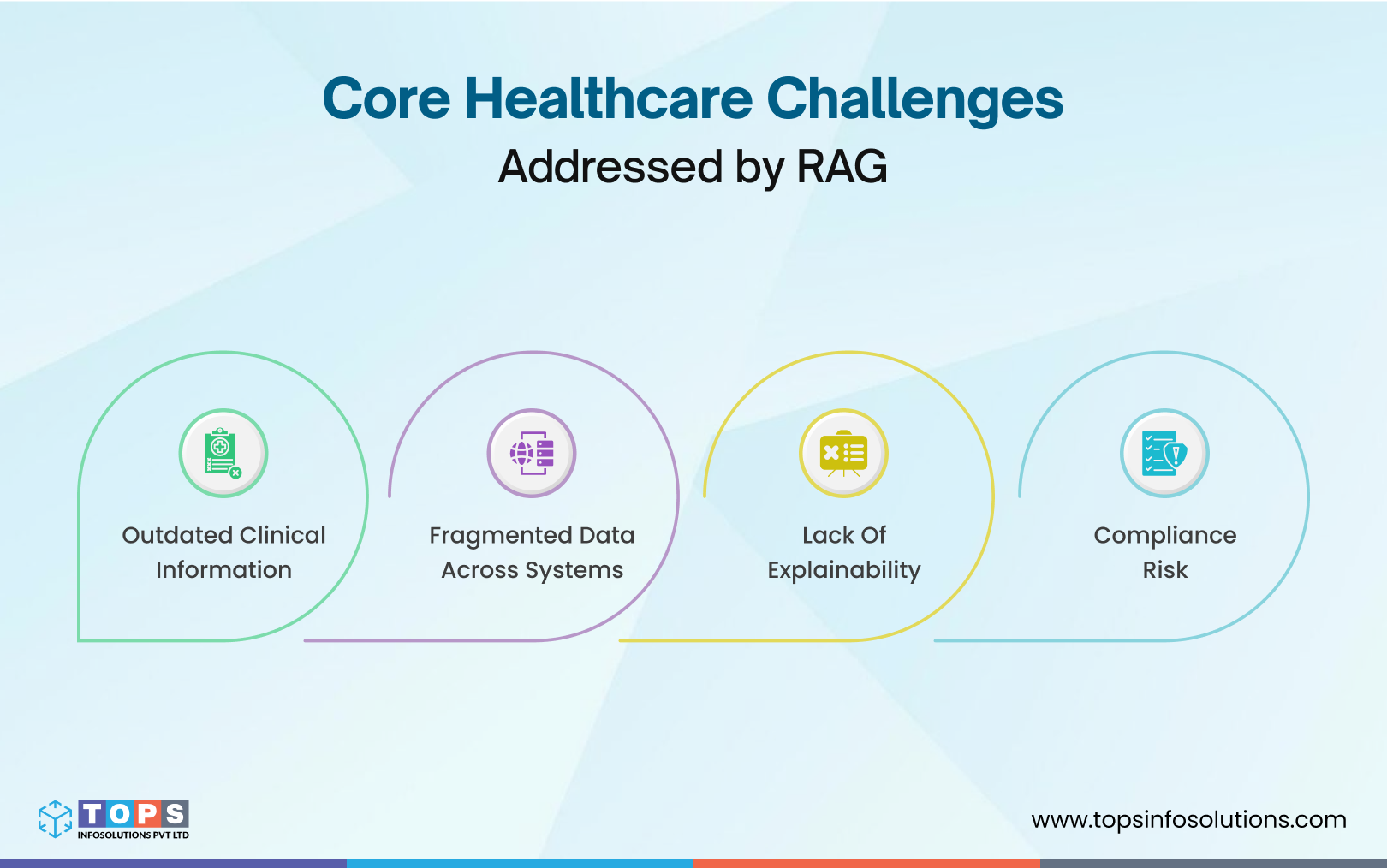
Outdated Clinical Information
As a healthcare professional, you cannot simply make do with static clinical information. Medical knowledge evolves constantly. Information like treatment guidelines, drug interactions, and care protocols changes with time and the latest research. Traditional AI models rely on historical training data, which may not reflect the latest standards and compliance.
Fragmented Data Across Systems
Healthcare data lives in silos. Healthcare practitioners in lab systems are using a different tool than those in billing and administrative departments. When you have a standalone AI model, every department lacks real-time access to this distributed context, leading to incomplete or generic responses.
Lack of Explainability
Since healthcare information carries high stakes, it is critical for professionals to get verified and sourced information while interacting with AI. But most of the traditional AI foundations fail to trace the source of the outputs. They often generate answers without clear references, making validation difficult.
Compliance Risk
Without controlled data access and auditability, AI outputs can create regulatory exposure. In healthcare, you need to ensure that every recommendation aligns with compliance and governance requirements.
High Impact Use Cases & Examples of RAG in Healthcare
RAG is slowly reshaping healthcare workflows and consolidating essential information into a single system. Let’s check out some of the top use cases where this technology can come in handy:
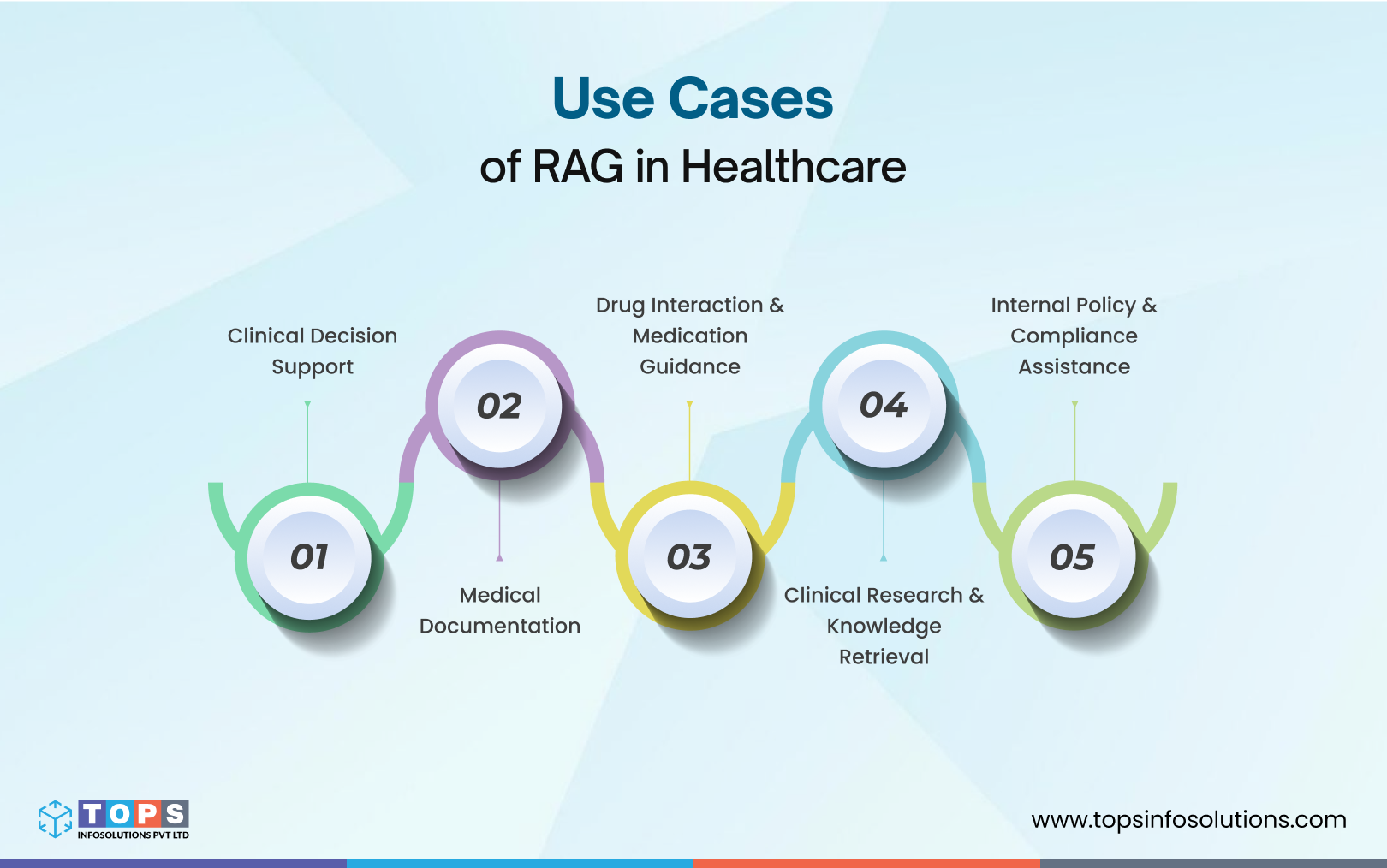
1. Clinical Decision Support
RAG strengthens clinical decision support by retrieving the most relevant treatment protocols, patient history, and current medical guidelines before providing recommendations.
In practical implementations in healthcare, AI-assisted workflows combine RAG with clinical knowledge bases like ICD, CPT, SNOMED CT, and LOINC. When the system ingests clinical notes, RAG retrieves relevant coding rules and terminology, which is already beyond the generic GPT-style outputs.
In one of our healthcare implementations, we built a system that reduces manual effort in clinical report generation and coding workflows. The solution allows users to securely upload clinical documents across specialties. Instead of manually reviewing notes and assigning ICD or CPT codes, the system processes the documents, retrieves relevant coding guidelines and historical practice data, and auto-assigns medical codes.
2. Medical Documentation
To add on to the previous point, documentation is a core part of healthcare operations. What RAG does is improve medical documentation by retrieving relevant patient records, physical notes, lab reports, and prior visit summaries.
For example, when a physician finishes a patient visit, the system does not simply generate a summary from dictation. Instead, it retrieves structured data like prior diagnoses from the EHR and medication lists, lab results, and allergies. It pulls all relevant historical notes and specialty-specific templates. The LLM then generates a draft that is strictly within this limit.
We’ve worked closely with clients in healthcare settings and helped them reduce omissions, improve clinical coding accuracy, and ensure documentation aligns with clinical standards using RAG.
3. Drug Interaction & Medication Guidance
As a healthcare professional, you can enhance medication safety by retrieving up-to-date drug databases, internal pharmacy guidelines, and patient-specific prescription history.
For example, DrugRAG is a research-driven RAG pipeline in practice. It is built to make LLMs more reliable for pharmacy-level medication questions. It actively retrieves verified drug knowledge like dosing rules, interactions, pregnancy safety, etc from structured sources and brings that evidence into the AI’s reasoning before it generates an answer.
4. Clinical Research & Knowledge Retrieval
Medical literature is expanding at an unprecedented pace. So much so that it’s realistically impossible to track every update manually. New studies, trial results, and treatment insights are published every day.
With RAG, you can bridge this knowledge gap by automatically retrieving and synthesizing relevant research before generating structured summaries. RAG can also parse unstructured clinical notes and match patients against complex inclusion and exclusion criteria.
Practical use-cases show that in patient recruitment, LLMs-match uses retrieval layers to extract relevant context from EHR records and align it with detailed trial inclusion and exclusion criteria. Instead of scanning thousands of abstracts manually, researchers receive structured, evidence-backed summaries that remain traceable to source literature. This accelerates discovery while maintaining scientific rigor.
5. Internal Policy & Compliance Assistance
Healthcare organizations operate under constantly evolving regulatory frameworks and internal governance policies. Misinformation or a lack of knowledge about healthcare compliance is dangerous in more ways than one.
RAG can support healthcare AI compliance by retrieving the latest SOPs, regulatory guidelines, audit requirements, and institutional policies before generating responses.
For example, hospitals running EHR platforms like Epic Systems have explored generative AI copilots that retrieve internal SOPs, billing policies, and coding guidelines before responding to internal queries. The system pulls data only from the hospital-approved documents, CMS guidance, and payer rules, then generates a response tied to those sources.
Compliance and Governance Considerations
In healthcare, AI adoption moves only as fast as compliance allows. That’s where well-designed healthcare RAG systems create a meaningful advantage:
Secure data access controls
You cannot model RAG systems to retrieve information that shouldn’t be retrieved. For example, you can block access to an outdated policy or document meant for internal use to a patient who does not need it. You get to approve and validate the sources, limit exposure to sensitive data, and reduce the risk of unauthorized access.
Audit trails and traceability
Because the responses are grounded in identifiable documents, you can easily track the exact source of an output. If a recommendation is questioned during an audit, compliance teams can review the exact policy or guideline referenced. It helps you maintain AI governance in healthcare.
Data Security
While data is an overall critical factor when considering AI, healthcare RAG systems must operate within stricter data protection frameworks. You’re dealing with sensitive patient data that needs to be encrypted in transit and at rest, with control retrieval boundaries to prevent unnecessary exposure.
Role-based access management
Different users can be granted different levels of access. A clinician may retrieve patient-level insights, but an administrative user can only access policy documents, supporting healthcare AI compliance.
Human review workflows
Research shows that 60% of users would be uncomfortable with a healthcare provider relying on AI while providing healthcare services. This is no surprise. When it comes to something as sensitive as one’s health, they expect a healthcare professional to deal with it humanely.
Healthcare AI can only work to its maximum potential if there are manual reviews involved at high-risk outputs. The keyword here is ‘high-risk.’ If the user is seeking a highly expert opinion, it must come from an actual expert rather than AI.
Controlled knowledge sources
Unlike open-ended models, RAG-as-a-service allows organizations to define knowledge boundaries. It is one of the most critical use cases of RAG in industries like healthcare, which have high regulatory pressure.
Implementation Plan for Healthcare Leaders
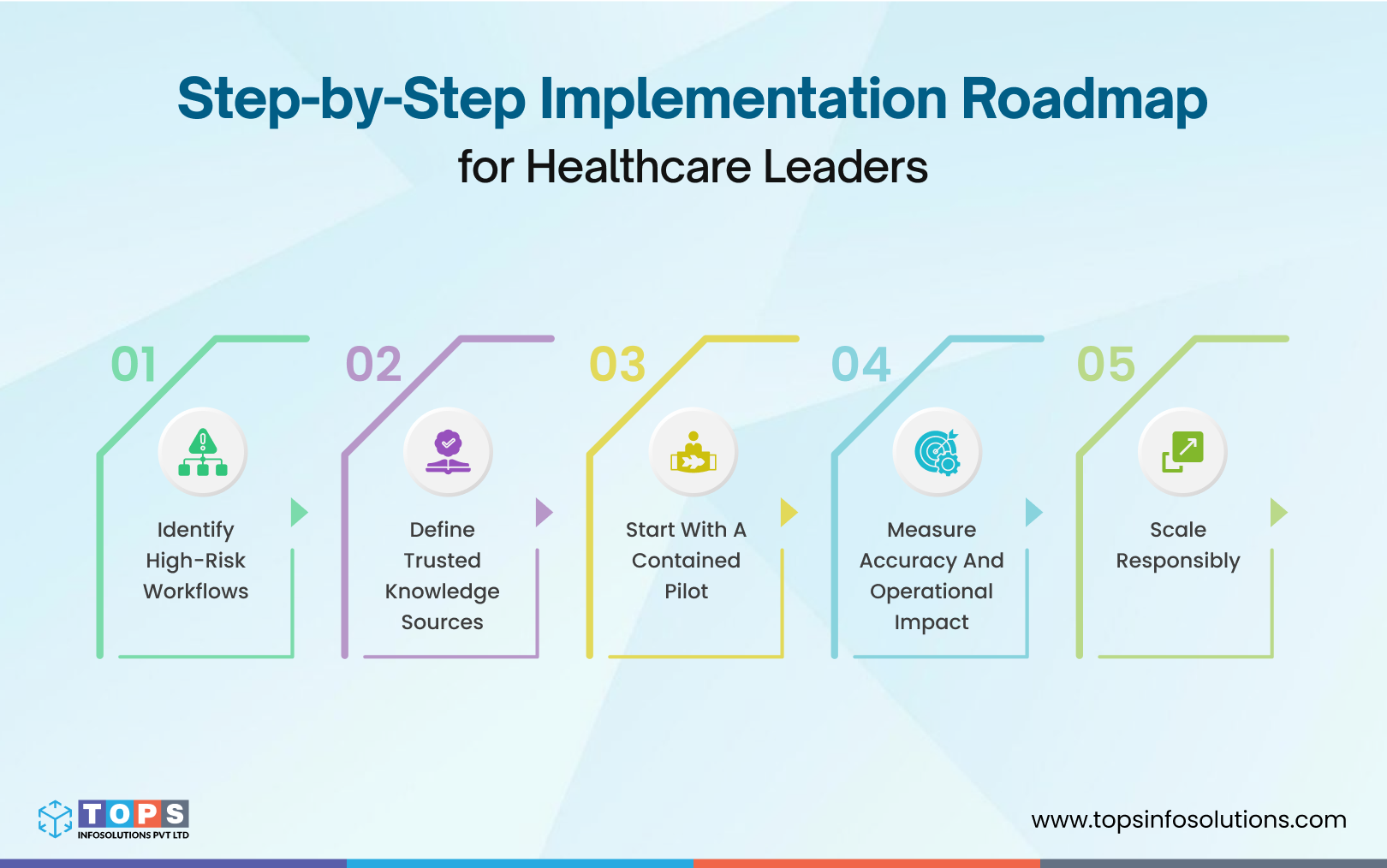
Many organizations move quickly into AI initiatives without fully understanding how RAG works in healthcare or where it can deliver the greatest impact. A focused healthcare AI implementation roadmap ensures you apply RAG where it benefits the most.
1. Identify high-risk workflows
Identify workflows where errors create financial, operational, or patient safety risks. This can include patient care, trauma centers, clinical decision support, etc. Prioritizing areas with high consequence ensures the right outcomes from AI.
2. Define trusted knowledge sources
Clearly define which guidelines, policies, databases, and internal policies and documents the system can access. You need to establish controlled knowledge boundaries for compliance and reliability.
3. Start with a contained pilot
Instead of implementing ten use-cases at once, focus on one use-case and deploy a limited pilot. If you keep the scope manageable, define success metrics upfront, and involve both technical and clinical stakeholders, you’re more likely to witness a positive result.
4. Measure accuracy and operational impact
Define measurable benchmarks before deployment. For clinical workflows, that would mean either comparing AI-generated outputs against expert-reviewed outputs. Or tracking the factual accuracy rates, guideline adherence, and hallucination reduction. You can also measure the precision of coding, denial rates, and rework reduction.
5. Scale responsibly
As systems mature, RAG integrates into broader AI in clinical decision support initiatives or evolves with agentic AI in healthcare. The key is layered governance, continuous validation, and incremental expansion rather than organization-wide rollout.
Reliable RAG as a Service in Healthcare
Healthcare organizations are quickly moving towards AI-driven transformation. However, speed without structure creates risk. RAG in healthcare offers a more controlled path by combining the power of LLMs with trusted sources and organization-specific data. The result is an AI that is more accurate, traceable, and aligned with regulatory expectations.
As a RAG as a service company, we help healthcare leaders build, deploy, and scale healthcare RAG systems. Our expertise spans across generative AI and AI-powered clinical coding solutions, enabling us to address complex healthcare challenges with production-ready solutions.
Connect with us to explore how RAG can be applied within your healthcare environment and how we can help you launch a structured AI initiative.