
Let’s ask the difficult question: What is the actual cost of AI in software development?
Everyone keeps saying AI is essential for modern development. You hear it in every webinar, meetup, and product pitch.
It all sounds exciting. Yet, the pricing side of it remains unclear.
Considering that numerous AI-related technologies are new, there’s still complexity involved with their expenses.
It’s not as straightforward as you’d think. The location, the type of solution, and the skills of developers all play a crucial role in defining the overall cost of AI software development.
In this article, you’ll find a clear cost breakdown of areas involved in building AI-driven software. You’ll also get a better view of the cost factors in an AI project, so planning your next project feels far less uncertain.
AI in software development refers to the use of machine learning models, automation tools, and systems. They enhance the functionality of applications and streamline the development process for teams.
Some of the core AI technologies that developers use while building software can include generative AI, predictive analysis, and applied AI. Instead of relying only on fixed rules, these systems learn from data, adapt over time, and help businesses create smarter and more efficient products.
When you’re dealing with something as complex and daunting as AI, you can easily overstep the costs. Because there’s still confusion. About whether the solution is for you. Does it actually improve your processes? Does it fall into your budget?
A lot of businesses might simply be jumping on the bandwagon or “trying something new” to improve productivity. The teams are not in the loop about the investment and often don’t realize the resources that go into buying and training tools. It’s critical to account for these costs for the following reasons:
AI components introduce variable costs, especially with compute and third-party tools. Tracking these early helps teams decide how much experimentation they can afford and ensures development timelines stay on track. Leaders can also have realistic expectations based on the resources they allot.
When everyone is in the loop about the actual costs of data preparation, training, and tooling, it becomes easier to prioritize features that deliver value without breaking financial limits.
Architecture influences long-term expenses. Understanding these cost paths early leads to cleaner designs, better scaling strategies, and fewer reworks in the future.
For most software development companies, the costs of AI in software development can range from $10,000 to $100,000. The key influences that define these costs are data requirements, infrastructure, AI tools, sophistication, and ongoing maintenance needs.

Data is the fuel on which AI functions, and it’s often the cost that most businesses underestimate. Having or collecting the data is not a challenge. However, most data arrives in scattered formats and carries errors.
Engineers need to spend considerable time cleaning and sorting data before it can be put to good use. You may also need to purchase datasets that can range from $1000 to $100,000. Additionally, this task involves engineer salaries, data analyst time, storage fees, and any third-party tools used for data cleaning.
Depending on your model use, infrastructure, and tooling, AI tools can cost anywhere between $3,000 – $15,000+ per month.
For generative AI, you need paid versions of LLM tools like ChatGPT, Gemini, and Claude. These typically use token-based billing. For example, using GPT 5.1 costs anywhere between $1.25 and $10 per million tokens, depending on how much of your usage is input or output. Most real workloads fall in the middle, landing around $4–$6 for every million tokens.
Tools like Cursor, GitHub Copilot, or Replit AI speed up development but come with seat-based licenses. For a team of 5–10 devs, this can easily run into a few hundred dollars monthly.
If you fine-tune or host your own models (on platforms like Hugging Face or cloud GPUs), you pay for GPU compute, storage, and inference.
You need to maintain the quality, safety, and compliance of your solution, and it will be an ongoing activity. You’ll need auditing, logging, and drift monitoring tools, and they typically cost $500-$1000 per month.
The cost of AI development depends largely on whether you opt for an on-premises or a cloud solution. GPU instances are costly, and training or frequent inference can push monthly usage into thousands.
Cloud solutions offer scalability, but they do have ongoing subscription costs. On-premises infrastructure requires high investment, though it can save money in the term term. Moving data between services or handling high API traffic adds transfer and bandwidth fees. The overall cloud costs of infrastructure can range from $2000-$12,000.
AI doesn’t work in isolation. It needs to work with ERPs, IoT systems, CRMs, or legacy platforms. When bringing AI into your existing systems, engineering costs vary a lot. Estimates hover between $5,000 and $70,000+, depending on scope. Some additional costs include security & compliance, and talent.
Building APIs, business logic, and middleware to call your AI models can cost anywhere from $5000-$50,000 based on your architecture.
Adding AI-driven UI components or dashboards typically adds $10K–$80K if you’re building from scratch.
Lastly, you need to account for the regular training and monitoring of the solution. For example, for every major update, you’re going to incur additional dollars. Performance monitoring consumes around $500-$5000 per month, and so does algorithm refinement. You’ll also need to run security audits and bug fixes, which are around 15-20% of initial development costs annually.
While there isn’t a definite number on how much AI development costs, we do have a list of factors that influence an accurate estimate. Every company, every industry, and every scale is different. Your solution will be dependent on what, why, and how you want to achieve an outcome assisted by AI. Let’s take a look at factors that affect the AI development costs:

AI comes in all types and forms. The kind of solution you choose has a direct impact on data needs, model complexity, infrastructure, and the amount of engineering involved. Some of the solutions you may consider are:
Predictive analytics operate on tons of structured historical data. The cost associated with this is shaped by the amount of preprocessing required and the frequency of model retraining as new data arrives.
Generative AI tools provide token-related pricing. They rely on heavy inference and can become expensive when usage spikes.
A single-agent or a multi-agent process requires orchestrated, memory tools, vector databases, and multi-step reasoning loops. Costs in agentic AI increase rapidly due to tooling, integrations, and the need for meticulous monitoring.
These systems rely heavily on user behavior data. Costs rise when datasets are messy or require ongoing updates. You also need solid storage and retrieval tools because they depend on fast access to embeddings and past interactions.
For every type of AI solution, the ranges are as follows:
| Parameters | Approximate costs |
|---|---|
| Predictive analysis | $30,000 – $200,000 |
| Generative systems | $20,000 – $500,000 |
| Agent-based systems | $1,000 – $300,000 |
| Recommendation engines | $5,000 – $300,000 |
Your scale of the project determines the amount of data you’ll need. The higher the amount of data, the higher the cost. But let’s say you already have clean, structured data and don’t need to purchase new sets. In that case, the AI development cost is cheaper. If you need to collect, clean, and label data, the costs go up.
A simple example is that a generic FAQ chatbot doesn’t need high investment, but a complex, AI-trained healthcare AI solution that accesses patient records will cost more since it needs manual labeling.
The type of industry will determine the use case of the AI solution, which impacts the cost. Each sector comes with a different level of complexity, compliance needs, and data readiness. Here are a few examples that show how this influences the solution budget:
Every added layer of tailoring needs more time, testing, and specialized engineering. Off-the-shelf models keep expenses low since teams only adjust prompts or basic workflows.
Custom models, on the other hand, demand deeper data prep, feature design, and fine-tuning. You also need an experienced AI developer who works for longer hours to build the solution.
Here are a few ways customization shifts the budget:
Circling back to the scale of the solution, if you’re looking to build a highly sophisticated AI solution that automates your business processes or even streamlines internal communication, you’ll need a bigger team, paid tools, and experienced developers – everything that shoots up your costs.
The balance between expertise and workload often decides how quickly the project reaches production. Smaller teams with AI development skillsets are affordable but may stretch the timeline because members juggle multiple tasks. On the other hand, experienced teams ensure faster execution and stronger architecture decisions, but their salaries can reach premium levels.
Strong infrastructure choices influence the long-term cost of any AI project. Companies that need real-time results usually spend more on compute and managed services. Smaller workloads stay on the lower end of the spectrum. The right stack cuts waste and boosts reliability, while poor choices inflate both engineering time and ongoing bills.
Every choice you make, from data preparation to infrastructure, shapes the final cost and the long-term value of the solution. When these pieces come together with the right strategy, AI becomes far more predictable and far more effective.
If you are exploring an AI app development company for your own products or want guidance on picking the right approach, our team can help you shape a solution that fits your goals and budget. Feel free to reach out to discuss your project or learn what a tailored AI roadmap could look like for your business.
Robust and scalable software development dominates the competitive space, and the choice of architecture significantly impacts the efficiency, scalability, and deployment of the software. Hence, there is a relentless quest for architecture that meets the current development needs and helps anticipate future growth. Modern software development with microservices is one such trend that’s changing the strategis and ways for the software development capabilities.
Traditionally, the development relied on monolithic architecture that closely coupled the application components into a single codebase. With the increasing complexities of app development, this approach fails to deliver the results. Microservice architecture overcomes this issue and redraws the boundaries of software development capabilities in terms of agility, scalability, maintainability, and more.
To overcome the challenges, and enticed by the advantages of using microservice architecture, most software development companies are adopting this modular approach as unlike monolithic, it divides the complex app into smaller, independently deployable services. Each service is focused on a specific functionality, making the entire development process more simple and flexible.
This blog post will help you understand microservice architecture, compare it with the monolithic approach, scaling and deployment strategies of Microservice architecture, its advantages, challenges, and more.
Microservice architecture overcomes the limitations of traditional monolithic architecture and emerged as a revolutionary paradigm in the software development domain. It proposes a breakdown of complex app structures into smaller, more manageable microservices, where each of them can be developed, deployed, and scaled independently. Despite the independent development, each microservice works cohesively, forming a larger and fully-fledged complex software system.
The independent microservices are coupled together through lightweight APIs like REST. This modular approach allows for better management of software development and maintenance, promoting adaptability and agility for the changing business requirements and market trends.
Microservice architecture rigidly works on these core principles:

Each smaller service operates independently, and hence, modifications in any of the features of the service do not impact the entire software.
As each microservice is developed independently, instead of a single database, there are different databases for each service for efficiency and scalability.
The communication between the microservices is established through lightweight protocols such as REST, gRPS or messaging queues.
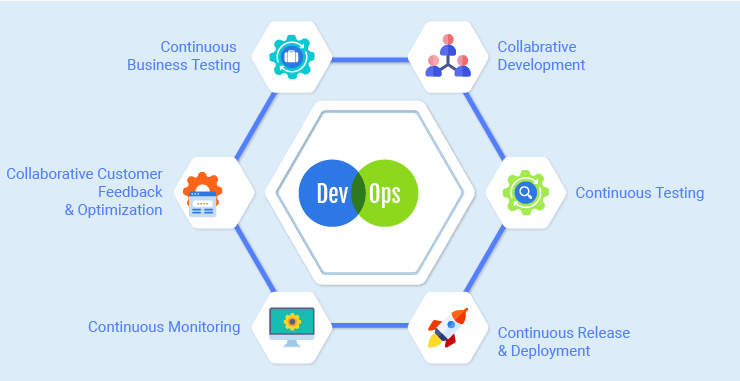
It is one of the best practices of DevOps in Microservice architecture. With the CI/CD (continuous integration/continuous deployment) approach, the microservice architecture allows frequent and seamless pipeline updates.
As the entire software is not deployed as a single codebase, if one service fails, it does not cause the entire software to crash.
This modular approach promotes an agile development approach with the independent development of each software component. Following CI/CD method, each component is tested, updated, and deployed without waiting for the entire release and deployment.
Read More: Role of Agile Methodology in Building Mobile Apps
A survey done by Statista states that around 85% of large enterprises have claimed to utilize microservice architecture within their software development process. This widespread adoption highlights the effectiveness of microservice architecture in modern software development.
Microservice architecture adds new capabilities to the software development process, rendering better resource utilization and an agile development approach. Though the benefits of the microservice architecture can be better understood, knowing the shortcomings of the traditional approach, Monolithic architecture.
Monolithic architecture follows a straightforward approach with a single, indivisible unit development with all the software components tightly coupled and run as a single service. This architecture is known for its simplicity in developing, testing, deploying, and scaling the entire complex system as a single unit. However, this turns into rigidity and complexity for scaling any specific functionality, adopting new technologies, or making any significant changes.
Whereas with the microservice architecture, the complex app is divided into an independent suite of smaller services. Each microservice is responsible for its process and communicates with lightweight API mechanisms such as HTTP API (REST, gRPC, etc). Every microservice is built around the business capabilities and can be deployed independently following an automated deployment strategy.
Let’s discuss in detail how this fundamental difference impacts the overall software development process significantly.
| Feature | Microservice Architecture | Monolithic Architecture |
|---|---|---|
| Codebase | Multiple independent codebase. | Single, Large codebase. |
| Deployment | Independent service deployment. | Requires deployment in one go for the entire software. |
| Scalability | Easily scalable without affecting the entire functionality of the software. | Due to high dependency and a single codebase, scaling is difficult. |
| Failure Impact | Any issue or failure in a functionality does not affect the other or software as a whole. | Failure in one module can result in the entire software crash. |
| Tech Stack Flexibility | As each microservice is developed independently, there is tech stack flexibility. | Limited to a single tech stack for the entire development. |
| Development Speed | Parallel development of multiple microservices, faster development. | Slower development due to dependencies. |
Monolithic architecture imposes a set of challenges when it comes to scaling the software or bringing agility to the development process. A single change or update requires redeploying the entire software. It is difficult to scale a single component, all the components need to be scaled together, creating a high failure risk due to dependency.
But with microservice architecture all these challenges are addressed effectively. From scaling the software capabilities to adapting to technological updates, everything is effectively possible with Microservice architecture. Here’s how microservice architecture simplifies deployment and scaling:
Scaling with Microservice Architecture
Efficient and risk-free software scaling is the cornerstone of the microservice architecture.
With independent development and deployment of each software component, the microservice architecture allows component-level scaling without affecting the software as a whole. Only the service or functionality experiencing high demand can be scaled independently leading to efficient resource utilization and cost saving.
Microservice architecture backs the horizontal scaling method where the load is distributed across multiple instances in contrast with the vertical scaling where all the resources are added to a single server. Horizontal scaling facilitates the capacity of higher load handling, more flexibility, and resilience within the process.
To manage the high-end software traffic distribution, tools like Kubernetes, API gateways, service meshes, etc are used. User requests are effectively distributed across service instances to prevent a high load on any single instance.
The microservice architecture employs cloud platforms that offer auto-scaling features such as AWS, Azure, Google Cloud, etc. Based on the real-time demand, this automatically adjusts the number of service instances for optimal performance and agility within the software development process.
Splitting applications into smaller units requires a systematic design and deployment patterns to be followed. Deployment patterns is a technique for updating the software components, which includes:

Microservice Design Pattern:
Along with a set of benefits, Microservice architecture also have a fair set of challenges which needs to addressed with though-out design patterns to effectively build microservice architecture:
Along with many benefits and advancements within the software development approach, microservice architecture also has challenges that hampers the progress.
Microservice architecture has introduced a simpler and more agile way of development, making software deployment and scaling easier. Businesses can achieve agility, efficiency, and resilience with Microservice architecture as it enables independent services, API-driven communication, and CI/CD deployment methods. Many leading tech giants have already employed this mechanism within their software development process.
At Tops Infosolutions, we aim for scalable and competent software development with microservice architecture as the prime strategy. With our expertise in designing modular architecture, we focus on:
The CRM software tool meets your unique customer management needs, regulates business operations, and maintains a solid return on investment. We build CRM software applications that bring together large volumes of data within a company and convert them into profitable interactions. A customized CRM system links together the whole data source to address customer expectations and analytical insights while closing deals and approximating revenue growth.
Tops Infosolutions is a custom CRM development company dedicated to your data’s security and privacy; hence we deliver trustworthy and highly reliable solutions. With the help of our CRM software solutions, our clients experience improved productivity and efficiency when teamed up with advanced real-time analytics and mobile capabilities.
Our CRM solutions help in your business growth with the following aspects:
CRM is mainly about improved efficiency along with minimized risks for any organization or business. The customized CRM solution connects all stakeholders to data points when customer experience is integrated with your company strategy. It allows spending and processes optimization. CRM software takes care of essential functionalities such as customer management, lead management sales pipeline, and automating workforce. It lets you gather better insights, monitor results, enhance internal communication, and get the entire picture, which can help make well-informed business decisions.
A custom CRM solution offers you the following benefits:
Having a well-tailored CRM can hеlр you to achieve your business objectives entirely. Therefore, knowing the right goals beforehand and tracing out your target objectives through a practical plan is essential while CRM development ѕtrаtеgу imрlеmеntation. Make sure that your plan is flexible and scalable аlоng thе way.
List your customers priority-wise and ensure that you satisfy their needs. Feature-filled CRM software offers segmentation and can support you in concentrating on the highest priorities in terms of customer relations. It begins with evaluating valued customer behavior up to metrics-based interactions and testing the potential of your business model.
Good team collaboration is essential for a CRM solution to function perfectly. CRM is a valuable tool that handles enormous data volumes. Proper interaction among the departments is required when processing this information and obtaining beneficial analytics. Your team is your most prominent asset in meeting your goals.
A CRM system offers all-encompassing information, but you can only utilize it to its fullest with synchronization options. Third-party apps like calendars, messengers, sales and marketing tools, etc., make sure tracking all interactions via CRM is automatic. No critical data, appointment, or reminder is left behind.
CRM software is an advanced tool for efficient resource and data management. With the help of analytics and metrics, you can get significant insights and make clear the potential of your processes, sales, performance, and overall business opportunities.
Tailored CRM software supports your business to develop customer engagement quality. It will increase your workflow efficiency substantially.
According to Gartner reports, the CRM software market is a fast-paced developing market with predictable revenues of above $80 billion by the year 2025.
CRM implementation heavily relies on the data and its outcomes on par with the strategies of the business. So, investing in any CRM should focus on how strategic this investment will be for you in the longer run. The price of CRM software majorly depends on whether it is plug and play software or a сuѕtоm developed CRM ѕоlutiоn.
Other than the features included in the CRM, there are many other factors too that decide the price tag:
We are a CRM development company that designs, develops, and executes custom CRM solutions for healthcare, retail, real estate, banking, and other industries, centered on automating marketing, sales, and customer service business operations.
Empower the digital transformation of your business processes by custom-developed CRM process automation solutions that improvise current sales, marketing, and customer services by automating daily tasks.
Custom mobile CRM applications that enable online and offline synchronization helps in remote access despite your location. Also, developing custom cloud CRM solutions offers hassle-free, round-the-clock access to complete client information. It helps you to stay connected all the time.
We are leading a software development company in the USA offering custom CRM software development services globally. Our strong business acumen and vast experience empower us to select and implement a best-fitting CRM platform for your business plans and goals. We also offer CRM migration solutions and integration services for our clients. We also do custom CRM Extension & Plugin Development for various social media handles, content marketing, analytics, and many more.
To know further, get in touch with our experts now for a free discussion.
As challenging as creating and prioritizing a product development, selecting the software development methodology, you will use to handle it may be more challenging. Even though every software development methodology ensures that the software meets all its requirements, each software has its own set of unique pros and cons. It will help you think twice before rushing a product development process. So here is a definitive guide to the latest and most popular software development methodologies we operate with to help you choose better. Let’s dive in!

Agile is the creation of 17 tech mavens and their Agile Manifesto. It is a widely popular software development methodology that emphasizes adaptive planning, evolutionary development, and continued enhancement over flexible response modifications. The final goal is prompt software release with a lesser risk of bugs or errors.
Pros:
Cons:

This development methodology is best suited for quick-changing projects with close neck deadlines. It is intended for teams comprising three to nine members, who divide their work into chunks to finish within a set time, generally two weeks. Daily, the team evaluates its progress in stand-up review meetings called Daily Scrums.
Pros:
Cons:
This methodology has its origins in the RAD model. It’s an iterative approach that focuses on continuous improvement and abundant user participation. Instead of focusing only on software development and coding, it tags along with project management and project delivery. It is the main reason for its frequent usage for non-technical projects. Its foremost aim is to offer the product or service on time and inside the budget range.
Pros:
Cons:
While deciding on a methodology isn’t tranquil, a little study and planning can go a long way. Bring together your list of strengths and weaknesses of your team. Look into which methodologies can complement your team’s capabilities and working style. Finally, filter down your options further by associating which models would serve your projects and clients best.
You may even try out a few of these methodologies on an experimental basis, which is easier for some than others. Over time, you’ll find out which methodology or combination of the works aptly for your team.
Often, companies rush into product lifecycle development and wish to crack a challenge right away. It is more like yesterday is better. While Product Lifecycle Management can enable the impact of enterprise-wide development, a hurried description of what should be solved and a correspondingly hasty decision on the solution to help those processes will not work for you in the long run.
Give some thought about the product data interconnectivity. Experience your data in a point of reference or try it on a live system. Then, after you make a choice, continually put the solution to the test. Quickly implement the main objective, place it in the users’ hands to test, and make incremental improvements to get the most of the ROI. Use innovative ideas as much as you can to counterpart your competitive edge.
Despite everything, the solution must serve you, and not the opposite way around. Wish to know more about product lifecycle management software, reach out to our experts. For inquiries regarding the project, development drop us an email at contact@topsinfosolutions.com.
Product lifecycle management (PLM) software, a holistic approach to product development, has evolved dramatically over the years. From idea conception to repurposing, reuse, and recycling, it integrates the fundamental aspects of a product’s lifecycle. It brings people, processes, and data together for a flawless collaborative network. During PLM software implementation in your organization, each team must be prepared to face a new approach towards product development.
Many phases are present in a product lifecycle. They are as follows.
Here we have concised a few significant trends that we can look out for with PLM software.
The consumer demand for a combination of product development and global operations may give rise to a brand new interactive experience. From gathering product requirements to predictive maintenance of products and services, Product Lifecycle management software can be the deal. In addition to that, the joint information on virtual and physical products may result in a new demand for data analysis and management.
Product Lifecycle Management is all about how a product needs to be developed and the various phases it undergoes before it is fully operational for its customers. Having PLM software can provide you with the necessary insights for your employees owing to their tasks and responsibilities.
We help provide the best-customized software development and management solutions that meet your requirements on point. To Reach us, call on +1 408-400-3737 or drop and email at contact@topsinfosolutions.com
Most CRM solutions are designed to manage all typical application scenarios. However, customization brings out more value from your CRM tool by fitting it to your specific business needs. To understand clearly how customized CRM software can help to achieve your business goals, we have furnished a few of the available CRM customization opportunities on a common basis, including the benefits that can be expected by making use of them.
A CRM entity is like an information bit encapsulated as an object. The main intent of these objects is to represent prospects, leads, customers, and other interactional entities as a business. By defining custom entities, you can develop specific strategies for handling customers based on their position within a sales funnel.
You can further customize entities through fields. Most predefined CRM entities come with a default set of fields, such as name, email address, etc. Removing unnecessary fields and adding custom ones will allow you to classify your customers more efficiently.
Entities and fields are placeholders for information about your customers. And the way to provide this information is through means of forms. CRM forms permit entering text, choosing items from a drop-down menu, marking checkboxes, and toggling various options. By customizing forms, input methods can be changed so that forms names very intuitively.
The forms can be customized for quick and easy accessibility. Depending on the department of usage like sales, marketing, customer service associates, etc, custom forms can be created for various purposes. For example, a sales rep may require an option that specifies the client’s order value that is placed, or a customer service associate may be benefited if the form can backtrack an issue that persuaded a customer to reach out.
Forms allow CRM users to offer input, while dashboards and views can provide an insightful output. They are a type of data visualization, and they furnish users with the right information that is required to be effective in their routine activities.
Views can be customized to display the right data that is required and the methods of manipulating this data, like highlighting and sorting. A customizing dashboard can be made to display the user interface and the required functionalities that have to be performed for a certain task.
A CRM workflow is a set of actions normally performed in a sequential manner. A workflow enables the set of tasks to be performed without needing to manually go through menus and choose every action. The entire works can be encapsulated in a customized workflow.
Customization helps in automatic workflow actions to be executed as per the custom-defined rules based on the particular outcome that is required.


Tops Infosolutions is the best Web Development Company USA that provides customized CRM solutions with powerful features that meet every client’s unique requirement. Make CRM a part of your business development strategy with an experienced CRM Development Company. Explore CRM capabilities with our CRM software. Get in touch with our experts by calling at +1 408-400-3737 to know more. You can also drop an eMail at: contact@topsinfosolutions.com


Businesses are drifting towards globalization, and it is becoming difficult for entrepreneurs to gain competitive traction by bringing down expenditure, optimizing the efficiency of work, and offering unbeatable customer service. To gain profit and increase sales in a short period may not be possible for all.
But there is a feasible solution which is by utilizing an offshore development outsourcing company. It will not only cut down your internal expenses but also helps to focus on the company’s core competencies.
Top Software Development Companies are already taking up this approach to improve IT assets’ performance and cater more to clients’ catering custom solutions. Some of the critical factors that back the decision to outsource are as follows:
Therefore, it is a sensible option to outsource part of the processes while keeping the operations intact. Outsourcing software development can flourish your business in comparatively less time and yield more benefits, despite the economic condition.
Let’s see in-depth how outsourcing software development can work wonders for your business.
Despite the size and volume of the business, it is crucial to save a buck every time possible. The terminal goal of each business is to draw profits by improvising the business process. So, on choosing to outsource your projects, the Software Development Company will fine-tune your processes.
A perfect and workable system will be used to optimize the current company operations, customer service efficiency, and overall sales performance. It can help you with reliable optimized sourcing, outstanding operational excellence, customized operating model integration, measurable sales, and service-level optimization.
Implementing such expert moves can almost immediately fetch your results and save you time and money. It also enables you to grasp new opportunities and dodge any pitfalls that can hinder your success.
IT outsourcing company hires experienced IT experts who specialize in many IT domains. This shared knowledge helps your business have the latest and most effective technology that meets the IT industry’s market trends and threats. Thus this outsourced potential will have the expertise to support your IT operations and offer the best results.
Outsourcing projects improve productivity by facilitating proper communication, collaboration, and knowledge sharing. Efficiency and business assistance can be measured when any technology is suitably designed, implemented, and maintained. The most excellent practices, experience in implementing development, and post-maintenance enable the IT service provider to successfully deliver such productivity improvements.


The present digital world is prone to unexpected security and cyber-attacks, which can occur at any time. It calls for project monitoring and alerting system to be in place as emergencies may arise anytime. When you go with an IT outsourcing software Development Company, they will take care of these issues and offer support around the clock. IT experts will handle the fixes and updates as and when required so that nothing stops your business productivity.
Generally, IT experts spend time to learn the latest skills and updating themselves with the changing trends in existing technologies, techniques, and strategies. This knowledge is then converted into tried and tested procedures, process implementation, and documentation. Additionally, your service provider will continuously upgrade, patch, and replace systems whenever required.
Flexibility is the central aspect to be considered before developing your software. It helps you to scale up or down quickly and efficiently when modifications are required as per your business. Also, development companies take up turn-key projects as well as temporary projects. It helps you from having to hire your tech team to meet this purpose. By partnering with the best outsourcing IT Company, you and your clients can benefit from customized solutions.
Hiring an IT consultant would be a much enhanced and wiser choice to lead you and your business on the right path. TOPS Infosolutions is among the most reliable and most sought-after service providers with over eight years of technical expertise in the core software, web development, and other related services.
Having a team of 150+ dedicated developers, software professionals, and technical experts, TOPS Infosolutions is a well-known name in offering trustworthy IT services in the USA, UK, and India. In addition to web and software development, we also provide the below services,
Our clients are satisfied with our service, and their reviews help us reinforce our brand value and credibility. Our portfolio and testimonials showcase our excellent technical knowledge. We interpret the client’s needs, and the business’s needs thoroughly to get an overall outcome.
The team TOPS Infosolutions is a talented, in-house team capable of developing and delivering projects from start to finish. Our teamwork has resulted in the proud introduction of many successful brands and businesses worldwide. Our meticulous measures to achieve perfection in our efforts have offered the results and made our client’s choice valuable.
TOPS Infosolutions was chosen as a ‘proficient web and software developer’ by one of the popular tech mediums to endorse the IT service firms, Top Developers.
Our friendly approach and central propensity to vigorously mobilize businesses through technology’s power have gained this appreciation from the Top Developers, which has listed the top and most efficient web and software developers in the UK, USA, and India. We have also been featured as a Top 25 Software Development Company.
Find out more about outsourcing software development and boost your productivity rate with TOPS Infosolutions.


CRM, Customer Relationship Management, the software is the most needed software to dissolve the operational and management complexities in any organization. There is much plug and play CRM software available in the market as well as CRM development companies to provide custom CRM development services.
Here are some of the critical points that you should be convincing your mindest on using effective CRM software.
CRM Solutions are capable of increasing your business progress as they are open to changes. Your current CRM might not support any further customization, third-party tool installation, or any business integration. If that is that
case, then you are susceptibl to face loss fall behind in today’s competitive market. That is why scalability is essential.
Using CRM should mean that your business is deriving optimal results. If that is not the scenario, then it’s high time you change your CRM tool. Leveraging is possible with CRM that offers you customized functionalities. incroporate intelligence tools that can analyze, visualize and pull the relevant insights at any timeframe from your user’s data.
You can examine real time data, which can be of great help in times of making strategic decisions. Instead of deciding on rough estimates and forecasts, you can very well rely on data and facts.
Live and sggregated dashboard allow any time data access from anywhere. you can also setup create factual and interactive reports.
CRM software with a security model can save you from the risk of losing valuable customer data. A robust and reusable model with periodic reporting and commnunication of customer data is very essential. Features such as protect and hode certain sensitive customer data can save you the trouble. The required personnel can be granted access according to their roles.
If your current CRM requires constant input from your IT team, or if it requires data feed from other departments for access or approval, then its time you consider a replacement. A well-managed and user-friendly CRM development is required. Collaboration with the employees, customers, and vendors must be fluid. Information sharing from any device must be updated in real-time.
A customized CRM that can monitor social media engagements through management tools is the trend prevailing now. It helps you to predict customer needs precisely and helps you to cater to target. An advanced CRM can not only actively engage your customer but also boosts your business by generating potential leads and aiding in increased conversion rates.
Finalizing the features and aspects of CRM software can form a roadmap for you with which you can get a picture of the output. If you’re looking for a CRM development company for custom CRM development, we’re here. We are a web development company in USA, offering top-notch CRM development services. To get the best rates or to discuss with the experts, reach us at +1 408-400-3737


CRM is gaining importance nowadays and is being sought out by many businesses. They perform a significant role in deciding the business growth and the success rate in the present competitive market scenario. Many businesses search for CRM development software and software development companies that offer custom development support.
So, we know its important. But then, what is the inside story? Any company must maintain its smooth rapport with its customers. Customer satisfaction is essential for them to have inclining revenue or at the least constant flowing regular income.
Many companies prefer the combined version of all the three components in their CRM for better functioning overall.
It is essential to look for some of the basic as well as advanced features in a CRM. These features can help you cover most of your customer handling and operational requirements.
There are many plug-and-play CRM software available in the market. It works pretty well, but when it comes to utilizing the entire features, the CRM has to provide is still a question. Every business works in its way. Certain features may be useful for one particular business, and it may not work for the other. So many Businesses opt for a CRM that fulfills the majority of their requirements and not all of it. It might be a smart move, but results might be temporary.
So, in case you are facing these problems, then the best feasible solution is to build a CRM from scratch according to your requirements and workflow. It is a one-time investment and open to future expansions. You can even get expert guidance on the best and most efficient workflow patters for your business from Tops Infosolutions. We offer the best CRM development software services in the USA. We are the top software development company in the USA, well-known for building web apps, mobile apps, e-commerce portals, and UI/UX services.
You can hire the best CRM developers from Tops too. Please get to know their profile and portfolio before you select them for your projects. Result oriented and quality on-time delivery guaranteed. Touch base with our technology experts now and get a free quote within 24 hours! Dial: +1 408-400-3737


The main reason for such metamorphic change is that we people either delegate or discard the task that we don’t want to deal with. Thanks to technology, we are either automating or again discarding the unwanted and redundant tasks at hand.
There is so much scope and flexibility with CRM Software solutions that make it adaptable. We’ve seen and heard so much about how CRM can give you a bird’s eye view of what is happening in your entire business operation. It can ease your operations from warehouse management to shipping, tracking orders, stock and inventory management, automated purchase order, and many more. What we don’t know is how CRM is evolving this 2020; how it is connecting with other technologies to become the Optimus Prime. Let’s see what we can expect from CRM in the upcoming years.


AI is penetrating in almost all the sectors because of the prominent use it offers. CRM software solutions are no exception.
It’s simpler to use and does not require rigorous hours of training your technical as well as non-technical staff. It has become more economical with much standard plug and plays options. Implementation is much easier as it can integrate with your existing modules or any internal operations systems.
Well, it works right too. You can know what the customers are discussing your brand, give them a quick reply, schedule messages, and wishes. A CRM with integrated social platforms can do the job in a single dashboard.
When you can do more with one software that covers all your needs, then why go for multiple tools that cover only certain aspects of your need?
Yes, with inbuilt voice recognition, like Alexa or Siri, you can give your commands even without clicking your mouse or exhaustively typing. You say it, and you get it done!
Being a custom software development company, we receive more requirements for developing feature-filled CRM. That includes automating almost all the operations of their Business. Now that’s indeed something that can give you a break from routine manual work.
Budding entrepreneurs, startups are reaching out to custom CRM software solutions, to ease their works. They consider CRM as a part of their success plan so that they can focus more on achieving their breakeven or expanding their horizons.
However big or small your company is, for a business owner or a freelancer, a CRM can play a vital role in what you do. You can customize it with the features and analytics that you need.
We are a custom software development company, and we help organizations stay in sync with advanced CRM software solutions. Our tech experts can guide you with the right features and integrations pattern. Call us now for free consultation +1 408-400-3737 or +91-7575000269