


Most AI tools are smart in a vacuum.
While they can read, write, and respond well, they still don’t actually know your business. Every session starts from zero. Every prompt needs more context than it should.
And somewhere between the AI’s potential and your actual processes, the gap stays wide open.
That’s exactly the problem Model Context Protocol is supposed to close. It enables Large Language Models to connect to external tools, data sources, and systems so that AI responses are not just quick but have the much-needed context.
Here’s a look at MCP use cases that go beyond the docs and into the work.
Why Understanding the Use Cases is a Must before Moving Forward
While you may already know what Model Context Protocol is, you need to figure out the value it brings to your business. Its true potential is realized when AI stops being a general-purpose assistant and starts behaving like someone who actually works at your company.
That shift happens when context is designed well, and MCP is the infrastructure that makes that design possible.
According to Anthropic’s documentation, MCP provides a standardized way to connect AI models to the systems where your data actually lives: databases, APIs, file systems, and external tools. Instead of copy-pasting context into every prompt, MCP lets the AI pull what it needs, when it needs it.
That’s the lens for every context-aware AI decision that follows.
MCP in Action: Use Cases Across Industries
The MCP use cases below map directly to industries where context is the difference between an AI that’s useful and one that’s just expensive autocomplete. These are MCP real-world applications built around the same operational problems your teams are already solving.
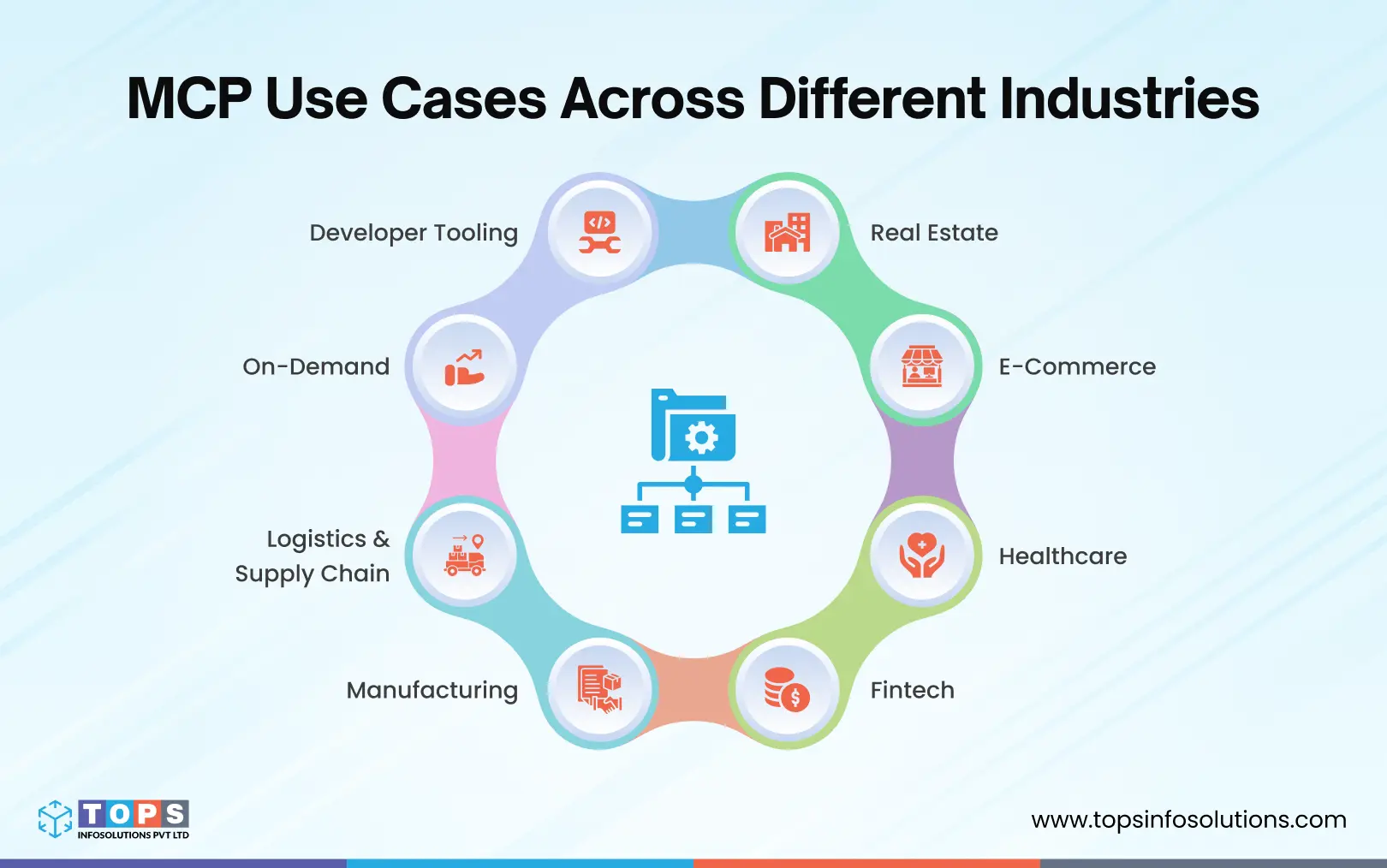
1. Real Estate: Agents That Know the Deal
Real estate teams juggle a lot of context simultaneously. No two deals look the same. Most agents either carry that context mentally or burn time switching between tabs to answer one client question. MCP-connected AI changes that by pulling everything into a single, context-aware session.
Example: Consider that a buyer’s agent is on a call with a client who’s ready to make an offer. Without MCP, the process would look something like this: The agent will put the client on hold to check the CRM, pull comps, and dig up the last offer they submitted on a similar property.
With MCP-powered AI, the agent simply asks the AI, and it surfaces the client’s stated budget, flags two active listings that match their criteria, and references the offer they lost last month and why. The context is gathered in real-time. Under the hood, this runs on a Remote MCP Server using Resource primitives to read CRM records and listing data, and Tool primitives to trigger the follow-up email draft.
This is what real estate MCPs look like in practice:
- AI assistant queries your CRM mid-conversation to provide client history, preferences, and past objections
- Live listings pulled and filtered without a separate search or data export
- Document storage is connected, so the offer history and contracts are accessible in context
- Query like “What properties have we shown Sarah in the last 30 days?” returns an actual answer. Not a prompt for more input
For real estate software platforms, this means AI that behaves less like a chatbot and more like a deal-aware colleague.
MCP type in use: Remote MCP Server (HTTP + SSE) — Resources for CRM and listing data, Tools for email drafting and follow-up triggers.
2. E-commerce: Smarter Decisions at the SKU Level
Amazon sellers and e-commerce operators are making dozens of micro-decisions every day, such as repricing, restocking, listing optimization, and returns. The data for those decisions is spread across inventory tools, order management systems, and ad dashboards that don’t talk to each other by default. MCP brings that context together so the AI can reason across all of it.
Example: Consider an e-commerce manager noticing a spike in returns on a specific product. Without context, they would simply pull an export from the returns systems, cross-reference it with the supplier log, and manually check the list reviews.
What MCP instead does is it connects to the returns data, showcases the defect pattern across the last three batches, links it to a supplier change made six weeks ago, and drafts a supplier escalation email. What would have taken two hours takes ten minutes.
What e-commerce MCP looks like in practice:
- Live inventory levels are pulled and cross-referenced with order velocity in one session
- Pricing rules are accessible mid-conversation without a manual CSV export
- Restock recommendations grounded in real data, not pattern guessing
- Returns and listing performance surfaced together for faster decision-making
This is one of the more tangible MCP AI real-world applications for e-commerce teams. Particularly, sellers managing large catalogs where manual oversight simply doesn’t scale.
MCP type in use: Remote MCP Server (HTTP + SSE) — Resources for inventory, returns, and supplier data, Tools for escalation drafting and repricing triggers.
3. Healthcare: Context That Doesn’t Cut Corners
In healthcare, missing context is more than an inconvenience. It’s a liability. A clinical assistant who doesn’t know a patient’s current medications, recent labs, or care plan can’t be trusted, regardless of the underlying model’s capabilities. Among context-aware AI use cases, healthcare is where the stakes are highest, and where MCP’s permissioned architecture matters most.
Example: A physician is reviewing a patient ahead of a follow-up appointment. She asks the AI to summarize the patient’s last three visits, flag any medication changes, and cross-reference the current prescription list against known contraindications.
The AI pulls from the EHR, surfaces two relevant flags, and drafts a pre-visit summary. All without the physician having to navigate four different screens or re-enter the context she’s already documented.
What healthcare MCP looks like in practice:
- EHR data is connected, so the AI references the actual patient record, not a generic template
- Compliance documentation and internal protocols are accessible in the same session
- Clinical summaries drafted with full awareness of current medications and recent labs
- Access control is enforced at the server level. Hence, the AI sees only what it’s permitted to see
MCP type in use: Remote MCP Server (HTTP + SSE) with role-based access control — Resources for EHR and compliance data, Prompts for structured clinical templates.
4. Fintech: Analysis That Reflects Reality
Generic financial AI is easy to find. AI that accounts for your actual portfolio, your client’s risk profile, and the latest regulatory updates is much harder. Because that data isn’t in any model’s training set. It’s in your systems. These are the kinds of model context protocol use cases that make the protocol worth the implementation effort.
Example: A wealth manager is preparing for a quarterly review with a high-value client. He asks Claude to pull the current portfolio breakdown, compare it against the client’s stated risk profile, and flag any positions that are overweight given recent market movement.
MCP-powered Claude queries the portfolio management system, cross-references the risk documentation, and surfaces three talking points, all grounded in the client’s actual data, instead of a generic market summary.
What fintech MCP looks like in practice:
- Live portfolio data is queried and analyzed within the conversation
- Regulatory and compliance documents pulled in context alongside client data
- Risk profiles referenced when generating recommendations, not assumed
- Back-office workflows supported with real-time, cross-system awareness
MCP type in use: Remote MCP Server (HTTP + SSE) — Resources for portfolio and compliance data, Tools for comparison logic and anomaly flagging.
5. Manufacturing: Intelligence on the Shop Floor
Manufacturing has always generated enormous amounts of data, such as machine telemetry, production schedules, maintenance logs, and supplier records. The problem isn’t data availability. But this data sits in isolated systems, and nobody has time to synthesize it manually. MCP gives AI the ability to connect across those systems and reason about operational reality in real time.
Example: A plant manager gets an alert that line output has dropped 12% over the last shift. To get to the root of the cause, he asks Claude. Claude has access to the machine telemetry and identifies that two pieces of equipment are outside their normal parameters.
It cross-references the maintenance log to confirm both are overdue for service, and flags the supplier delay that pushed the parts delivery back by a few days.
What manufacturing MCP looks like in practice:
- Machine telemetry and maintenance logs are connected, so AI tools like Claude can flag early indicators of equipment failure before downtime occurs
- Production schedule data is pulled alongside inventory levels to surface bottlenecks proactively
- Supplier records and lead time data are connected, so procurement decisions are made with full context
- Quality control logs are analyzed across production runs to identify recurring defect patterns
- AI-assisted work order generation grounded in current capacity data, not static templates
For manufacturers adopting AI, MCP bridges the gap in operational data and intelligence that can act.
MCP type in use: Remote MCP Server (HTTP + SSE) — Resources for telemetry, maintenance, and supplier data, Tools for work order generation and bottleneck flagging.
6. Logistics & Supply Chain: Decisions That Move as Fast as the Freight
Logistics operates on real-time data such as shipment status, carrier performance, warehouse capacity, and customs documentation. AI tools that can’t access that data live are only useful for retrospective analysis. MCP enables logistics AI that operates in the present tense.
Example: A logistics coordinator is managing a high-priority shipment that’s showing a delay flag. She asks Claude what’s happening. It pulls the live tracking data and checks the carrier’s recent performance history on that lane. It identifies a weather-related hold at the origin hub, and cross-references two alternative routing options with their estimated delivery windows. She makes the call in minutes instead of working the phones for an hour.
What supply chain MCP looks like in practice:
- Live shipment tracking data is connected, so the AI can answer “Where is this order and will it arrive on time?” with an actual answer
Carrier performance history is pulled to inform routing decisions proactively - Warehouse inventory and capacity data connected for AI-assisted fulfillment planning
- Customs documentation and compliance rules are accessible mid-session for cross-border shipment handling
- Delay or exception alerts contextualized with order history so the AI can recommend the right escalation path
For logistics platforms and 3PL providers, these MCP examples in real-world operations translate directly into reduced manual coordination and faster exception handling.
MCP type in use: Remote MCP Server (HTTP + SSE) — Resources for tracking, carrier, and customs data, Tools for routing queries and exception escalation.
7. On-Demand: Platforms That Know What’s Happening Right Now
On-demand platforms such as food delivery, home services, or mobility are defined by a real-time state. Driver locations, order queues, service availability, and surge conditions can all change by the minute. AI that can’t access live operational data is essentially useless in this environment. MCP makes real-time context the foundation, not an afterthought.
Example: A customer contacts support about an order that’s been sitting in “preparing” status for 40 minutes. The support agent asks the AI support tool what’s going on.
With MCP, the tool has context of order as it pulls the live order state and checks the restaurant’s current queue depth. It flags that the assigned driver had a cancellation 20 minutes ago and no reassignment was triggered, and drafts a resolution message with a revised ETA. It does this all before the agent has finished reading the ticket.
What on-demand MCP looks like in practice:
- Live order queue and driver availability are connected, so the dispatch AI can make routing decisions with the current state
- Customer history and preferences are pulled mid-session to personalize support interactions without re-prompting
- Service zone and availability data connected for dynamic capacity management
- AI-assisted refund or dispute resolution grounded in the actual order timeline, not a manual lookup
- Surge and demand signals are connected, so operations teams get AI recommendations that reflect what’s actually happening
For on-demand product teams, this is where AI stops being a support layer and starts being core infrastructure.
MCP type in use: Remote MCP Server (Streamable HTTP) — Resources for live order and driver state, Tools for reassignment triggers, dispute resolution, and ETA drafting.
8. Developer Tooling: Where Vibe Coding Gets Serious
Developers using AI for coding hit the same ceiling fast: the AI doesn’t know the codebase, the architecture decisions made six months ago, or what the CI/CD pipeline is currently doing. This is one of the most high-leverage use cases of MCP for engineering teams, and the infrastructure behind AI-led development that goes beyond autocomplete.
Example: A developer is debugging a production issue that surfaced after the last deployment. She asks Claude to trace the error. Claude connects to the codebase, pulls the relevant module, and checks the recent commit history. It cross-references the CI/CD logs from the last build and identifies a dependency version change that broke a downstream function.
What developer tooling MCP looks like in practice:
- Codebase exposed as a context server so the AI understands the full system, not just the open file
- Internal documentation is connected, so architectural decisions are accessible mid-session
- CI/CD pipeline state pulled in real time, enabling context-aware debugging and deployment support
- Developers work with an AI that knows the project — not one they have to re-brief every session
For teams adopting vibe coding practices, MCP is what separates a productivity boost from a fundamental change in how software gets built.
MCP type in use: Local MCP Server (Stdio) — Resources for codebase, docs, and pipeline state, Tools for dependency diffing and error tracing.

What Actually Makes These Use Cases Work
Across all five domains above, there’s a common thread: the AI isn’t smarter in isolation. It’s smarter because the context is structured, permissioned, and delivered at the right time.
A few things separate implementations that work from those that stall:
- Context design before tool selection. Before writing a single MCP server, you need to map what data the AI actually needs and when. Poor context design is the most common reason MCP projects aren’t up to expectations.
- Access control at the server level. MCP’s architecture supports granular permissions. Use them. An AI with too much access is a different kind of liability than one with too little.
- The RAG vs. MCP question. Not every problem needs MCP. If your AI just needs to answer questions from a static knowledge base, RAG is simpler and often sufficient. MCP earns its complexity when you need live tool access, real-time data, or multi-system context in a single session.
Pro tip: Since MCP is still new, you can hire vibe coding developers. They are better equipped with AI-coding skills and designing workflows with MCP. It improves your chances of successful AI implementation and keeps you ahead of the curve.
Is MCP Right for What You’re Building?
That depends on one question: Is context the bottleneck?
If your AI feels capable but disconnected, or if it would work well if only it knew more about your systems, MCP is probably the right direction. If the problem is more about accuracy on a fixed dataset, start with RAG and revisit.
The honest answer is that most serious AI integrations will eventually need both. MCP handles the live, connected layer. RAG handles the knowledge layer. Together, they close most of the gaps between AI potential and operational reality.
That’s the shift teams are chasing. And it’s achievable, but only if the implementation is designed well from the start. Context architecture, server design, access control, and integration with your existing stack all have to be thought through. That’s where we come in. We work with product teams and engineering leads who are done evaluating MCP and ready to build with it.
FAQs
Model Context Protocol is commonly used in industries like eCommerce, healthcare, fintech, logistics, and manufacturing, where AI needs access to real-time data and multiple systems to make accurate decisions.
In eCommerce, MCP helps AI connect inventory, order management, and returns data to automate decisions like restocking, pricing adjustments, and performance analysis in real time.
MCP enables AI to access live shipment tracking, warehouse capacity, and carrier performance data, allowing faster routing decisions, delay handling, and operational planning.
MCP allows AI to securely access patient records, lab results, and clinical data, helping healthcare professionals generate accurate summaries, flag risks, and improve patient care.
In fintech, MCP connects AI with portfolio data, risk profiles, and compliance systems, enabling more accurate financial analysis, reporting, and personalized recommendations.
MCP use cases show how AI can move beyond static responses and work with live data, making it useful for real-time operations, automation, and business-critical decisions.
Yes, MCP can be integrated into custom software and enterprise systems to connect AI with internal tools, databases, and workflows, enabling context-aware automation across the organization.