






























Quick Summary
This blog compares fine-tuning, RAG, and prompt engineering and breaks down when each approach actually makes sense for an AI project. It covers the cost, speed, and accuracy trade-offs between the three, along with a practical decision framework and common mistakes teams make when choosing.
Key Takeaways:
-
- Prompt engineering: Fastest and cheapest, best for validation and general reasoning tasks
- RAG: Ideal when knowledge changes often or citations are required
- Fine-tuning: Worth the cost only for narrow, high-volume tasks needing consistent format or tone
- Most production systems combine at least two of the three, rather than relying on just one
Consider this: The leadership tells the engineering team to add AI to the product. And gives them a quarter to do it. The team picks fine-tuning first because it sounds like the “real” solution. Three months and a meaningful budget later, the model performs well in testing.
But then it falls behind the moment a policy, price list, or product spec changes. Nobody planned for retraining. The knowledge baked into the model is now the wrong knowledge.
Not because fine-tuning is a bad technology, but because it was the wrong tool for a problem that needed current information, not new behavior.
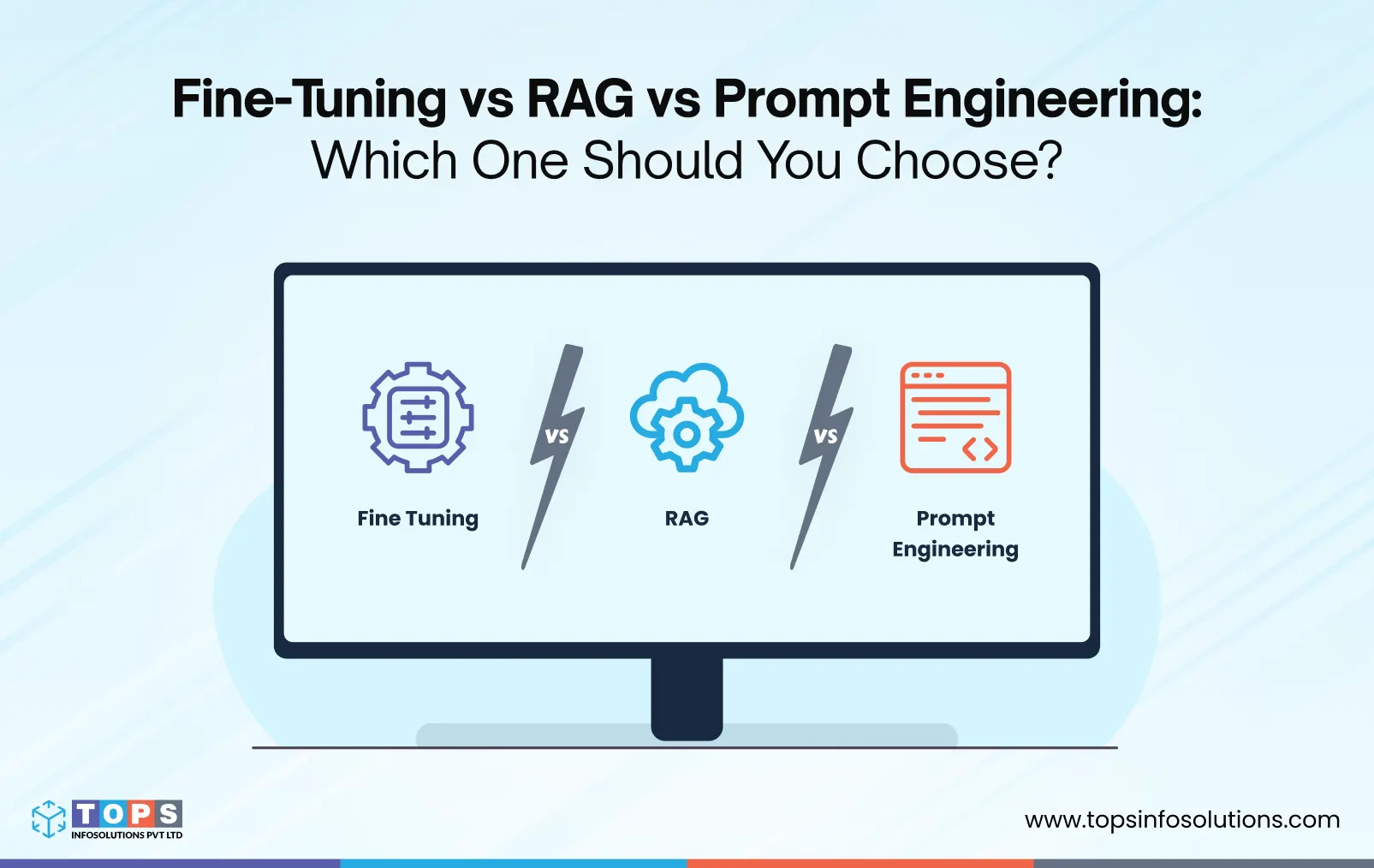
Choosing the wrong one between fine-tuning, RAG, and prompt engineering is one of the most common and expensive mistakes in applied AI right now. These are the three main LLM customization approaches available today, and the idea isn’t to pick the most advanced one but rather to match the tool to what’s actually failing. Is the model missing knowledge, or is it simply missing the right instructions? Or does it need to behave differently at its core? Each question has a different answer.
What Do RAG, Fine-Tuning, and Prompt Engineering Actually Do?
It helps to think of these three as different levers on the same machine, not three competing products.
Prompt engineering
Prompt engineering shapes the instructions you give a model. You’re not changing what the model knows or how it was trained. You’re changing how you ask. This includes system prompts, few-shot examples, chain-of-thought instructions, and structured output formatting. It’s the fastest and cheapest lever to pull, and it requires no extra infrastructure.
RAG (Retrieval-Augmented Generation)
RAG changes what the model can see at the moment it answers. Instead of relying only on what it learned during training, a RAG system retrieves relevant documents, records, or data from your own sources and feeds them into the prompt in real time. The model’s weights never change. Only its available context does.
Fine-Tuning
Fine-tuning involves changing the model itself. You continue training a base model on your own examples so the behavior adapts to an internalized pattern, a tone, a format, or a task.
Think of it this way: Prompt engineering is giving someone clearer instructions. RAG is handing them the right reference material during an open-book exam. Fine-tuning is having them study and internalize the material ahead of time, closed-book.
None of these are mutually exclusive. Most production systems that hold up under real usage combine at least two. The mistake isn’t choosing one. It’s assuming you have to choose only one, or defaulting to the most expensive option because it sounds more serious. This distinction between prompt engineering vs fine-tuning LLM behavior, and where RAG fits between the two, is the foundation for every decision that follows.
Cost, Speed, and Accuracy: A Side-by-Side Comparison of Fine-Tuning vs RAG vs Prompt Engineering
A direct look at retrieval-augmented generation vs fine-tuning, alongside prompt engineering, makes the trade-offs clearer than any framework alone.
| Factor | Systems Prompt Engineering | RAG | Fine-Tuning |
|---|---|---|---|
| Time to first working version | Hours to days | Days to a few weeks | Weeks to months |
| Upfront engineering cost | Minimal | Moderate (retrieval pipeline, vector store) | High (data prep, training runs, evaluation) |
| Ongoing running cost | Included in normal API usage | Moderate infrastructure cost | Lower per query at high volume, but retraining adds up |
| Handles frequently changing data | No | Yes, this is its core strength | No, requires retraining |
| Source attribution/citations | Not inherent | Yes, retrieval can point to the source | No, the model can’t cite what it “knows” |
| Best for | General reasoning, early validation, low query volume | Knowledge-heavy tasks, live or proprietary data | Narrow, high-volume tasks needing consistent format or tone |
| Data requirements | None | Your existing documents or records | Hundreds of labeled, high-quality examples minimum |
A pattern worth calling out directly: prompt engineering is close to free to start, and fine-tuning is the most expensive to get wrong. That asymmetry alone is a good reason to validate the cheaper option before committing budget to the expensive one.
When Prompt Engineering Is Actually Enough
There’s a quiet pressure in a lot of AI projects to reach for the most technically impressive solution first. Prompt engineering doesn’t sound impressive. But in most cases, it’s the correct answer.
Prompt engineering tends to be enough when:
- Query volume is low enough that per-query cost isn’t a real constraint yet
- The task is general reasoning, summarization, or open-ended conversation rather than a narrow, repeatable pattern
- You’re validating a concept before committing engineering time to infrastructure
- The knowledge the model needs is already public and well-represented in its training data
The strongest reason to start here isn’t cost. It’s information. Running a focused prompt engineering pass before building anything else tells you exactly where the model actually struggles. Maybe it hallucinates specific facts, which points to RAG. Maybe it can’t hold a consistent output format, which points to fine-tuning. Skipping this step means guessing at a solution to a problem you haven’t fully diagnosed yet.
When You Need RAG
RAG earns its place the moment a project depends on information the model wasn’t trained on, or information that changes faster than any retraining schedule could keep up with.
This covers most enterprise use cases in practice, and increasingly forms a core piece of a broader enterprise AI implementation strategy: customer support tools that need to reference current product documentation, internal knowledge assistants connected to a company’s own systems, contract or policy search tools, and anything where the answer needs to point back to a specific source.
RAG is the right call when:
- The underlying knowledge changes daily, weekly, or monthly
- The use case requires citing where the answer came from
- The data is proprietary, internal, or simply too large to include in a prompt directly
- You need to update the knowledge base without retraining a model every time something changes
A Real-World Example: Choosing RAG Over Fine-Tuning
In one implementation, TOPS worked on for a document-heavy enterprise client. Fine-tuning was the initial plan, largely because it was the more familiar-sounding option. Once the actual requirement was mapped out, the real need was fast, accurate retrieval across a constantly updated set of documents with source citations. A RAG architecture met that requirement in a fraction of the time a fine-tuning cycle would have taken, at a lower ongoing cost, and without a retraining pipeline to maintain going forward.
RAG isn’t free of engineering work. Retrieval quality, chunking strategy, and embedding choices all directly determine answer quality. A poorly designed retrieval layer produces a model that reads back convincing nonsense. This is real engineering work, just a different kind than model training.
When Fine-Tuning Earns Its Cost
Fine-tuning is the right call less often than most teams assume, but when it fits, it fits well.
It tends to make sense when:
- The task is narrow and repeatable: consistent structured output, a specific tone, a classification or extraction pattern
- Query volume is high enough that the per-query savings over time outweigh the training cost
- You have a genuinely strong dataset to train on, typically several hundred high-quality labeled examples at minimum
- The behavior you need can’t be reliably captured through instructions or retrieved context alone
Fine-tuning is behavioral, not informational. It’s better suited to teaching a model to always respond in a specific JSON schema, or to consistently adopt a brand’s voice, than to teaching it new facts. Facts go stale. Behavior, once learned well, tends to hold.
The break-even question is a business one as much as a technical one: does the cost of a training run and its maintenance pay for itself against the query volume and the value of each correct, consistently formatted response? For low or moderate volume, it usually doesn’t. For high-volume, narrowly defined tasks, it often does.
A Decision Framework You Can Actually Use
Knowing when to use RAG vs fine-tuning, or whether prompt engineering already covers it, comes down to a short set of questions, asked in order, once the marketing language is stripped away.
1 : Is the model failing because of unclear instructions, missing knowledge, or wrong behavior?
Run a prompt engineering pass first, regardless of what you eventually build. It’s the fastest way to find out.
2 : Does the task depend on information that changes often or that needs to be cited?
If yes, RAG is likely required, on top of whatever prompt engineering you’ve already done.
3 : Is the underlying knowledge static, and is the real problem behavioral or structural?
Consider fine-tuning, but only after confirming that prompting and retrieval genuinely can’t solve it.
4 :What’s the query volume, and does it justify the fine-tuning investment?
Low volume rarely justifies the cost. High, sustained volume on a narrow task often does.
5 : Do you have the data to fine-tune well?
Without several hundred high-quality examples, fine-tuning tends to underperform a well-built RAG or prompting setup anyway.
Most production systems that hold up don’t land on a single answer. They end up layering prompt engineering as the baseline, RAG for anything knowledge-dependent, and fine-tuning reserved for the one or two tasks where behavior genuinely needs to be baked in.
Common Mistakes Teams Make
A few patterns show up repeatedly in AI projects that stall or run over budget.
Fine-tuning before validating with prompting
Teams commit to a training pipeline before confirming that the problem couldn’t have been solved with better instructions. This wastes months on a solution to a problem that may not have needed one.
Blaming the model for bad retrieval
When a RAG system gives wrong answers, the instinct is often to fine-tune the model. Frequently, the actual issue is chunking, embedding quality, or a retrieval pipeline that isn’t surfacing the right documents. Fixing retrieval is usually faster and cheaper than fine-tuning around its weaknesses.
Treating it as either-or
The strongest systems combine these approaches deliberately: prompting to shape output, RAG to ground answers in real data, fine-tuning reserved for the specific tasks that need it. Picking exactly one and forcing every use case through it tends to produce a system that’s overbuilt in some places and underpowered in others.
Wrapping Up
Choosing between fine-tuning, RAG, and prompt engineering isn’t about picking the most advanced technology. It’s about matching the tool to the actual problem. Start with prompting to diagnose what’s really failing. Most systems that hold up in production use some combination of the three, not a single answer applied everywhere. In practice most production systems combine two of the three, and choosing the mix is an architecture decision we make during discovery on every custom AI development engagement.
The cost of getting this wrong isn’t just budget. It’s months of engineering time spent on infrastructure that the problem never actually needed. TOPS has guided engineering teams through this exact decision across industries, building the architecture that fits the actual requirement instead of defaulting to whichever approach sounds most advanced.
Frequently Asked Questions (FAQs)
RAG gives a model access to external information at the moment it answers, without changing the model itself. Fine-tuning changes the model’s weights through additional training, so the behavior is built in rather than looked up.
Yes, and many production systems do. A fine-tuned model can still use RAG to pull in current information, combining consistent behavior with up-to-date knowledge.
A basic RAG pipeline typically costs a few hundred dollars a month to run. A single fine-tuning run can depend on the provider, data size, and volume, and most projects need multiple runs to get the results right.
Often, yes. It’s the fastest and cheapest way to validate an idea and identify exactly where the model needs more support before investing in RAG or fine-tuning.
When the task is narrow and high-volume, and the goal is consistent behavior, structure, or tone rather than access to changing information.
A RAG pipeline can often go from prototype to production in a matter of weeks. Fine-tuning, including data preparation and evaluation, typically takes longer and often needs several iterations.
Yes. This is where RAG has a clear advantage, since it retrieves current information at query time instead of relying on what was baked in during training.
Not necessarily, though you do need a solid, well-labeled dataset and the engineering capacity to evaluate and maintain the fine-tuned model over time. Many teams work with an experienced AI partner rather than building this capability in-house from scratch.