




































Quick Summary
This guide explores how AI is transforming clinical documentation by automating medical note creation, improving documentation accuracy, and reducing administrative burden for healthcare professionals. It also explains how AI-powered documentation supports better clinical workflows, regulatory compliance, and enhanced patient care through intelligent automation.
Key Takeaways:
-
- AI automates clinical documentation by generating accurate medical notes from patient interactions and clinical data.
- AI-powered documentation reduces administrative workload, allowing healthcare professionals to spend more time on patient care.
- Integration with Electronic Health Record (EHR) systems improves documentation efficiency and minimizes manual data entry.
- AI enhances documentation quality by improving accuracy, consistency, and compliance with healthcare regulations.
- Real-time clinical insights and intelligent workflows support faster decision-making and better patient outcomes.
- Healthcare organizations can improve operational efficiency, reduce documentation errors, and enhance clinician productivity through AI-driven clinical documentation.
At some point, every healthcare organization scaling its clinical capacity hits the same wall.
The documentation process that worked for 30 clinicians starts showing cracks at 60. Records become inconsistent. Compliance gaps appear in places no one was watching. And fixing it manually is no longer an option.
This is a structural problem.
AI clinical documentation is how scaling healthcare teams are solving it. Not by automating speed. By building accuracy and consistency into the process itself. So the right information gets captured, every time, across every clinician and every site.
This post covers what that looks like in practice, the use cases driving real operational change, and what to get right before you deploy any of it.
Challenges of Clinical Documentation
As clinical operations scale, the structural problems get harder to ignore.
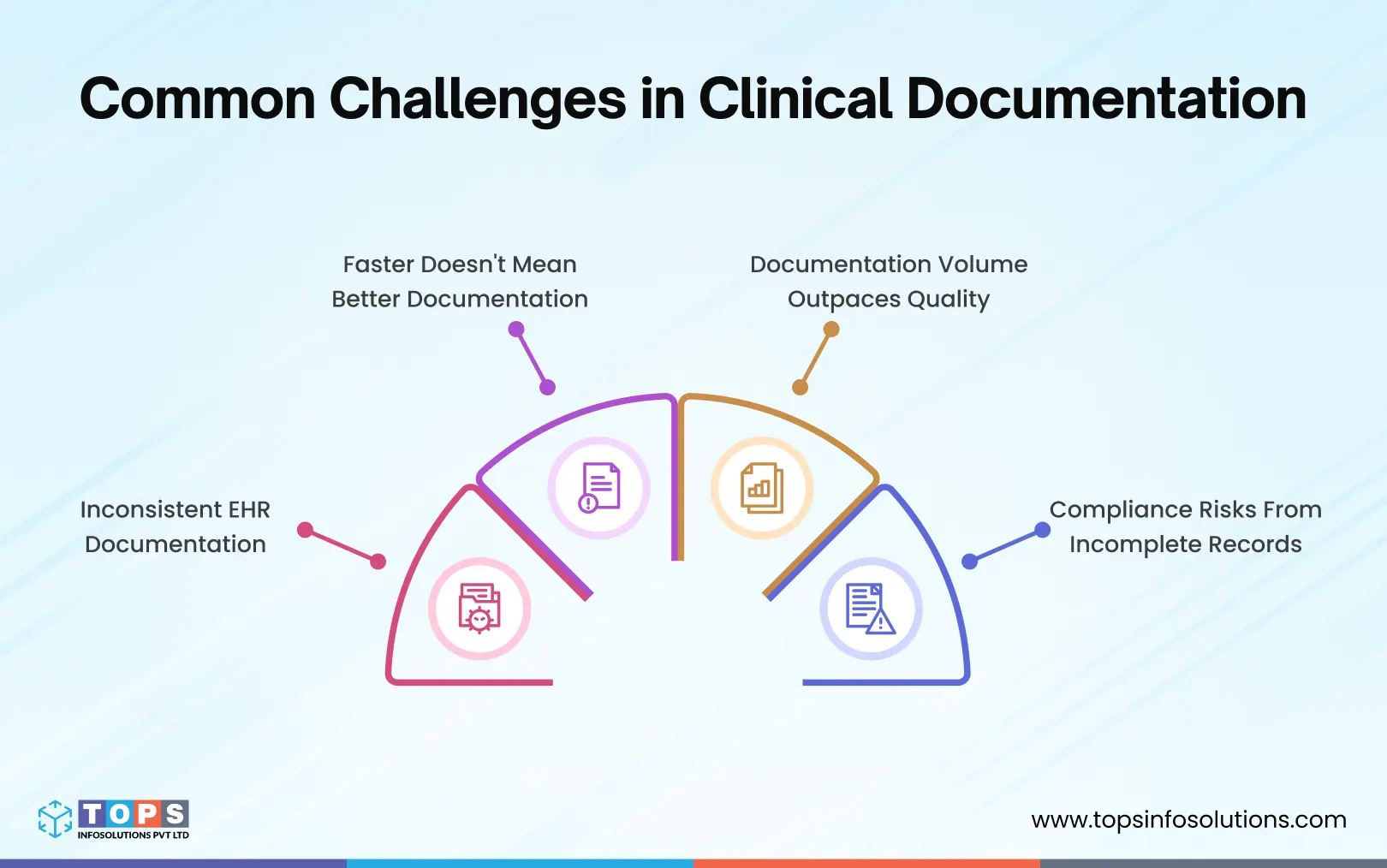
1. Inconsistent Documentation Across EHR Systems
Not every clinical team works within a single EHR. Many teams operate across several EHR platforms.
Each system structures data differently. Fields differ. Workflows differ. What gets captured in one system does not always translate cleanly into another.
The result is a documentation landscape that is inconsistent by design. Before AI can improve documentation quality, this variability is the first problem to solve.
2. Faster Documentation Does Not Mean Better Documentation
When documentation feels slow, the instinct is to make it faster. Shorter templates. Voice-to-text. Auto-populated fields.
These help at the margins, but they do not fix the underlying problem.
Documentation done quickly is often documentation done incompletely. In a team spread across dozens of sites, those small gaps compound into something much harder to manage.
3. How Documentation Volume Outpaces Quality at Scale
When 20 clinicians do the job, documentation gaps are visible. A supervisor can spot them. A team lead can follow up.
At 80 clinicians across multiple sites, that stops being possible. Too many records. Too many sites. Too little time for manual oversight to catch what is slipping through.
Research suggests that 57% of healthcare organizations identify reducing administrative burden through automation as the most significant opportunity for AI adoption. But burden reduction is only half the equation.
The other half is quality and making sure what gets documented is accurate and complete, not just submitted.
4. The Compliance Risk Inside Incomplete Clinical Records
Incomplete records are a major liability.
Gaps in what was captured. Unsigned protocols. Updated guidance that was circulated but never reflected in the notes that followed.
These gaps surface during audits, inspections, and incident reviews, at exactly the moment when records need to be airtight.
AI improves clinical documentation by structuring data, annotating notes, evaluating quality, identifying trends, and detecting errors across multiple clinical settings and specialties. The case for a smarter approach is well established. The question is what it actually looks like in practice.
What Smarter AI Clinical Documentation Actually Means
Speed is easy to measure. Quality is not. That is why most documentation tools get evaluated on the wrong metric. Smarter AI documentation is not about how fast a record gets submitted. It is about what that record contains when it does.
The industry term for this is Clinical Documentation Integrity (CDI). It refers to documentation that is not just complete, but clinically accurate, consistently structured, and defensible under scrutiny.
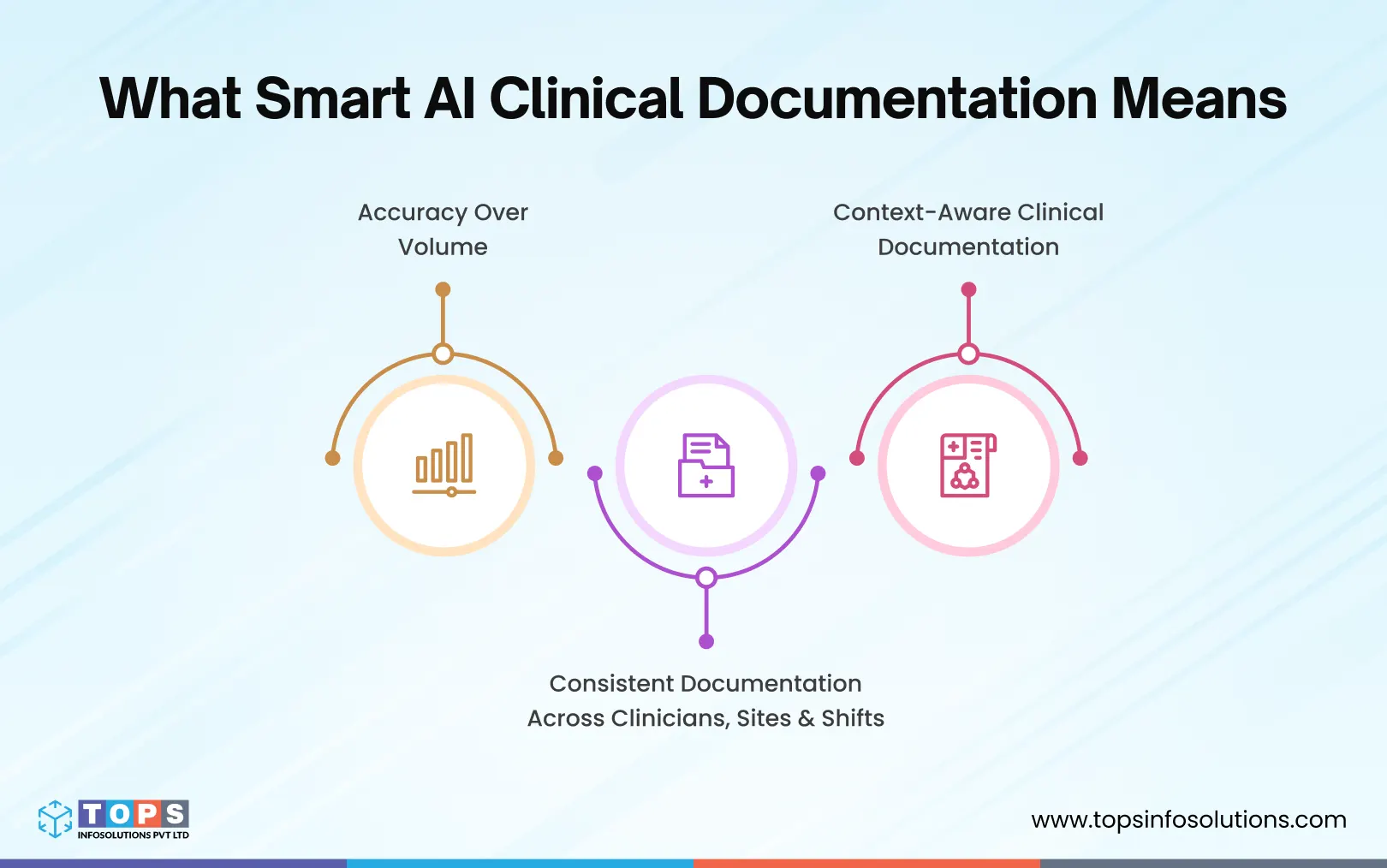
1.Accuracy Over Volume
Smarter documentation AI does not generate more fields. It surfaces the right ones at the right moment.
For a clinician working through a complex case, that means prompts calibrated to the patient’s risk level and care pathway. Not a generic template applied to every record regardless of context.
The difference shows up at the audit. Records built with context-aware prompting are more complete, more defensible, and more useful to the next clinician who opens them.
2.Context-Awareness That Reflects Clinical Intent
The most useful AI documentation tools do not just record what a clinician inputs. They recognize what a clinician is doing.
A complex, high-risk encounter carries different documentation requirements than a routine follow-up. Smarter systems recognize that distinction and adjust accordingly.
This is where AI moves from a time-saving tool to a genuinely clinical one. Not replacing judgment but rather supporting it with the right structure at the right moment.
3.Consistency Across Every Clinician, Every Site, Every Shift
In a distributed clinical workforce, consistency is the hardest thing to maintain.
Different clinicians have different documentation habits. Different sites run different EHR systems. Without a standard enforced at the system level, documentation quality becomes a function of individual behavior rather than organizational design.
AI that operates across the entire network is what makes CDI achievable at scale. Every clinician, every site, every shift is working within the same structured framework.
AI Clinical Documentation Use Cases in Healthcare Operations
Understanding what smarter documentation looks like is one thing. Knowing where AI is actually being applied, and what it changes in practice, is another. Here are the use cases making the biggest operational difference.
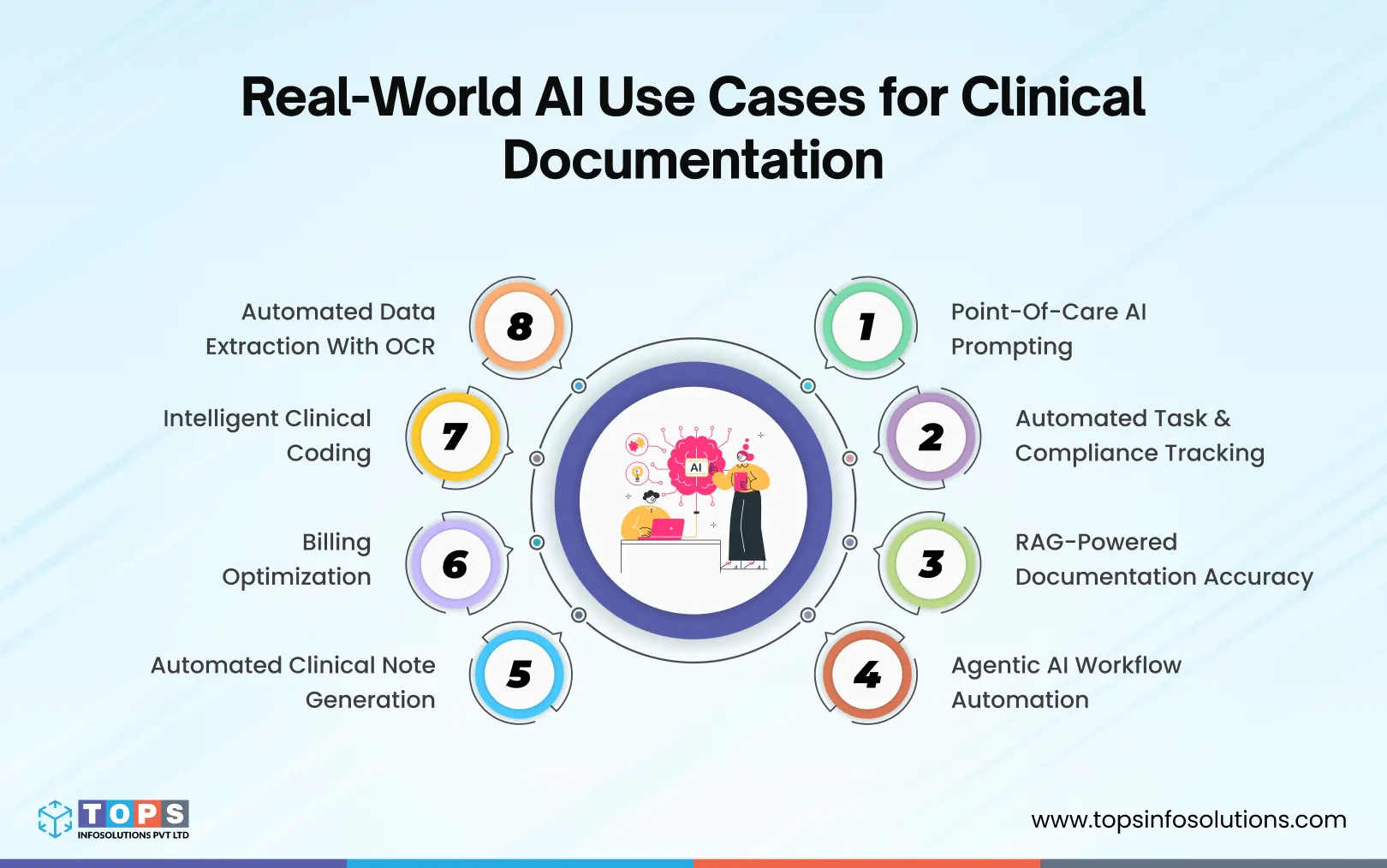
1.Intelligent Prompting at the Point of Care
Most documentation gaps do not happen because clinicians forget. They happen because the system does not remind them at the right moment.
AI surfaces the relevant prompts when a patient record is opened. If a high-risk monitoring task is due, it is flagged before the record is closed. Not after an audit reveals it was missed.
Documentation shifts from a reactive task to an embedded part of the clinical workflow. Nothing falls through the cracks because the system does not allow it to.
2.Intelligent Clinical Coding
AI is increasingly being applied at the point where clinical documentation meets revenue by reading completed notes, identifying missing or incorrect codes, and strengthening clinical coding in healthcare before a claim is submitted.
Clinical coding has traditionally been a manual, retrospective process. A coder reviews a completed note and assigns the appropriate codes.
AI agents are changing this by assigning and reviewing codes in real time, flagging inconsistencies before a record is finalized.
The downstream impact is significant. Accurate codes mean accurate billing and insurance claims. They support regulatory compliance reporting. And they generate population health data that is actually reliable enough to act on.
3.Automated Data Extraction With OCR
A significant portion of clinical documentation still exists in unstructured formats. Handwritten notes. Scanned referral letters. Paper-based discharge summaries.
Optical Character Recognition (OCR) combined with agentic AI reads through these documents, structures the clinically relevant details, and flags anything incomplete or ambiguous for review before it enters the record.
This removes a manual data entry layer that is both time-consuming and error-prone. Information that previously required a staff member to transcribe gets captured, checked, and filed automatically, without disrupting the clinical workflow around it.
4.Real-Time Completeness and Compliance Tracking
A common documentation risk in a large clinical team is work that gets done but is never fully captured. A review happens, but the record stays thin. Updated guidance lands, but isn’t reflected in practice.
AI helps close that gap by checking records for completeness as they are created, surfacing what is missing while the clinician is still in the encounter. The result is a documentation trail that holds up under later review, rather than one that has to be pieced together after the fact.
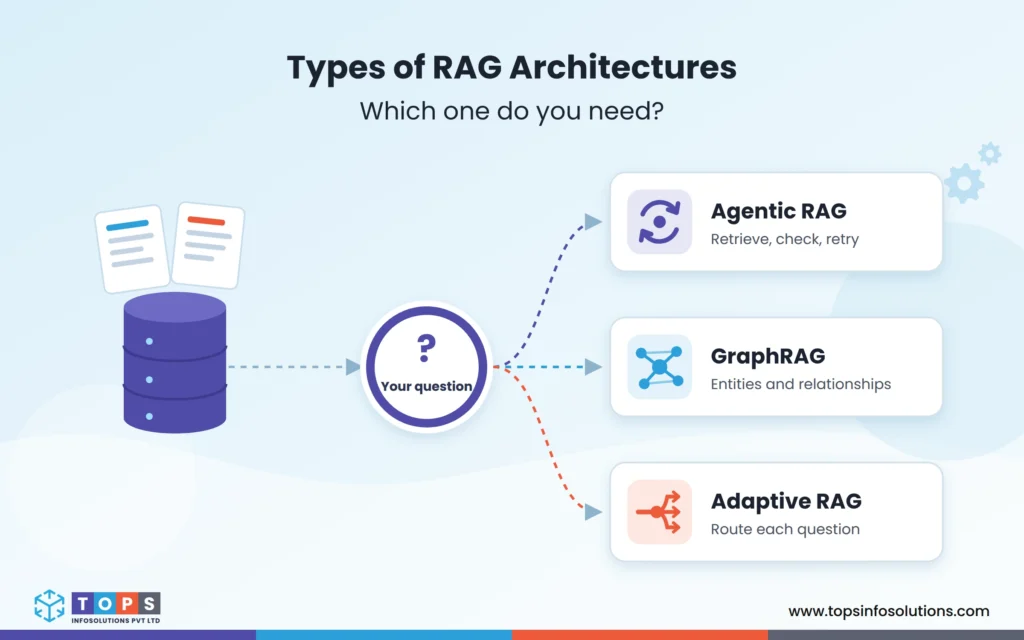
5.RAG-Powered Retrieval for Documentation Accuracy
Generic AI output is one of the most common failure points in clinical documentation deployments. A model that draws on general training data will not reflect your protocols, your formularies, or your compliance requirements.
RAG in healthcare addresses this by pulling from verified, organization-specific knowledge bases. The result is documentation grounded in what your team actually follows, not what a model assumes they do.
It is the difference between AI that generates a plausible record and AI that generates an accurate one.
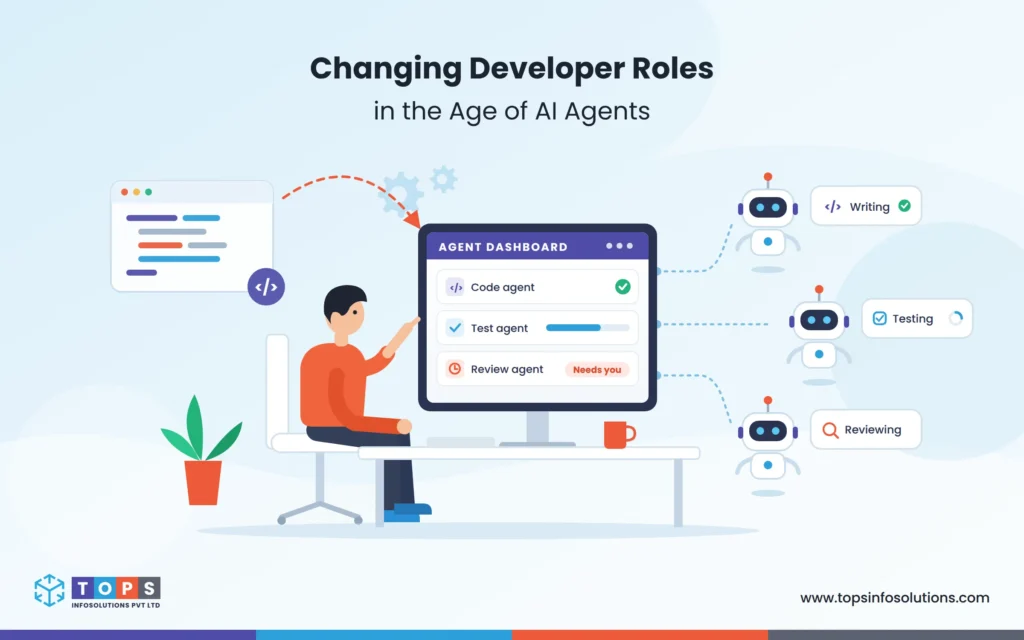
6.Agentic AI for Documentation Workflow Automation
Beyond individual documentation tasks, agentic AI in healthcare handles the coordination layer that surrounds them.
Flagging overdue records. Routing incomplete submissions for review. Escalating compliance gaps before they become audit findings.
These are not clinical judgment calls. They are administrative coordination tasks that consume significant operations team time. AI agents handle them autonomously, at scale, without fatigue, freeing the operations team to focus on what actually requires human attention.
7.Automated Clinical Note Generation
One of the most actively deployed applications of AI in clinical documentation is automated note generation, AI that listens to a clinical encounter in real time and produces a structured note without the clinician typing a word.
Ambient AI scribes transcribe the conversation, identify clinically relevant information, and populate the record in the background. The clinician reviews and approves. The documentation gets done during the encounter, not after it.
Research found that AI-generated notes scored higher in quality than those produced through standard EHR workflows, suggesting that when functioning properly, AI scribes can create more complete and better-structured documentation than time-pressured clinicians.
For distributed teams, this also removes the variability that comes from clinicians documenting hours after the fact.
8.Billing Optimization
Clinical coding is where documentation quality has its most direct financial consequence. AI brings real-time reasoning that sharpens coding accuracy and strengthens both financial and clinical outcomes, closing the loop between what was documented and what was billed, before it costs the organization money.
Benefits of Smarter Clinical Documentation
Getting documentation right has consequences that reach well beyond the records themselves. Here is what changes when accuracy and consistency are built into the process.
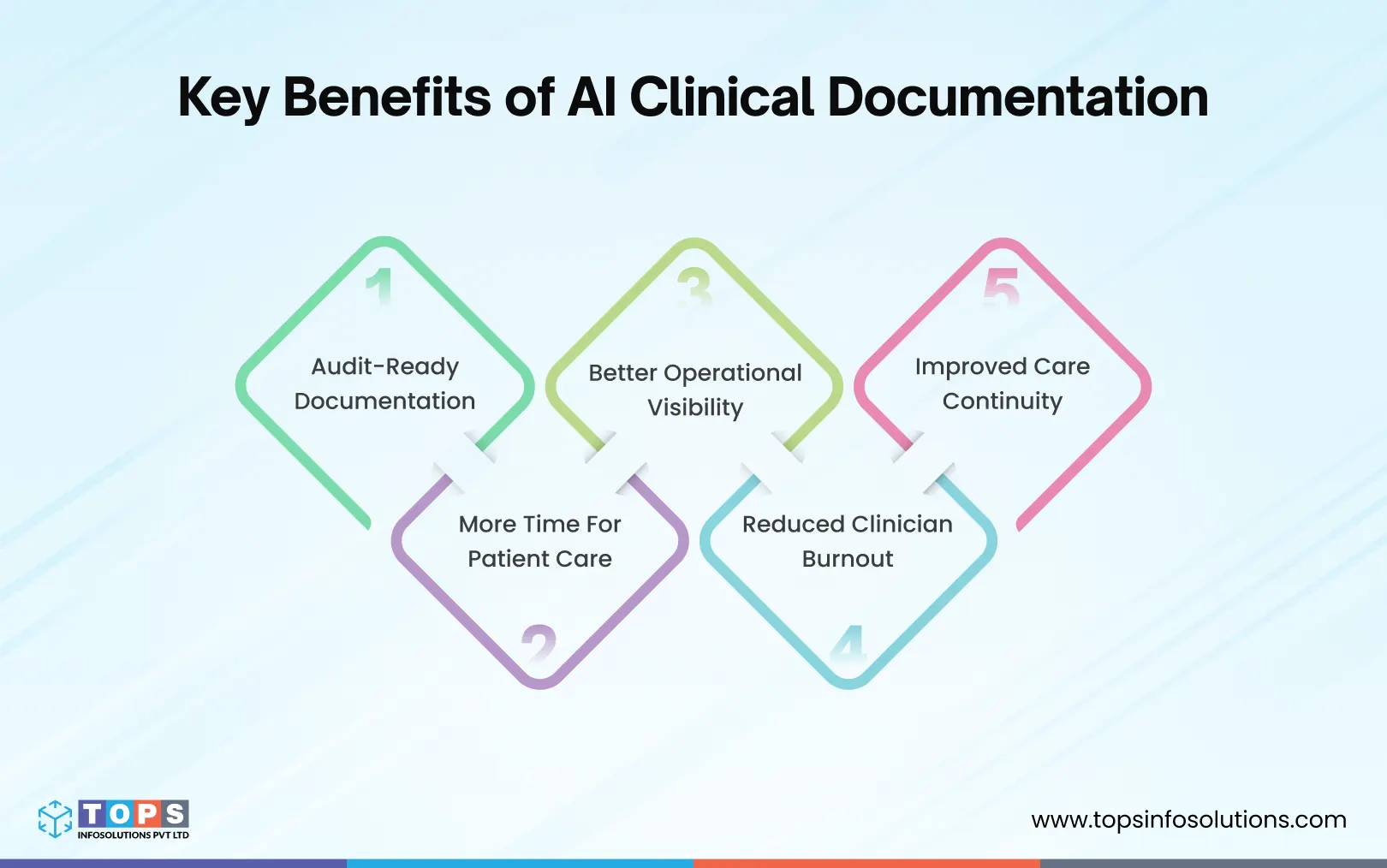
1.Audit Readiness Without the Last-Minute Scramble
When documentation is accurate and complete as a byproduct of daily clinical workflow, audit preparation stops being a separate exercise.
The records are already there. The trail is complete and time-stamped. The evidence of what was done, and when, is built in rather than reconstructed.
Audits become a confirmation of what the team already knows. Not an excavation of what they hope to find.
2.Clinician Time Reclaimed for Patient-Facing Work
Research found that 65% of clinicians reported enhanced efficiency in documentation tasks, with a median time saving of 20 minutes per clinician per session following AI implementation.
Across a distributed workforce, that compounds quickly. Twenty minutes per clinician per shift, across 80 clinicians, is not a marginal gain. It is a significant operational one.
That time does not disappear. It goes back to patient care.
3.Operational Visibility Across Every Site and Every Shift
Smarter documentation gives leaders something manual processes cannot: a real-time picture of clinical activity across the entire network.
Where is documentation quality starting to slip? Which sites or specialties are trending toward gaps? What needs attention before it becomes an audit finding?
That visibility turns documentation from a compliance burden into an operational asset.
4.Reduced Clinician Burnout
Documentation burden is one of the leading contributors to clinician burnout. Not the clinical work itself, but the administrative layer that surrounds it.
A systematic review and meta-analysis found that AI tools produced a moderate reduction in documentation workload and related burnout, with the quality of AI-generated notes at least comparable to those prepared manually by clinicians.
When documentation is embedded into the clinical workflow rather than saved for the end of a shift, clinicians finish the day with less unfinished work following them home.
5.Better Continuity of Care
A complete clinical record is not just a compliance asset. It is a care asset.
When documentation is accurate and consistently structured across every clinician and every site, the next person to open a patient file has everything they need. No gaps to piece together. No missing context to chase down before making a clinical decision.
In distributed teams where a patient may interact with different clinicians across different sites, this matters significantly. Continuity of care depends on continuity of documentation, and AI is what makes that achievable at scale.
Risks to Avoid When Deploying AI for Clinical Documentation
AI clinical documentation is not a guaranteed win. The tools are only as effective as the thinking behind the deployment. These are the failure points that operations leaders encounter most often.
1.AI That Prioritizes Speed Over Clinical Context
The most common failure mode is optimizing for the wrong thing.
A tool that generates a completed record in seconds is not useful if that record lacks clinical precision. Moderate accuracy in real-time AI documentation tools still precludes broad implementation in some clinical settings.
Generic output that does not account for care pathway, patient risk level, or site-specific protocols creates more work for clinicians. Not less.
Before evaluating any tool, the first question is not how fast it works. It is how well it handles clinical context.
2.Poor Integration With Existing Clinical Systems
AI documentation tools do not operate in isolation. They need to connect with the systems your team already uses.
A tool that requires clinicians to duplicate effort across platforms, or that cannot read and write to the systems where records actually live, will not be adopted. It will be worked around.
Integration is not a technical afterthought. It is the foundation of whether the tool functions in practice.
3.Clinician Workarounds That Quietly Undermine Adoption
Even well-designed tools fail if clinicians find ways around them.
Workarounds happen when a tool adds friction instead of removing it. When it interrupts the workflow instead of embedding into it. The result is a system that appears to be in use but is not actually changing documentation behavior.
Adoption is an operations problem as much as a technology one. Implementation needs to account for how clinicians actually work.
Is Your Documentation Process Ready for AI?
Deploying the right tool into a broken process does not fix the process. It automates the chaos. Here is how to assess where your operation actually stands.
Signs Your Current Process Will Not Scale
These are the indicators that a documentation process is approaching its limits.
- Task completion is tracked manually or checked after the fact rather than in real time. Audit preparation requires significant manual effort to compile records that should already be in place.
- Documentation quality varies across clinicians and sites, with no systematic way to address it.
- Updated guidance has been rolled out, but there is no reliable way to confirm it has been put into practice.
- Operations team time is spent chasing documentation and matching codes rather than reviewing them.
If more than two of these describe your current operation, the process is already under strain. Scaling without structural change will not resolve that strain. It will accelerate it.
Three Questions to Ask Before Implementing AI Clinical Documentation
Choosing the right AI solution is only part of the equation. Success depends on how well it integrates with your clinical workflows, supports your teams, and scales with your operations. Before starting an AI clinical documentation initiative, ask these questions.
Does it fit the way our clinicians already work?
AI should enhance existing workflows, not force clinicians to adopt entirely new ones. The right solution integrates seamlessly with your EHR, documentation processes, and clinical systems, making accurate documentation a natural part of patient care rather than an additional administrative task.
Which documentation processes should AI automate?
AI delivers the greatest value when it handles repetitive, administrative work such as clinical coding support, document extraction, compliance tracking, and completeness checks. Clinical decision-making should always remain with healthcare professionals. Clearly defining these boundaries leads to better adoption and stronger outcomes.
Do we have the right implementation partner?
Successful AI clinical documentation requires more than model development. It demands expertise in healthcare workflows, EHR integration, compliance, security, and change management. Working with an experienced healthcare AI partner like TOPS that helps you design a solution tailored to your organization, reduces implementation risks, and builds a foundation that can scale as your operations grow.
Closing Thoughts
Clinical teams are moving quickly toward AI-supported documentation. But the leaders seeing real operational gains are not the ones who moved fastest. They are the ones who asked the right questions first.
At TOPS, we help healthcare companies build and deploy AI documentation systems that are accurate, auditable, and built around how clinical teams actually work. If your documentation process is approaching its limits, let us show you what a structured approach looks like in your environment.
Frequently Asked Questions (FAQs)
AI clinical documentation refers to the use of artificial intelligence to support, automate, or improve the recording of clinical information during and after patient interactions. This includes intelligent prompting, automated completeness checks, clinical code extraction, voice-to-text transcription, and AI-generated summaries grounded in verified clinical data.
AI improves accuracy by surfacing context-aware prompts at the point of care, flagging missing or incomplete information before a record is closed, and applying consistent documentation standards across every clinician and site. This reduces the variability that comes from relying on individual behavior.
Speed-focused tools reduce the time it takes to submit a record. Quality-focused tools ensure the record is complete, accurate, and compliant when it is submitted. The best implementations do both, but quality should always be the primary objective, particularly in regulated healthcare environments where incomplete records carry compliance risk.
Yes, when implemented correctly. The key requirements are integration with existing clinical systems, a complete and immutable audit trail, data handling that meets the relevant regulatory standards in your region, and clear boundaries between what the AI handles and what requires clinical judgment.
Retrieval-Augmented Generation (RAG) allows AI documentation tools to draw on verified, organization-specific knowledge bases rather than generic training data. This means documentation prompts, summaries, and suggestions are grounded in your own protocols and clinical standards, reducing the risk of generic or inaccurate AI output.