







































Quick Summary
Moving an LLM application into production is only the beginning. Without a structured evaluation layer, teams often rely on user feedback to discover hallucinations, inaccurate responses, or declining performance. This article explains why LLM evaluation, testing, and AI observability are essential for delivering reliable AI applications at scale.
Key Takeaways:
-
- Why prompt testing alone isn’t enough for AI in production
- The difference between testing, evaluation, and observability
- What a production-ready LLM evaluation framework looks like
- Practical implementation strategies for engineering teams
Getting started with AI isn’t the hard part. It can work in a demo, pull the right documents, and launch on schedule.
But after a few weeks, you start noticing the cracks. Users report answers that sound confident but are wrong. Nobody can point to the moment things broke, because nothing broke. The model just quietly got worse.
This is exactly why LLM evaluation exists: to close the gap between “it worked in testing” and “it’s degrading in production” before users find it first.
Your AI Didn’t Fail Overnight. It Drifted There.
A passing demo proves an LLM can produce a good answer under controlled conditions. It says nothing about what happens across ten thousand real user queries, each with different phrasing, context, and intent.
Recent data backs up how common this gap is. AI agent failure rates in production environments range from 70% to 95%, driven mainly by compounding errors, tool breakdowns, and hallucinations rather than any single dramatic bug. In production, the failure modes look different from those in staging:
- Hallucinations creep in as retrieval sources change or a model version updates.
- Inconsistent outputs appear when the same question is asked in two different ways.
- Poor retrieval quality surfaces when a knowledge base grows, and relevance scoring hasn’t kept pace.
- Latency climbs as traffic scales past what was tested.
- Costs rise quietly as token usage per request increases without anyone tracking it.
The dangerous part is how invisible these issues stay. Traditional application monitoring tracks uptime and response codes, and an LLM can return a 200 status with a completely wrong answer.
Understanding the Three Pillars: Testing, LLM Evaluation, and AI Observability
These three terms get used interchangeably, but they solve different problems and belong at different stages of the AI application lifecycle.
LLM Testing
LLM testing happens before deployment. It answers a narrow question: does the system behave as expected on known inputs?
This includes unit tests for individual functions, prompt testing against a fixed set of examples, prompt regression testing to confirm a change hasn’t broken prior behavior, and pre-deployment validation gates. Testing is necessary, but it only covers the inputs someone thought to write a test for.
LLM Evaluation
Evaluation measures output quality against defined criteria run continuously rather than once. It scores responses on correctness, relevance, faithfulness to source material, groundedness, helpfulness, and safety.
Where testing checks “does this pass,” evaluation asks “how good is this, and is it still good today?” A strong AI evaluation framework is what separates a system that passed launch checks from one that’s still trustworthy three months later.
AI Observability
AI observability is what makes evaluation useful at scale. It monitors live production behavior, traces requests end to end, and shows why performance changed, not just that it changed. This is sometimes called LLM observability when scoped specifically to language model pipelines rather than general infrastructure.
Observability turns “quality dropped” into “quality dropped after the retrieval index was updated last Tuesday,” which is the difference between a diagnosis and a guess.
| Testing | Evaluation | Observability | |
|---|---|---|---|
| When | Pre-deployment | Continuous | Continuous, in production |
| Question answered | Does it work on known cases? | How good is the output? | Why did behavior change? |
| Scope | Fixed test set | Sampled live traffic | Full request pipeline |
| Output | Pass/fail | Quality scores | Traces, alerts, trends |
Each pillar depends on the other two. Testing without evaluation catches only what you anticipated. Evaluation without observability tells you something is wrong without telling you why. Observability without evaluation shows you traces with no judgment of whether the output was actually good.
Why an LLM Evaluation Layer Actually Matters
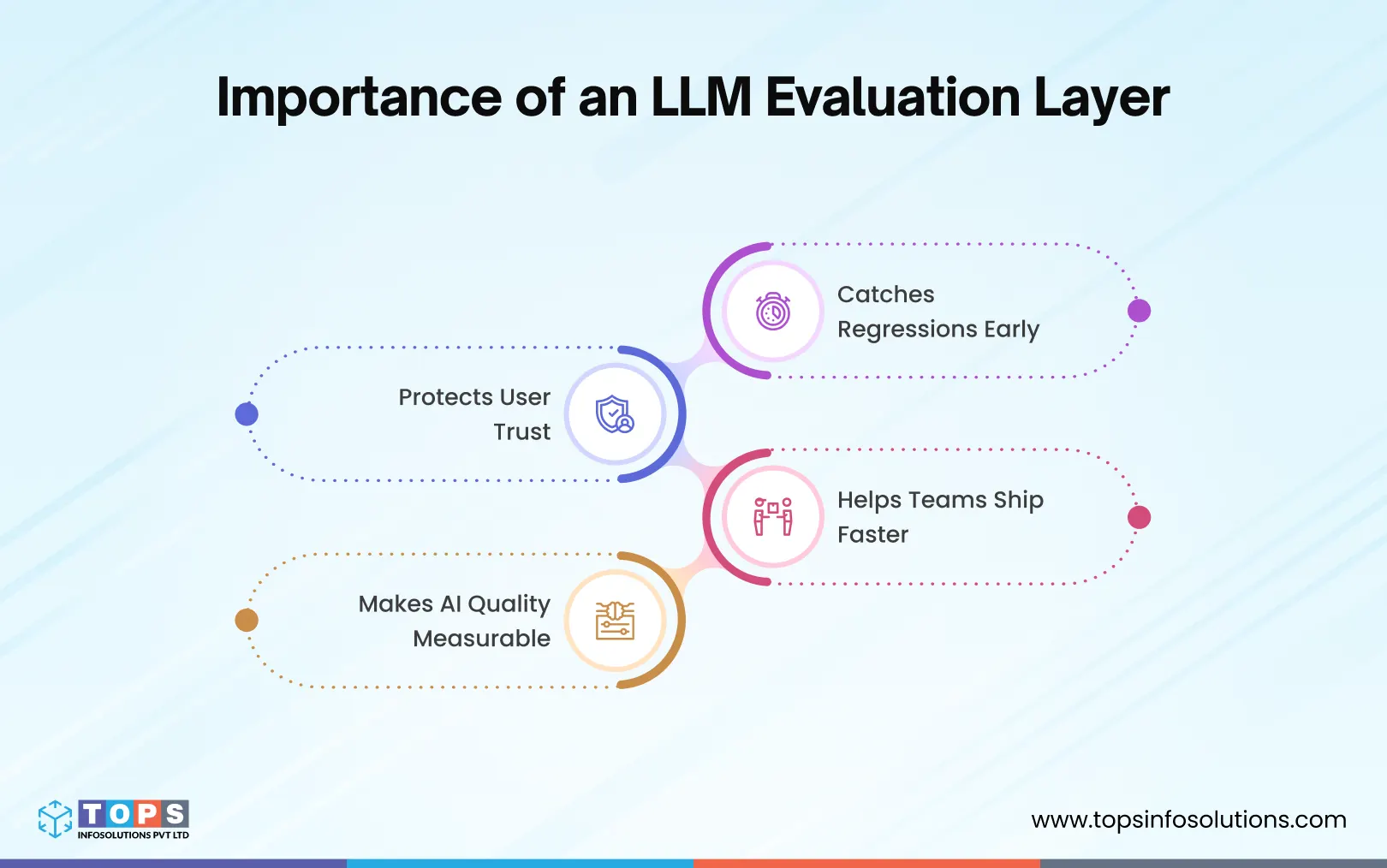
Every prompt update, model upgrade, or retrieval change can affect the quality of your AI application in ways that aren’t immediately visible. Unlike traditional software, LLMs produce probabilistic outputs, making conventional testing insufficient. An evaluation layer continuously measures quality, while observability helps explain why performance changes over time.
It catches regressions before users do
A small prompt tweak or model update can silently reduce response quality. An evaluation layer compares every change against predefined benchmarks, helping teams detect regressions before they reach production instead of learning about them through customer complaints.
It protects user trust
One inaccurate response can make users question the reliability of your AI feature. By continuously measuring response quality, an evaluation layer helps teams identify issues early and maintain the consistent experience users expect.
It helps teams ship faster
Without objective quality checks, every AI update requires time-consuming manual validation. Automated evaluation gives teams confidence to release prompt, model, or retrieval changes more frequently while reducing the risk of introducing errors.
It turns AI quality into a measurable metric
“The AI seems fine” isn’t something engineering leaders can report on. Evaluation provides measurable quality scores, while observability helps explain why those scores change, making AI performance as trackable as any other production system.
What an Evaluation Layer Actually Looks Like
An evaluation layer sits inside the request pipeline, not off to the side as an afterthought. Inside that evaluation layer, several things happen before a response reaches the user or gets logged for review:
- Automatic quality scoring, often using an LLM-as-a-judge pattern where a second model scores output against defined criteria
- Hallucination detection, checking generated claims against retrieved source material
- Citation validation, confirming referenced sources actually support the claim being made
- Latency monitoring, tracked per request and per pipeline stage
- Cost tracking, tied to token usage, so spend is visible before the invoice arrives
- User feedback collection, capturing thumbs up/down or correction signals
- Human review triggers, flagging low-confidence or high-risk outputs for a person to check
Guardrails run inline on every request, since they gate what the user sees before it’s sent. Evaluation runs separately: most teams log full traces on all traffic, then route a sampled percentage, commonly 10 to 20 percent, through LLM-as-judge scoring. That balance keeps production AI monitoring affordable while still surfacing quality regressions early. An evaluation layer is what separates a demo from production-ready AI solutions, and it’s the component most teams add only after something goes wrong in front of a customer.
For RAG-based applications specifically, RAG evaluation adds another layer: scoring retrieval relevance separately from generation quality, since a weak answer often traces back to what was retrieved, not how it was phrased.
Metrics That Actually Matter in Production
Dashboards full of numbers are easy to build and easy to ignore. The metrics worth tracking fall into three groups.
Quality Metrics
- Answer correctness
- Groundedness (does the output stay tied to retrieved source material)
- Context relevance
- Hallucination rate
- Citation accuracy
Performance Metrics
- Response time
- Token usage
- Cost per request
- Error rates
User Metrics
- User satisfaction
- Escalation rate
- Task completion
- Feedback scores
No single metric tells the full story. A response can be fast and cheap while being wrong. It can score well on correctness while frustrating users because it’s slow or verbose. The value comes from watching these together and noticing when one moves without the others, since that’s usually the earliest sign that something upstream has changed.
Common Mistakes That Break Production AI
Most production AI failures trace back to a handful of recurring mistakes, not a single dramatic incident.
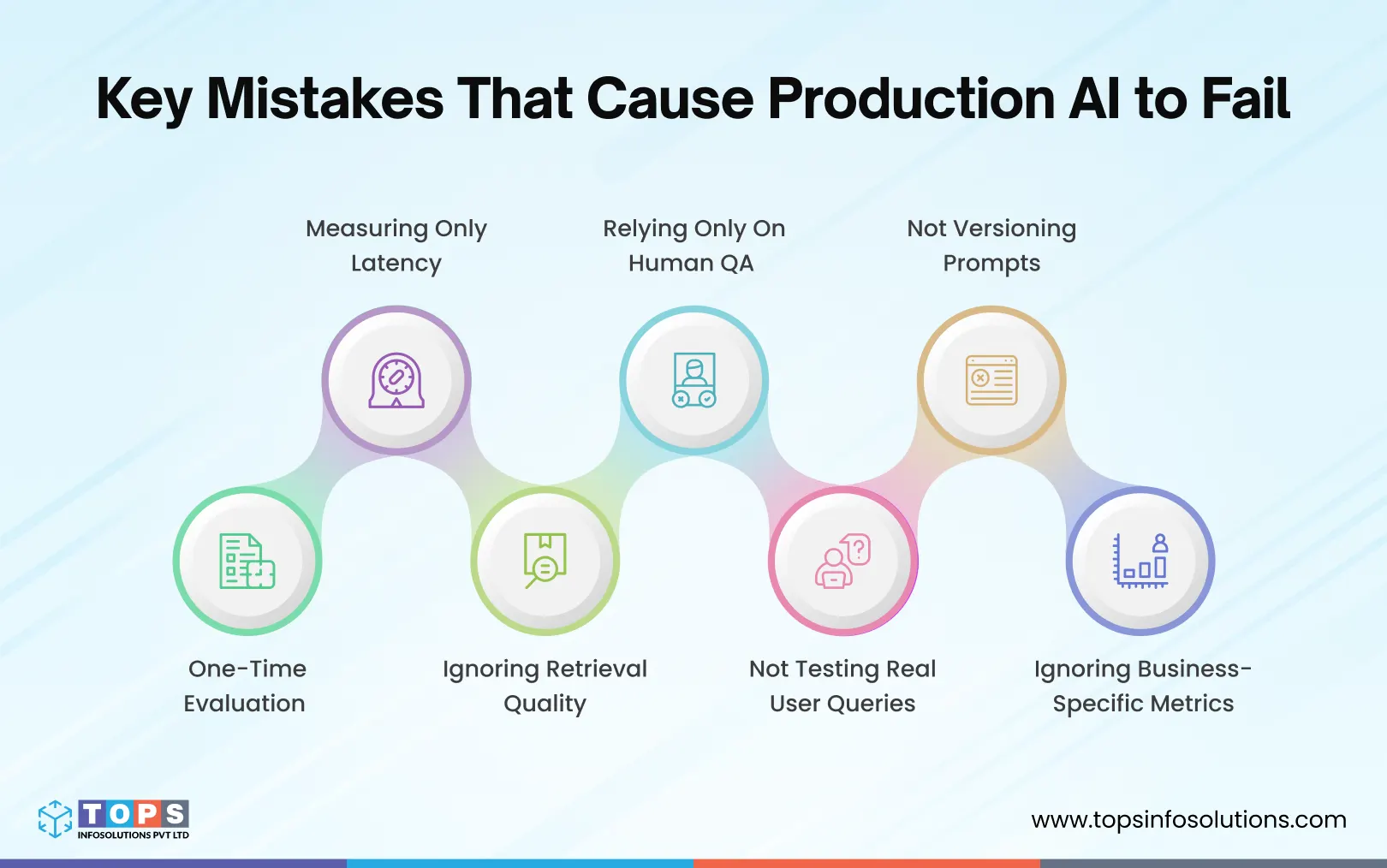
Treating evaluation as a one-time activity
A model that passes evaluation at launch can still drift weeks later. Usage patterns shift, data sources change, and model providers push silent updates. Without continuous scoring, that drift goes unnoticed until a user reports it. By then, the gap between good and degraded has usually been open for weeks.
Measuring only latency
Speed is easy to track and tempting to optimize for, since it shows up cleanly on a dashboard. But a fast wrong answer is still wrong, and teams that chase latency alone often miss quality regressions entirely. Response time matters, but only alongside correctness and groundedness. Optimizing one at the expense of the other creates a system that feels fast and fails quietly.
Ignoring retrieval quality
In RAG systems, a weak generation score often traces back to poor retrieval, not the model itself. Teams debug the prompt or swap models when the real issue is that relevant documents never made it into context. Retrieval quality needs its own evaluation, separate from generation quality. Without that split, teams fix the wrong layer, and the problem resurfaces.
Depending solely on human QA
Manual review catches nuance that automated scoring can miss, but it does not scale past a small volume of requests. A team reviewing 50 conversations a day cannot catch a regression across 50,000 daily queries. Human review works best as a targeted layer, applied to flagged or high-risk outputs. Used as the only line of defense, it becomes a bottleneck that lags behind production by days.
Failing to test against real user queries
Curated test sets rarely match the messiness of how people actually phrase questions. Real users misspell, abbreviate, ask multi-part questions, and switch context mid-conversation. A system that scores well on a clean benchmark can still fail on the first ambiguous query it meets in production. Evaluation sets need to be refreshed with real production traffic, not just the examples used at build time.
Not versioning prompts
Without version control, there is no way to correlate a quality change with the prompt edit that likely caused it. A small wording tweak can shift output quality in ways that only show up days later. Prompt versioning turns a guessing game into a lookup. When a regression appears, the team can trace it to the exact change that introduced it.
Overlooking business-specific evaluation metrics
Generic quality scores measure correctness and fluency but miss what actually matters to a specific use case. A support bot that responds politely but never resolves the issue will still score well on generic metrics. Business-specific criteria, like resolution rate or escalation avoidance, catch what generic scoring cannot. Without them, the evaluation layer optimizes for the wrong outcome.
Teams that catch these early tend to have one thing in common: they treat evaluation as infrastructure from the start, not as a fix bolted on after the first bad incident.
Steps to Build an LLM Evaluation Strategy
A production-grade LLM evaluation strategy doesn’t need to be built all at once. It scales in stages, each one building on the last.
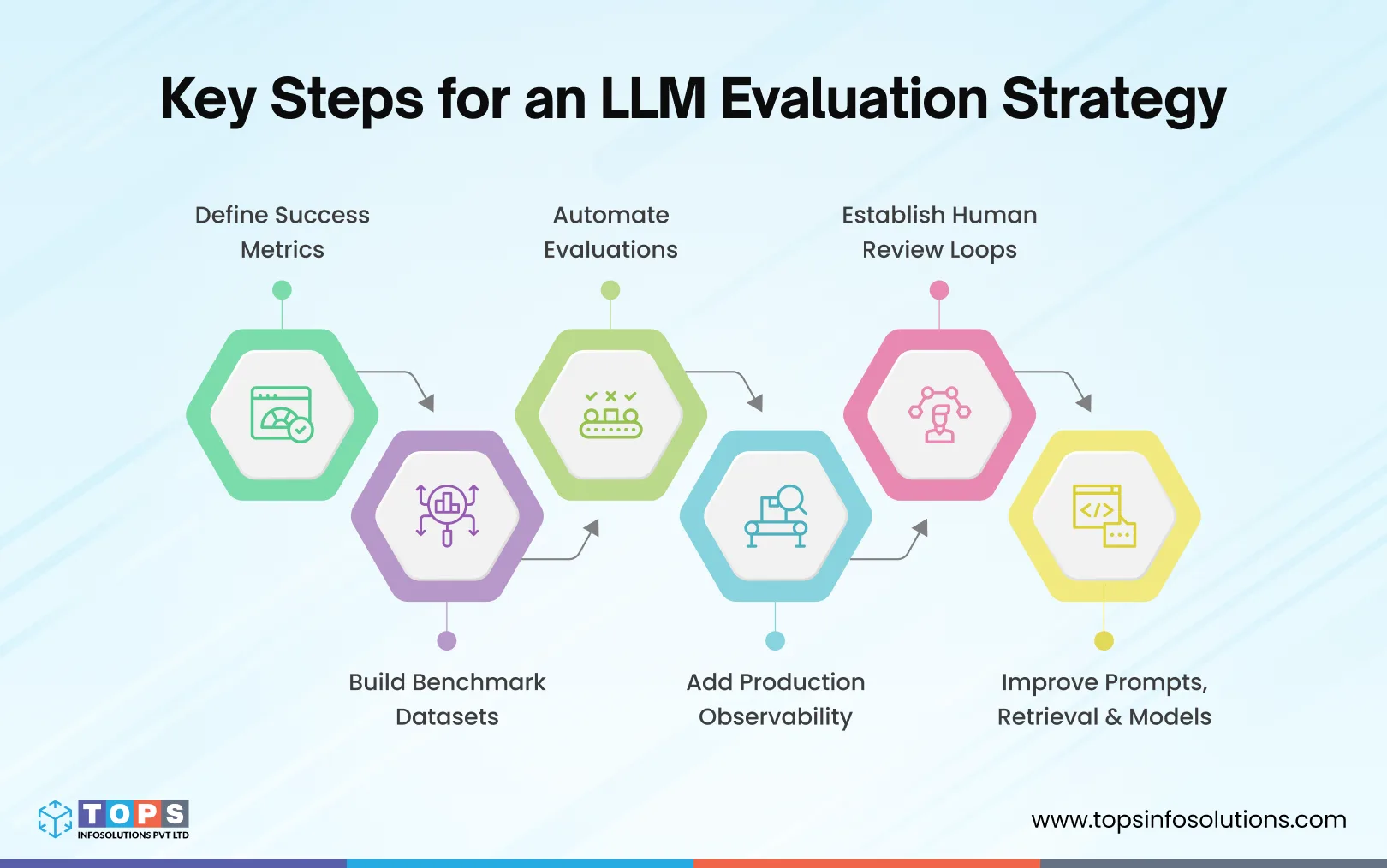
Step 1: Define success metrics
Decide what “good” means for this specific application before building anything to measure it. A customer support bot and a legal research assistant succeed on different terms. Success criteria set at the start prevent teams from optimizing for generic scores that don’t reflect real business value. Skipping this step means every later metric lacks a clear target.
Step 2: Create benchmark datasets
Assemble representative examples, including edge cases, to evaluate against consistently over time. A strong benchmark includes both typical queries and the messy, ambiguous ones real users send. Static benchmarks go stale as usage patterns shift, so they need periodic refreshing with production data. Without this, evaluation scores measure performance against a scenario that no longer reflects reality.
Step 3: Automate evaluations
Layer in LLM-as-judge scoring and rule-based checks so quality gets measured on every deployment, not just at launch. Automated scoring catches regressions within hours instead of weeks. Rule-based checks handle objective criteria like schema compliance, while judge models handle nuanced quality like helpfulness. Together, they cover far more ground than manual review alone ever could.
Step 4: Add production observability
Instrument tracing across the full pipeline so failures can be diagnosed, not just detected. A trace should capture the query, retrieved context, prompt, and final output as one connected record. When a quality score drops, tracing shows exactly which pipeline stage changed. Without it, teams know something broke but spend days finding where.
Step 5: Establish human review loops
Route flagged or low-confidence outputs to a person, and feed that feedback back into the evaluation criteria. That feedback loop is what improves the evaluation criteria over time. A review process that never feeds back into scoring stays static while the product keeps changing.
Step 6: Continuously improve prompts, retrieval, and models
Use what evaluation surfaces to guide the next iteration, rather than shipping changes on intuition alone. Every regression caught by the evaluation layer is a data point about what to fix next. Over time, this turns evaluation from a safety net into a feedback engine for the whole system. Teams that close this loop consistently ship improvements faster than teams still debugging by guesswork.
Wrapping Up
An LLM feature that works in a demo is a start, not a finish. Production reliability comes from watching outputs continuously, not from trusting the launch checks forever. Testing catches known failures. Evaluation catches the ones nobody anticipated. Observability explains why they happened. Together, they turn AI reliability from a guess into a tracked number.
Teams that build this discipline early ship changes faster and lose less trust to silent regressions. TOPS has helped engineering teams get this layer right, from early tracing to full evaluation pipelines, so reliability stops being a guess.
Frequently Asked Questions (FAQs)
LLM evaluation is the continuous process of measuring an AI system’s output quality against defined criteria such as correctness, relevance, and safety, rather than testing it once before launch.
Evaluation scores whether an output is good. Observability shows what happened across the full request pipeline and helps explain why quality changed. Production systems need both.
Testing checks behavior against a fixed set of known inputs. Real users ask questions in ways no test set anticipates, and models can drift over time even when the prompt hasn’t changed.
A mix of quality metrics (correctness, groundedness, hallucination rate), performance metrics (latency, cost, error rate), and user metrics (satisfaction, task completion) gives the most complete picture.
Most teams combine full request tracing with sampled automated scoring, commonly 10 to 20 percent of traffic run through an LLM-as-judge, plus a human review loop for flagged outputs.
Evaluation won’t prevent hallucinations on its own, but it catches them faster by scoring groundedness and citation accuracy on an ongoing basis, which shortens the time between a regression and a fix.