

Quick Summary
Vibe coding accelerates software development using AI, but without the right practices, it creates fast technical debt. These 8 best practices help teams turn AI-generated code into reliable, production-ready systems.
Key Takeaways:
-
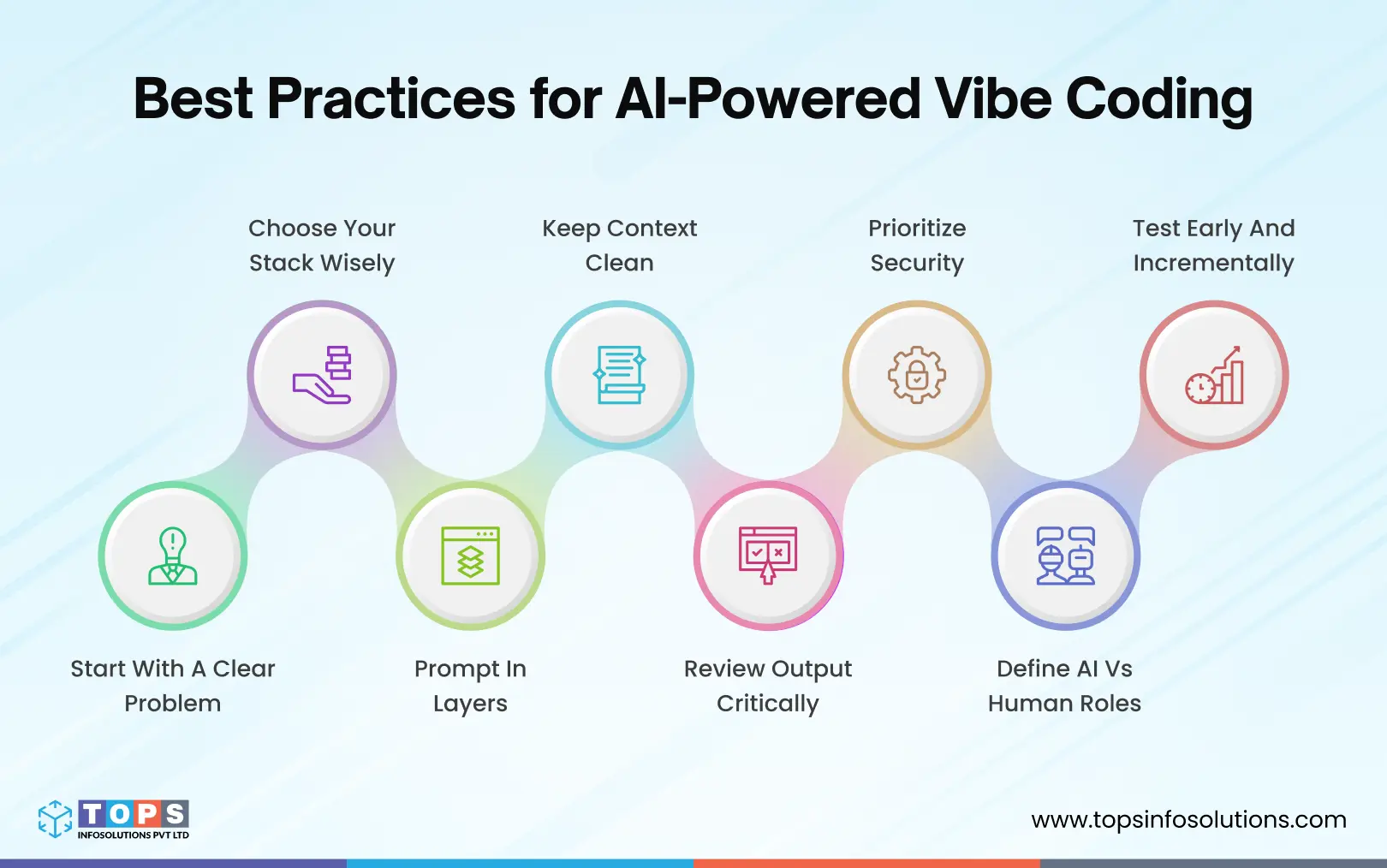
- Start with a clear problem statement before writing any prompt
- Choose well-supported frameworks so that AI generates more reliable code
- Use layered prompting for complex features, not one-shot requests
- Maintain a context file to prevent AI drift across sessions
- Always review AI output for security gaps, edge cases, and hardcoded values
- Define clearly what AI owns vs what humans own in the workflow
- Test in vertical slices, not at the end of the full build
Vibe coding works. But without the right practices behind it, you’re just shipping fast debt.
Unfortunately, vibe coding today looks a lot like AI did a few years ago. The term is everywhere, but execution? Unclear.
If you manage to look beyond the hype, you’ll see a real shift in how software gets built. And this isn’t experimental anymore. 85% of developers already use AI tools in their daily workflow.
You describe what you want in natural language, and AI generates working code. Not just snippets, but full workflows driven by conversation.
The difference between a prototype and a production-ready product comes down to how you use it.
Here are the vibe coding best practices that actually make it work.
1. Start With a Clear Problem Statement
The most common mistake developers make when starting with AI is treating it like a search engine, typing something vague and seeing what comes back.
The result is predictably mediocre. AI will generate something, but it will be the most statistically likely interpretation of what you asked, not your specific vision.
The fix is simple. Before you write a prompt, figure out your problem state and write a brief.
It doesn’t need to be long. It should answer four questions:
- Who is the user? What are they trying to do, and what’s their context?
- What does this feature take in and put out? Inputs, outputs, data shapes.
- What are the constraints? Tech stack, performance expectations, existing integrations.
- What are the edge cases? Empty states, error conditions, and permission levels.
When you start a session with this context instead of a cold prompt, the quality of what the AI produces is categorically different. You spend time reviewing good output instead of re-prompting around bad assumptions.
For technical leads, there’s an added benefit: the build brief becomes your benchmark for reviewing output. If the AI didn’t meet the spec, you know exactly why and what to change.
This is one of the best practices of vibe coding that immediately improves output quality.
2. Choose Your Stack Intentionally
AI doesn’t choose your architecture, you do. But your stack choice directly affects the quality of AI-generated code, and most developers underestimate this.
Understand that AI models are trained on enormous amounts of publicly available code. Frameworks with large, active communities like Next.js, React, FastAPIs, and Supabase have far more training data behind them. Better training means more reliable output, fewer hallucinated APIs, and less time spent on correcting wrong code.
Choosing familiar frameworks also improves how well these tools perform in real-world scenarios, especially for teams offering vibe coding services.
What to avoid: Niche or legacy frameworks where AI output requires heavy correction. The speed advantage disappears when you’re spending half your time verifying whether a generated function actually exists in the library.
Choose a stack the AI knows well, and let it do its best work.
3. Prompt in Layers, Not in One Shot
Even with a solid build brief, one-shot prompting breaks down on anything beyond trivial features. The problem is that complex features have too many dimensions to resolve correctly in a single response.
Layered prompting is one of the most effective vibe coding practices for improving output quality.
Step 1: Structure first
Ask for the skeleton. Data models, component hierarchy, and function signatures. Don’t ask for implementation yet.
Step 2: Confirm before building
Ask the AI to explain its approach before writing code: “Before you implement this, walk me through how you’d structure it.” This surfaces misalignments cheaply, before they’re baked into code.
Step 3: Implement logic
Now build the core functionality, informed by the confirmed structure.
Step 4: Edge cases and error handling
Explicitly prompt for what happens when things go wrong. The AI will not surface this on its own.
Step 5: Polish
Clean up, refactor, and add comments.
The difference in output quality between a one-shot prompt and a layered session on the same feature is significant. The layered output is easier to review, easier to hand off, and easier to maintain. These tips come in handy when you’re building for a client or a production environment.
4. Keep Context Clean Across Sessions
Here’s something that catches most developers off guard: AI has no memory between sessions, and even within long sessions, context degrades. The model starts making decisions that contradict earlier ones. Code that was consistent in session one starts drifting in session three.
This is called context decay, and it’s one of the most underappreciated problems in vibe coding workflows.
The fix is a living context file. This includes a short document that captures the decisions your project has already made. It should include:
- Stack and dependencies
- Naming conventions and code style decisions
- Key architectural decisions and why they were made
- Known constraints and things to avoid
- Current project state and what’s in progress
Paste this at the start of every new session. It takes ten seconds and prevents hours of drift.
In more advanced setups, this context isn’t just passed manually. Systems like retrieval-augmented generation (RAG) allow vibe coding tools to pull in relevant data, documentation, or past interactions before generating code.
For teams, this file has a second benefit: it’s a near-instant onboarding document in case you hire a Vibe coding developer who joins the project mid-build.
Tools like Cursor make this easier with persistent rules files. However, the habit matters more than the tool.
5. Review AI Output Like a Senior Dev
Speed is the point of vibe coding. But speed without review leads to poor outcomes.
Among all the vibe-coding best practices, this is where most teams fail.
Code review doesn’t disappear in a vibe coding workflow. It changes shape. You’re reviewing more code, faster. Which means your review instincts need to be sharper, not relaxed.
Four things to always check in AI-generated code:
- Security assumptions: AI will sometimes assume an authenticated context that doesn’t exist, skip input validation, or expose data that should be protected. Check every endpoint and every data access.
- Hardcoded values: AI frequently hardcodes API keys and environment-specific URLs. They need to be externalised before anything goes near a staging environment.
- Edge case handling: AI optimises for the happy path. Verify the null inputs, empty arrays, network failures, and permission edge cases.
- Unnecessary complexity: AI sometimes generates technically correct but overcomplicated solutions. If you can’t explain what a function does in two sentences, push back on it.
One technique that consistently pays off: before reviewing code yourself, ask the AI to self-critique. “What are the weaknesses or risks in this implementation?” It will surface real issues that are enough to prioritise your review.
For technical leads: define what “reviewed and approved” means before the project starts. Not all code carries equal risk. Security-sensitive paths, data access layers, and anything touching payments or PII should have a stricter review gate than internal tooling. Set that policy early.
6. Treat Security as a First-Class Concern
AI-generated code often assumes a safe environment. It skips validation, trusts inputs, and exposes data in ways that wouldn’t pass a real security review.
This isn’t because the AI is careless. It’s because it optimizes for working output, not secure output. In practice, this shows up as missing input validation, improper access control, or weak authentication assumptions.
The risk isn’t obvious at first. The code runs. The feature works. But under real-world usage, these gaps become vulnerabilities.
To ensure better security in vibe coding, validate all inputs at the boundary, move secrets to environment variables early, review every API and data access layer with a security lens, and add basic rate limiting and authentication checks wherever necessary.
Strong security is a critical part of AI-assisted coding best practices, especially for production systems.
7. Define What AI Owns and What Humans Own
Skipping the practice of ownership is what causes most problems in vibe coding.
When AI ownership is undefined, one of two things happens. Either everything gets generated and shipped without proper oversight, and you accumulate risk you can’t see. Or developers distrust AI output and barely use it, and you lose the speed advantage entirely.
The distinction that works in practice:
- AI owns: First drafts of features, boilerplate and scaffolding, repetitive logic, test generation, and documentation.
- Humans own: Architecture decisions, security-sensitive code, anything touching user data or payments, integration design, final review, and sign-off.
This part simply means using AI coding responsibly and deploying it where it creates the most value without creating the most risk.
There’s an IP dimension here too. AI-generated code that is reviewed, modified, and signed off on by your team is owned by your team.
Code that is generated and shipped as-is sits in murkier territory. Establish your review process not just for quality, but for ownership.
8. Test Early, Test in Slices
AI doesn’t know your edge cases. It does not know your specific data, your users’ actual behaviour, or the specific failure modes your system will encounter in production.
This means testing cannot be deferred. The practice that works: build and test in vertical slices. Test one complete feature, like UI, logic, data layer, and error handling, from end-to-end before moving to the next, instead of a full feature list built in bulk and tested at the end.
Use AI to generate your test cases too. “Write unit tests for this function, covering the happy path, edge cases, and failure states” is one of the highest-value prompts in the entire AI software development workflow. AI is good at generating comprehensive test coverage faster than most developers can write it manually.
Bonus tips
Treat AI as the overenthusiastic new intern who is desperate to prove themselves. While coding, AI sometimes fixes things you don’t ask for. It increases the workload instead of decreasing it. Prompts like “do not modify anything outside this function” save more time than you expect.
Don’t let go of the habit of documenting. Create an instructions folder with markdown files. It should be full of doc-example components to provide to the AI to guide it better.
Don’t let a chat run forever. When it runs its length, just open a new one. The AI context window is limited, hence it will forget the patterns and design, and simply end up producing bad outputs.
Context is everything with AI. While prompts are great, consider additional resources that the AI can access to provide better outputs. You can mention files that you know will save a lot of requests. Just ensure they’re relevant, as too much context can overwhelm the AI.
Conclusion
Vibe coding is not a shortcut. It’s a skill with a real craft behind it, and real returns when that craft is applied properly.
The best practices for vibe coding mentioned above aren’t theoretical. They’re what separates production-grade AI-assisted development from prototypes that look good until they don’t.
These are the habits that let you ship fast and ship well. It’s also where vibe coding shifts from experimentation to applied AI, building systems that actually work in production.
Our team builds this way for clients across multiple industries. If you’re evaluating vibe coding for your next product, or looking for a team that’s already figured out the hard parts, we’d be glad to talk.
Frequently Asked Questions (FAQs)
Vibe coding is an AI-driven approach to software development where you describe functionality in natural language, and AI generates the code. It works through iterative prompting, where developers guide the system, review outputs, and refine the logic instead of writing everything from scratch.
The most effective AI-coding best practices include defining a clear problem before prompting, using layered prompts, maintaining context across sessions, reviewing AI-generated code carefully, and testing features in small slices. These practices help turn fast output into reliable, production-ready systems.
No, vibe coding does not replace traditional development. It accelerates the AI development process, especially early builds and repetitive tasks. However, human expertise is still required for architecture, security, scalability, and final validation.
Common risks of vibe coding include poor code quality, lack of edge case handling, security vulnerabilities, and inconsistent outputs due to context loss. Without proper review and structure, teams may end up with technical debt instead of usable systems.
Vibe coding tools typically include AI coding assistants, IDE integrations, and backend automation platforms. These tools help generate code, manage context, and speed up development workflows, but they still require human oversight to ensure quality.
To make AI-generated code production-ready, teams need to review it for security, validate inputs, handle edge cases, test thoroughly, and refine architecture. Following structured vibe coding practices ensures the code is stable, scalable, and maintainable.
Vibe coding can be used in enterprise environments, especially for internal tools and rapid prototyping. For critical systems, it works best when combined with strong review processes, security checks, and experienced engineering oversight.