





Quick Summary
AI in real estate is no longer a concept. It’s a practical layer embedded into daily workflows to reduce manual effort, improve lead conversion, and drive faster decisions.
Here’s what artificial intelligence in real estate looks like today:
- Lead scoring to prioritize high-intent prospects
- Agentic AI for instant follow-ups and nurturing
- RAG-powered search for smarter property discovery
- Generative AI for listings and marketing content
- Personalized recommendations based on user behavior
- Predictive pricing and market insights
- Document automation for contracts and compliance
- Campaign optimization to improve ad performance
Everyone in real estate has heard the pitch by now.
AI can transform your business by automating follow-ups and streamlining daily tasks. It can also help write property listings and score leads more efficiently. With the right workflows, your team can spend less time on repetitive tasks and more time closing deals.Most of it sounds compelling until you ask the obvious question: where exactly does it fit into how my team actually works?
According to NAR’s Member Profile research, agents spend only 26% of their working hours on revenue-generating activities. The rest is absorbed by admin, paperwork, and coordination.
Understanding how AI improves real estate operations starts with knowing exactly where those hours are being lost.
That’s the gap this blog addresses.
Not AI as a concept, but as a workflow layer that is embedded into your CRM and listing sites.
Let’s take a look at practical use cases of AI in real estate, each with a Example workflow.
Top Use Cases of AI in Real Estate
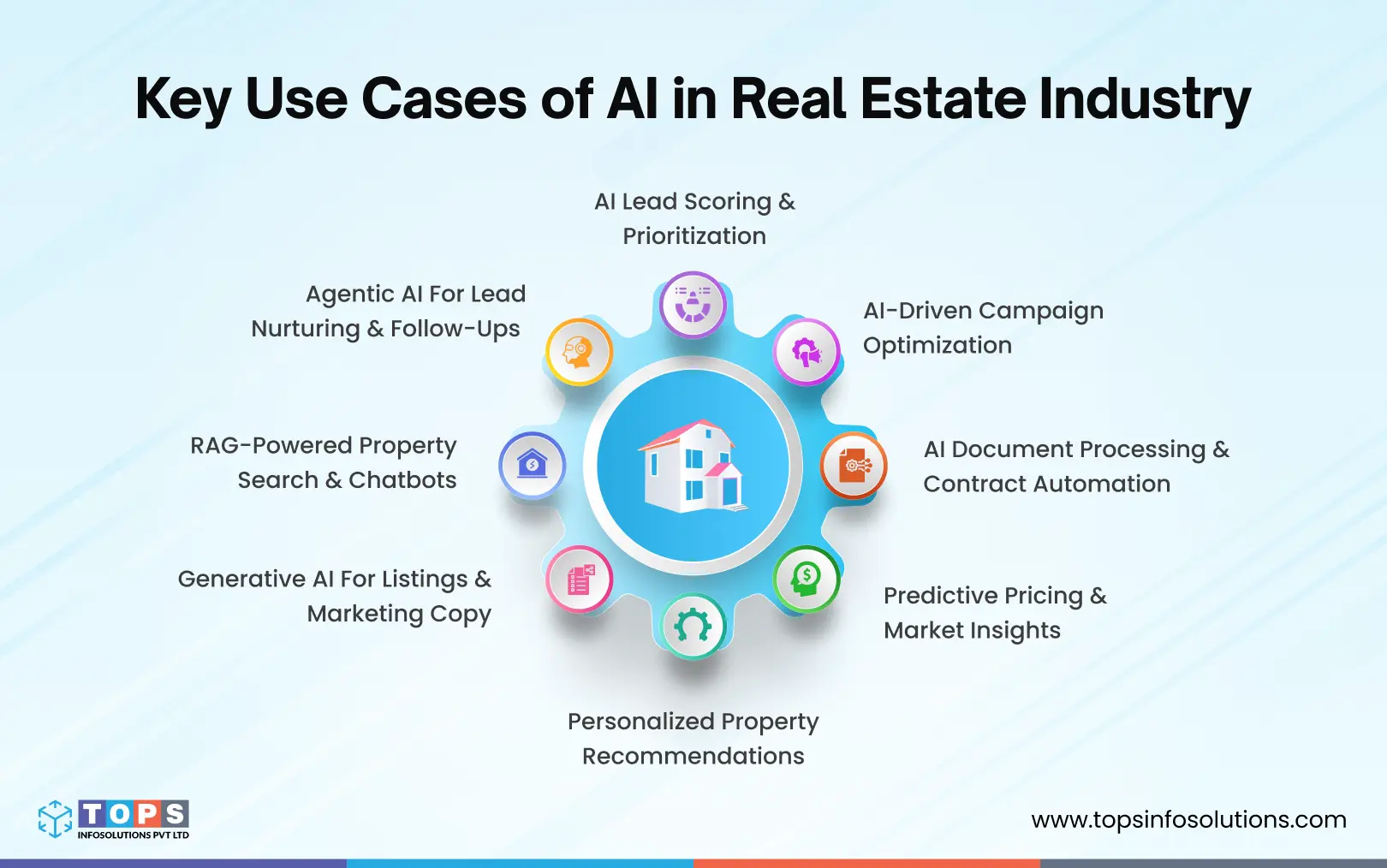
AI use cases in real estate span a wider range than most teams realize. It’s about building a connected layer across the tools your team already uses daily. The use cases below cover how artificial intelligence in real estate is being applied across different workflows.
1. AI Lead Scoring and Prioritization
Not every lead in your CRM deserves the same urgency. The problem is that without a proper filter, you tend to allot time to leads that aren’t important and chase the wrong ones.
AI-powered lead scoring changes that by analyzing behavioral signals: how many times someone visited a listing, what price range they filtered for, whether they opened emails, and how long they spent on the mortgage calculator. The model builds a score in real time and surfaces the leads most likely to convert.
Example workflow: A brokerage integrates AI scoring into its CRM. Instead of working through 200 contacts alphabetically, agents open their dashboard each morning to a prioritized list: 12 hot leads at the top, flagged with the reason why. This can reduce response times and help sales teams engage qualified leads more efficiently.
Tech layer : Applied AI / predictive models embedded into custom CRM workflows.
2. Agentic AI for Lead Nurturing and Follow-Up
As a real estate professional, you’d know. The problem most of the time isn’t generating leads. It’s nurturing them. Speed-to-lead is one of the most cited problems in real estate. According to research, the industry benchmark sits at a 5-minute response window, yet most agencies respond hours later. How Agentic AI works is that it closes that gap without adding headcount.
Unlike a simple drip sequence, an AI agent reasons about context. It knows a lead viewed a 3-bed listing twice, didn’t open the last email, and has a saved search in a specific zip code. It crafts a relevant follow-up, sends it at the right time, logs the activity in the CRM, and queues the next touchpoint, all without anyone pressing send.
The workflow behind this typically connects the CRM, email platform, and SMS tool through an orchestration layer like n8n or LangChain. They’re triggered by lead behavior, not a calendar schedule. The result is a follow-up that feels timely and relevant rather than automated and generic.
Example workflow: A property management firm deploys an AI agent that handles first-response to every inbound inquiry within 90 seconds, qualifies the lead through a conversational exchange, and hands off to a human agent only when the prospect is ready to schedule a call.
Tech layer : Agentic AI with multi-step autonomous workflows built with LangChain and n8n.
3. RAG-Powered Property Search and Chatbots
A standard search bar on an IDX website does keyword matching. A RAG-powered search understands intent.
Ask “show me something quiet, close to good schools, under $600K,” and instead of returning zero results, it maps that natural language query against live MLS data, neighborhood profiles, school ratings, and price history to surface the most relevant matches, and explains why.
The same RAG architecture powers compliance-aware chatbots that can answer “what are the HOA rules for this building?” or “is this property in a flood zone?” by pulling directly from uploaded documents rather than generating a plausible but inaccurate answer.
Example workflow: An IDX website with RAG-based search sees significantly longer average session times and higher lead form completions. Because buyers find what they’re looking for instead of bouncing after a frustrating keyword search.
Tech layer: RAG as a Service – vector databases, live MLS data integration, document grounding.
4. Generative AI for Listing Descriptions and Marketing Copy
Creating descriptions for large property inventories can become repetitive and time-consuming for real estate teams. One of the top AI use cases in real estate is using generative AI to handle the first draft, and even the final one if you train it right.
Feed it the property specs, a few key selling points, and the target buyer persona, and it produces a listing description, a social caption, an email subject line, and an ad headline in under a minute. Tone, length, and format are all adjustable.
More importantly, it stays consistent. Every listing gets the same quality of copy, whether it’s a $200K condo or a $4M waterfront property.
Example workflow: A real estate marketing team uses a custom GenAI tool integrated with their CMS. Agents fill out a structured form, the AI generates the copy, a marketing professional reviews and approves, and the listing goes live. What used to take 45 minutes per property now takes under 10.
Tech layer: Generative AI – custom LLM integration with GPT or Claude, fine-tuned on your brand voice and listing style.
5. Personalized Property Recommendations
If you take a look at major listing problems, personalized property search was already a leading AI use case in real estate.
Advances in AI APIs, machine learning frameworks, and cloud infrastructure have made these capabilities more accessible to real estate companies.
The engine tracks a buyer’s browsing behavior on the listing site: what they clicked, saved, skipped, and how long they stayed on each listing.
Over time, it builds a preference profile that goes beyond their stated filters. It starts to understand that this buyer always skips properties with small kitchens, even when everything else matches, and factors that in.
Example workflow: An agency adds a “Properties You’ll Love” module to their IDX site. Returning visitors see a personalized feed instead of a generic results page.
Tech layer: Applied AI — behavioral data pipelines, collaborative filtering models, IDX integration.

6. Predictive Pricing and Market Intelligence
Pricing a property well is part art, part data. AI models trained on historical transaction data, neighborhood trends, seasonal patterns, and macroeconomic signals can generate pricing recommendations that are more granular and more current than a standard CMA.
For buyers, the same models can flag when a listed property is overpriced relative to comparable sales, or when a neighborhood is trending upward before it’s obvious to the market.
Example workflow: A boutique brokerage embeds a pricing intelligence dashboard into their internal CRM. Before every listing presentation, the agent walks in with an AI-generated pricing band, comparables ranked by relevance, and a 90-day market outlook.
Tech layer: Predictive ML models, BI dashboards, integrated with MLS and public records data.
7. AI Document Processing and Contract Automation
Real estate paperwork is notoriously dense. Imagine getting greeted with hundreds of purchase agreements, disclosure forms, inspection reports, and HOA documents on a Monday morning. Most of it still gets processed manually, which is slow and error-prone.
Generative AI combined with OCR can read, extract, summarize, and flag issues across documents in seconds. An AI layer on your contract workflow can auto-populate standard fields, identify missing signatures, flag unusual clauses, and send reminders, all without a coordinator chasing paper trails.
Example workflow: A real estate attorney’s firm integrated an AI document processor into its deal pipeline. Lease review time dropped significantly because the AI pre-reads every document and surfaces only the clauses that need human attention, rather than requiring line-by-line reading on every contract.
Tech layer: Generative AI + OCR pipeline, integrated into document management and CRM workflows.
8. AI-Driven Campaign Optimization
Running ads for real estate is expensive and highly competitive. Generic campaigns with static copy drain budgets fast. One of the use cases of AI in real estate is that AI makes the campaigns more adaptive.
Connected to your CRM and marketing automation, AI can test ad variations automatically, shift budget toward the creatives and audiences that are performing. It can retarget website visitors with listings relevant to what they actually browsed instead of a generic “homes for sale” ad.
Example workflow: A developer running a pre-launch campaign for a new residential project uses AI-driven ad optimization across Meta and Google. The system A/B tests 12 creative variants in the first week, identifies the top 2, reallocates budget, and reduces cost-per-lead while volume stays constant.
Tech layer: Marketing automation + Generative AI for creative variation, behavioural retargeting.
What are the Top Benefits of AI in Real Estate?
When strategically implemented across well-defined business processes, artificial intelligence can help real estate companies improve operational efficiency, deliver more personalized customer experiences, and make better use of their data. From automating repetitive tasks to supporting sales and business decisions, AI can create value across multiple areas of the real estate lifecycle.
Improved Lead Management
AI can help real estate sales teams identify, qualify, and prioritize leads based on factors such as customer preferences, property requirements, engagement history, and previous interactions. AI-powered lead scoring and automated follow-ups can help sales teams respond more consistently while allowing agents to focus their time on high-priority prospects.
Faster and More Efficient Operations
Real estate businesses manage many repetitive activities, including document processing, data entry, customer inquiries, appointment scheduling, and CRM updates. AI-powered automation can handle or assist with these tasks, reducing manual effort and allowing employees to spend more time on activities that require human judgement and expertise.
Personalized Customer Experiences
AI can analyse customer preferences, search behaviour, budget, location requirements, and previous interactions to deliver more relevant property recommendations. AI-powered assistants can also provide personalized responses and guide customers through the property discovery process, creating a more convenient and engaging experience.
Data-Driven Decision-Making
Real estate companies generate and manage large volumes of property, customer, market, and operational data. AI and machine learning can analyze these datasets to identify patterns, generate insights, support demand forecasting, and assist with pricing and investment analysis. This enables businesses to make decisions using data alongside professional judgment.
Better Scalability
As a real estate business grows, the number of properties, customers, leads, documents, and service requests can increase significantly. AI-powered workflows can automate repetitive processes and support higher volumes of activity without requiring every task to be handled manually. This can help businesses scale operations while maintaining consistent processes and customer service.
Why Choose TOPS for AI Real Estate Development?
Building an AI-powered real estate solution requires more than integrating a language model or adding a chatbot to an existing platform. A successful solution needs to work with your property data, business workflows, existing software, security requirements, and customer experience.
At TOPS Infosolutions, we help real estate businesses identify practical AI opportunities and develop custom solutions around their specific operational and business requirements. Our AI development capabilities cover Generative AI, RAG, Agentic AI, predictive analytics, intelligent automation, and AI-powered applications.
Our AI Real Estate Development Capabilities
AI-Powered Property Search
Build intelligent property search solutions that understand natural-language queries. Deliver relevant results based on preferences, location, budget, and property data.
RAG-Powered Real Estate Assistants
Connect AI assistants with property listings, documents, FAQs, and business data. Provide accurate responses using your approved information sources.
Agentic AI Workflows
Develop AI agents that can perform multi-step tasks such as qualifying leads, recommending properties, scheduling appointments, updating CRM records, and initiating follow-up workflows based on predefined business rules.
Generative AI Solutions
Our Generative AI development services help real estate businesses simplify content creation, property descriptions, customer communication, document summaries, and virtual assistant workflows.
Predictive Analytics
Apply machine learning and predictive analytics to support use cases such as property pricing analysis, demand forecasting, lead prioritization, and real estate portfolio analysis.
Intelligent Process Automation
Automate repetitive workflows across lead management, document processing, customer support, property management, and CRM operations to reduce manual effort and improve process consistency.
The Bigger Picture
Modern AI development tools can reduce the time required to prototype and validate AI-powered features. At TOPS Infosolutions, we use AI-assisted tools and vibe coding development to accelerate the build cycle for real estate platforms. This means a RAG-powered chatbot that might have taken six weeks to prototype two years ago can now be in your staging environment in a fraction of that time.
As a real estate software development company with hands-on experience in AI in real estate software development, TOPS Infosolutions has built these systems for real estate clients at various scales. The starting point is always a conversation about where your current workflow breaks down.

Frequently Asked Questions (FAQs)
The highest-impact applications are AI lead scoring, agentic follow-up workflows, RAG-powered property search, generative AI for listing content, and AI-driven campaign optimization. These integrate directly into existing tools without requiring a complete technology overhaul.
Basic automation follows fixed rules: send this email after 3 days, assign this lead to that agent. AI workflows reason about context. An agentic system knows a lead viewed a listing twice, didn’t open the last email, and adjusts the follow-up content and timing accordingly. The difference is between a static sequence and a system that adapts based on behavior.
RAG stands for Retrieval-Augmented Generation. Instead of relying solely on what an AI model was trained on, RAG connects the model to your actual data, like MLS feeds, property documents, and compliance information, before generating a response. For real estate, this means chatbots and search tools that answer accurately instead of confidently making things up.
This is one of the most important shifts of the last two years. Capabilities that previously required enterprise-scale data teams, such as recommendation engines, predictive pricing, and agentic workflows, are now buildable for mid-size brokerages through custom development. The barrier isn’t technology access anymore. It’s having the right development partner who understands both the AI stack and the real estate workflow.
It depends on the scope, but timelines have compressed significantly with AI-assisted development. A focused integration, such as adding AI lead scoring to an existing CRM or deploying a RAG-powered chatbot on an IDX site, can move from scoping to staging in a matter of weeks. Full-stack builds that connect CRM, IDX, and marketing automation take longer but follow a modular approach, so individual components can go live incrementally.
It depends less on the AI model than on the integration work. A focused project – lead scoring on existing CRM data, or a RAG chatbot on your IDX site = is usually a scoped build measured in weeks. The main cost drivers are access to your MLS feed and CRM APIs, the number of systems involved, and ongoing usage volume.
Use built-in features when they cover the workflow and your data lives in that one system. Custom builds make sense when the workflow spans several tools – CRM, IDX, marketing, transaction management – or when the capability is a competitive differentiator you want to own.
Agentic AI can perform multiple connected tasks toward a defined objective. For example, an AI agent could qualify a lead, recommend properties, schedule a viewing, and update a CRM according to predefined workflows and permissions.
Common AI applications include lead scoring, lead nurturing, property search, personalized recommendations, predictive pricing, document processing, listing generation, property management, predictive maintenance, and investment analysis.