




Quick Summary
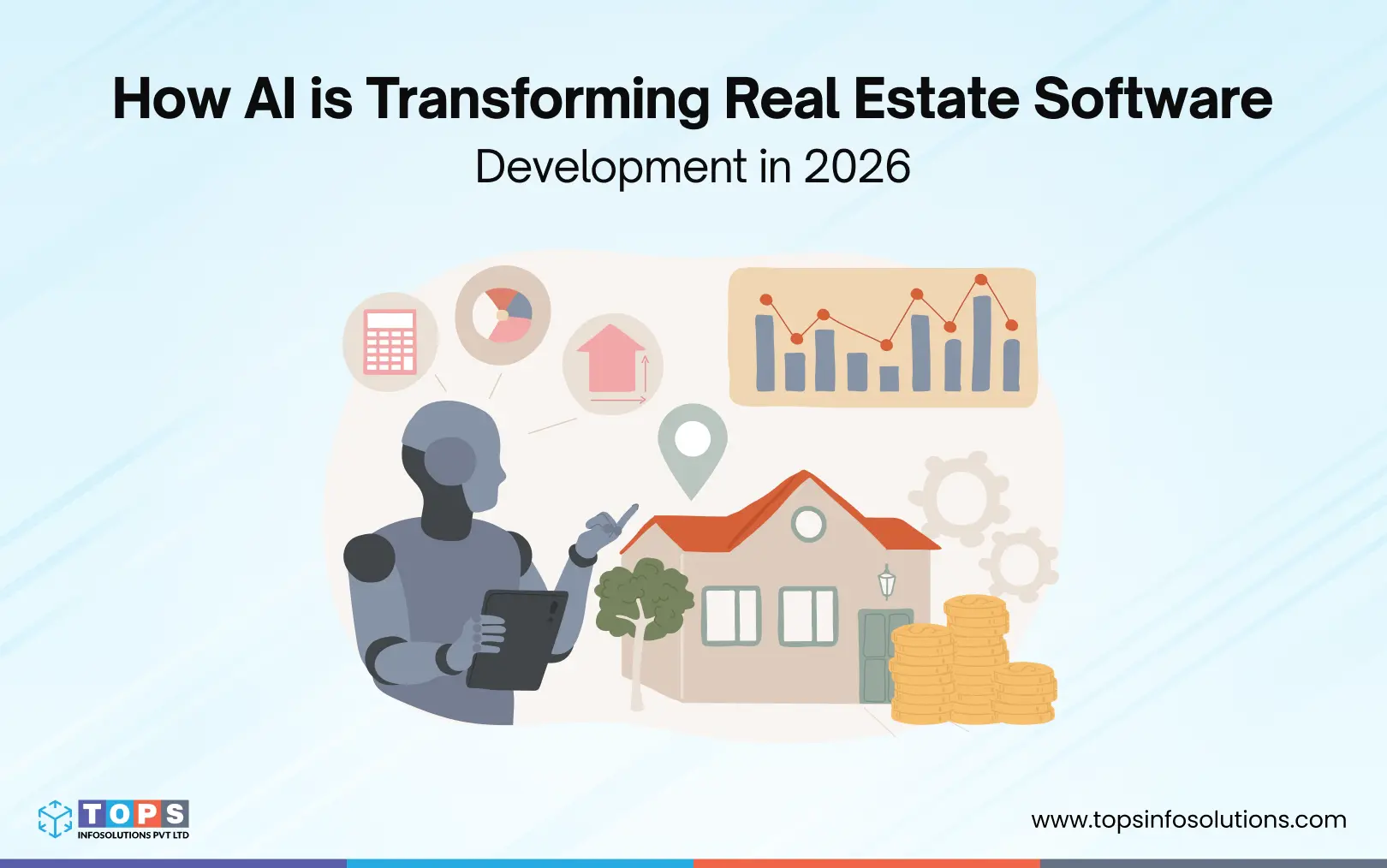
Real estate software development in 2026 is all about building intelligent systems that improve lead conversion, streamline workflows, and support data-driven decisions with AI.
Here’s what the blog covers in a nutshell:
- Real estate firms face lead gaps, missed opportunities, and AI adoption pressure
- AI adds value through lead scoring, automation, recommendations, and analytics
- Key features include unified dashboards, MLS/IDX integration, and reporting
- Three approaches: off-the-shelf, AI augmentation, or custom development
- Costs typically range from $10K to $90K+ based on scope
- Choosing the right partner requires domain expertise and strong AI capability
Real estate firms today are dealing with a mix of problems.
Not enough leads. Missed opportunities from the leads they already have. And most importantly? The increasing pressure to adopt AI.
According to Morgan Stanley, AI alone could unlock $34 billion in efficiency gains for the real estate industry over the next five years.
Yet, for most real estate leaders, the question isn’t whether AI matters. It’s where it actually fits.
This uncertainty is where many firms get stuck.
In this blog, we cover everything you need to know about real estate software development in 2026, from AI features and real examples to cost and what to look for in a real estate software development partner.
What Is Real Estate Software Development, And Why AI Matters?
Real estate software development is the process of building digital platforms tailored to how property businesses actually operate. Unlike generic tools, purpose-built real estate software solutions are designed around your specific workflows that can manage listings, track leads, automate lease renewals, or coordinate transactions across multiple teams.
But here’s where it gets interesting. Software alone is no longer enough.
AI is what separates a functional system from a truly intelligent one. Modern AI-powered real estate platforms do a lot more than store and display data. They learn from it, act on it, and surface insights that help your teams make faster, smarter decisions.
Here’s what AI brings to real estate software that traditional tools simply can’t:
- Smarter lead qualification: AI scores and prioritizes leads based on behavior, not just form fills
- Automated workflows: Follow-ups, reminders, and status updates that run without manual input
- Predictive insights: Pricing trends, demand forecasting, and investment signals based on real data
- Personalized experiences: Property recommendations tailored to each buyer’s preferences and activity
- Faster document processing: Contracts, leases, and compliance documents handled in a fraction of the time
Real Use Cases of AI in Real Estate Software
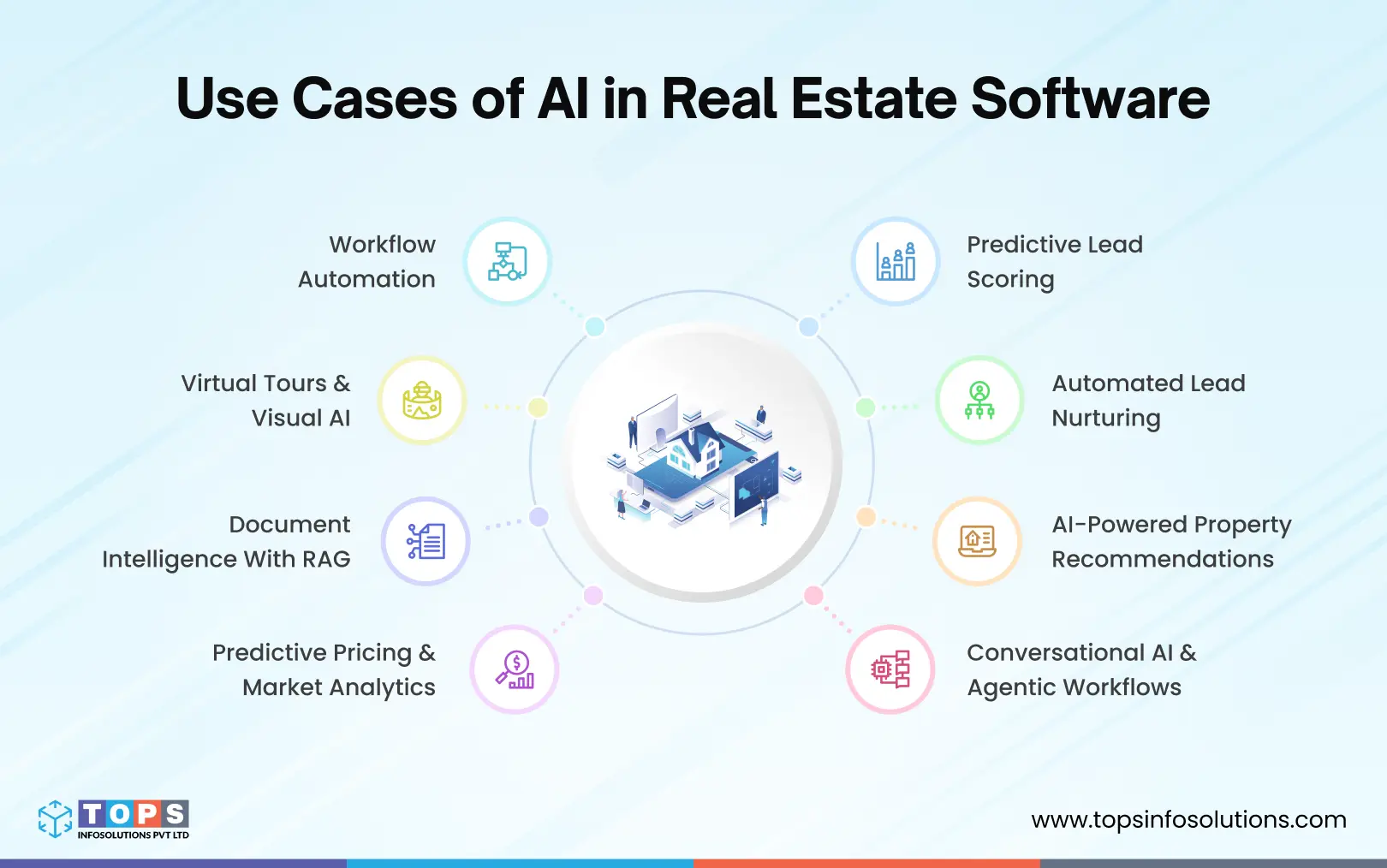
AI in real estate software has moved well past the chatbot phase. Today, it is embedded into the core of how modern real estate platforms operate, from the moment a lead fills out a form to the day a deal closes. Here is what use cases of AI in real estate actually look like in practice.
1. Predictive Lead Scoring
Not all leads you generate are qualified. But without AI, your team treats them like they are. AI can analyze behavioral signals, engagement history, budget indicators, and demographic data to rank leads by conversion likelihood. Your team stops chasing cold contacts and starts focusing on the ones most likely to close.
2. Automated Lead Nurturing
Speed to follow-up is one of the biggest drivers of conversion in real estate. AI-powered workflows trigger personalized follow-ups via email, SMS, or WhatsApp based on where a prospect is in the journey. No manual intervention. No leads slipping through the cracks.
Think about a mid-sized brokerage managing 500 inbound leads a month. Manually, agents can realistically follow up with maybe a third of them in time.
With AI-driven nurturing, every lead gets an immediate, personalized response the moment they inquire, a follow-up if they go quiet for 48 hours, and a targeted message when they re-engage with a listing. The team’s effort stays focused on warm conversations, not chasing silence.
3. AI-Powered Property Recommendations
Generic search is a thing of the past. AI analyzes a buyer’s browsing behavior, saved listings, and engagement patterns to surface properties that genuinely match their preferences. This improves inquiry quality and reduces the time agents spend on mismatched leads.
4. Conversational AI and Agentic Workflows
This is where things get significantly more powerful. Rather than just answering FAQs, agentic AI systems can qualify buyers, schedule property tours, send follow-up communications, and escalate to a human agent only when needed. These systems run continuously, around the clock, without supervision.
Picture a property management company handling inquiries across 20 residential projects simultaneously. Instead of a front desk team fielding hundreds of calls and emails daily, a conversational AI agent initially qualifies, checks availability, books site visits, and updates the CRM in real time.
Human agents step in only at the negotiation stage. The result is faster response times, lower overhead, and a significantly better experience for the buyer.
5. Predictive Pricing and Market Analytics
Pricing a property based on gut feel or last quarter’s comps is a liability. AI models factor in historical sales data, neighborhood trends, demand signals, and macroeconomic indicators to recommend pricing with far greater accuracy. This helps sellers price competitively and helps investors identify opportunities before the market catches up.
6. Document Intelligence with RAG
Real estate runs on paperwork. Lease agreements, sale contracts, compliance documents, and inspection reports all contain critical information that typically requires manual review. Using Retrieval-Augmented Generation (RAG), AI can extract, summarize, and flag key clauses across large document volumes in seconds. What used to take hours now takes minutes, with far fewer errors.
7. Virtual Tours and Visual AI
AI-enhanced virtual tours do more than let buyers walk through a property remotely. Computer vision can analyze property condition, flag maintenance issues, and even generate staging suggestions based on the space. This helps agents qualify interest earlier and reduces the number of in-person visits needed before a decision is made.
8. Workflow Automation
From task assignments to compliance checks to status updates across teams, AI eliminates the administrative drag that slows real estate operations down. Teams spend less time on coordination and more time on what actually moves deals forward.

TOPS in Action: AI-Powered Real Estate Platform Example
A real estate business approached us with a problem that many in the industry will recognize. Their agents were juggling multiple disconnected tools with no unified way to track leads from inquiry to close. The team was busy but not productive.
The core problems we identified:
- Leads coming in from 200+ sources with no intelligent prioritization
- Inconsistent follow-ups leading to lost opportunities
- Separate tools for CRM, website, and marketing with no integration
- Fully manual ad management and content creation
We built an integrated AI growth platform from the ground up that brought everything under one roof.
What we delivered:
- AI-powered CRM with smart lead scoring, automated drip campaigns, and two-way SMS communication
- Website builder for real estate agents with MLS integration for seamless lead capture across devices
- AI marketing engine that automatically generates social media content, runs Google and Facebook ad campaigns, and produces SEO-optimized blog content
- Unified pipeline where the website captures leads, the CRM nurtures them, and AI handles marketing, continuously, without manual intervention
The outcome? A fully unified platform where no lead goes unattended and marketing runs without manual effort.
Key Features of Real Estate Software Development to Look For in 2026
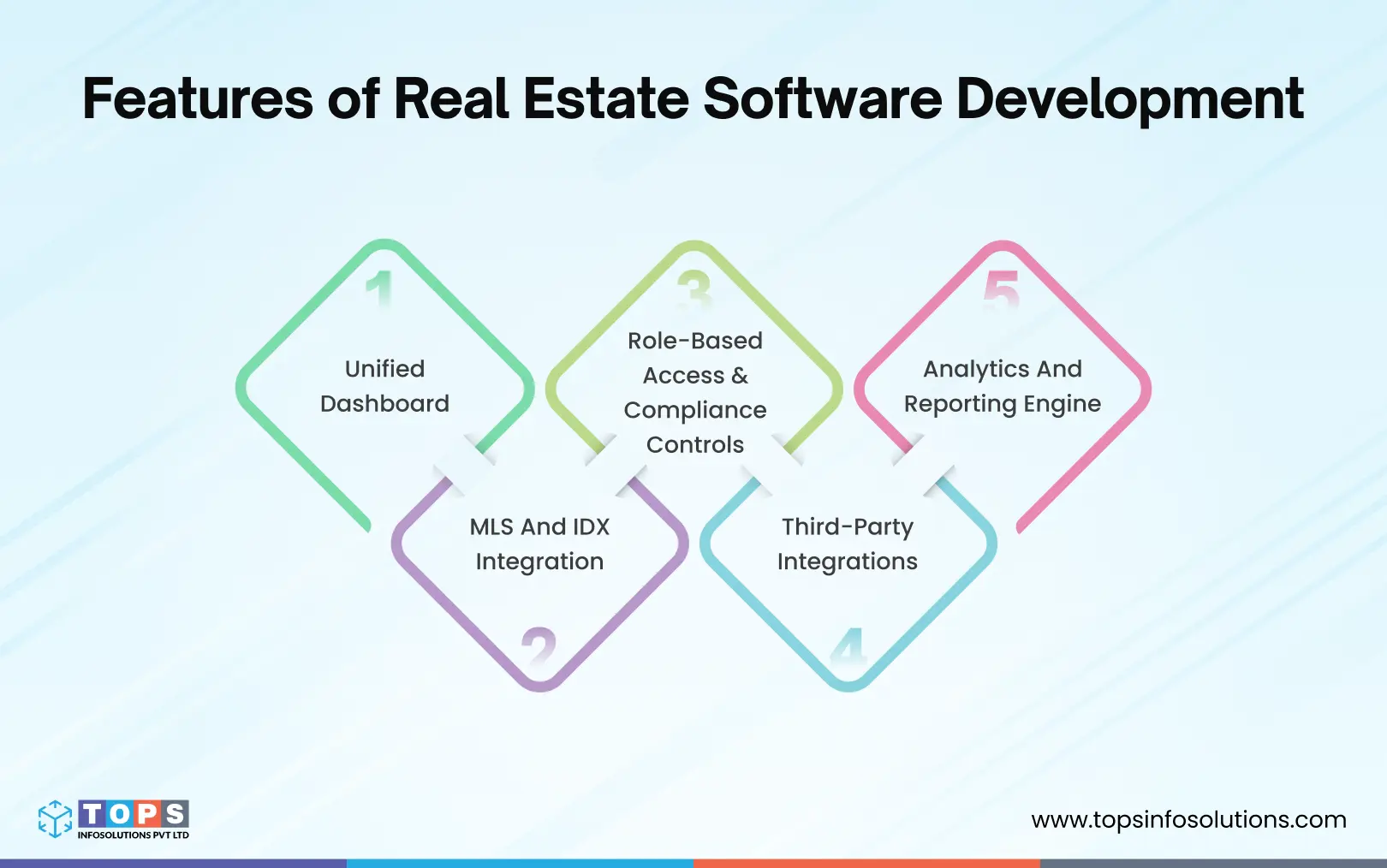
Building or upgrading a real estate platform is a significant investment. Knowing what to prioritize makes the difference between software that drives results and software that just adds another tool to manage. Here are the core features of real estate software development that modern platforms should have.
1. Unified Dashboard
A fragmented view of your business is one of the biggest operational liabilities in real estate. A well-built platform brings leads, listings, transactions, team activity, and performance reports into a single interface. Decision makers get a real-time picture of what is happening across the business without toggling between five different tools.
2. MLS and IDX Integration
Seamless MLS and IDX integration ensures listing data stays current, accurate, and connected to your lead and transaction workflows. If data flows consistently, agents can always work with up-to-date information, and buyers get accurate listings without manual updates from your team.
3. Role-Based Access and Compliance Controls
Not everyone in your organization needs access to everything. Role-based permissions ensure that agents, managers, admins, and executives each see and interact with only what is relevant to their function. This also supports data security, audit trails, and regulatory compliance across different markets.
4. Third-Party Integrations
Real estate businesses run on an ecosystem of tools. E-signature platforms, payment gateways, accounting software, communication tools, and ERP systems all need to integrate. A modern real estate platform should integrate cleanly with your existing stack so data flows without manual bridging or duplication.
5. Analytics and Reporting Engine
Gut feel is not a growth strategy. Built-in analytics give you visibility into lead sources, conversion rates, agent performance, deal timelines, and revenue trends. When your reporting is connected to live data, you can spot problems early and double down on what is working.
How to Build Real Estate Software – Choosing the Right Approach
Modernizing your real estate tech in 2026 adds an additional dimension: “How well does your chosen approach support AI?” Here are your three main paths and what each one means for your business.
Off-the-Shelf Software: Fast to deploy. Limited by design.
Tools like Salesforce, HubSpot, or AppFolio work well in the early stages. Some now offer basic AI features like automated emails or simple lead scoring. But these are surface-level.
The core problem? The AI in off-the-shelf tools is built for everyone, which means it is optimized for no one. It is not trained on your data or built around your workflows. As you scale, you end up adapting your business to the software rather than the other way around.
Augmenting Your Existing System: The smart middle ground.
If you already have a platform that handles core operations but lacks intelligence, augmentation is often the fastest path forward.
This means layering AI capabilities like lead scoring, workflow automation, predictive pricing, and document intelligence on top of your existing stack via integrations and APIs. No full rebuild needed. Think of it as adding a brain to a system that already has the bones.
Custom Real Estate Software Development: The highest ROI path if AI is a strategic priority.
Custom real estate software development means building entirely around your workflows, your data, and your growth plans. No compromises. No ceiling.
More importantly, custom platforms are built AI-ready from the ground up. Your AI is trained on your data, tuned to your workflows, and built to improve over time. Features like agentic workflows, RAG-powered document intelligence, and predictive analytics perform significantly better when the architecture is designed for them from day one.
What Approach is Right for You?
| Situation | Recommended Approach |
|---|---|
| Early stage, validating workflows | Off-the-shelf to start |
| Existing platform, but needs more intelligence | Augment with AI integrations |
| Scaling with complex workflows | Custom development with an AI layer |
| Building a PropTech product | Custom with AI at the core |
Real Estate Software Development Cost in 2026
One of the first questions any CTO or CEO asks before greenlighting a software project is: What is this going to cost? The honest answer is that it depends.
The cost of AI in real estate development can range anywhere from $10, 000 to $90, 000. Here is a practical breakdown of what drives cost and what you can roughly expect.
What Influences the Cost
Before any number makes sense, these are the variables that move it up or down. If you’re evaluating advanced capabilities, understanding the AI software development cost structure behind features like automation, recommendations, and analytics can give you better clarity on overall investment.
- Scope and complexity: The more workflows, user roles, and features involved, the higher the investment
- AI features: Predictive analytics, AI tools, vibe coding, agentic workflows, and RAG-based document intelligence add development depth
- Integrations: MLS, IDX, payment gateways, e-signature, ERP connections all add to the build
- Platform: Web only, mobile only, or both affects the timeline and cost significantly
Team location: Offshore development with the right partner can deliver the same quality at 40-60% lower cost than onshore teams
Approximate Cost Ranges by Software Type
| Software Type | Approximate Range |
|---|---|
| Basic CRM or Property Management System | $10,000 — $30,000 |
| Mid-complexity platform with AI features | $30,000 — $90,000 |
| Enterprise platform with a full AI layer | $90,000 and above |
| PropTech product for market launch | Custom scoping required |
These are directional ranges. The actual number for your project depends on your specific requirements, integrations, and the engagement model you choose.
How to Choose the Right Real Estate Software Development Company
The technology decision is only half the equation. Who you build it with matters just as much. Here is what actually separates a reliable partner from one that will cost you more in the long run.
Domain Experience in Real Estate
Generic software development experience is not enough. Check if your real estate software partner understands how real estate businesses actually operate, like lead pipelines, MLS integrations, and transaction workflows. Does the software partner have experience with compliance requirements and the nuances of building for agents, managers, and executives simultaneously? Ask to see real estate-specific work, not just a broad portfolio.
Real AI Capability
There is a big difference between a company that talks about AI and one that actually builds it. Look for partners with hands-on experience in applied AI, generative AI, agentic systems, and RAG. The right partner should be able to explain exactly how AI will be embedded into your specific workflows.
End-to-End Delivery
Real estate software projects rarely end at launch. You need a partner who can handle consultation, development, integration, migration, and ongoing support under one roof. Fragmenting these across multiple vendors creates gaps, delays, and accountability issues.
Transparent Process
Surprises in software development are expensive. Look for partners with clearly defined milestones, regular communication, and honest timelines. A good partner will tell you what is not feasible as readily as they tell you what is.
Flexible Engagement
Your needs will evolve. A custom software development company that only offers one rigid engagement model is already limiting your options.
Conclusion
The real estate industry is at an inflection point. The firms pulling ahead are not necessarily the biggest or the best funded. They are the ones who have made a deliberate decision to build smarter systems and put AI to work across their operations.
The path forward starts with clarity on what you need in terms of taking an existing platform to the next level or modernizing a legacy CRM solution.
Real estate software development in 2026 is not just about digitizing your workflows. It is about building an intelligent foundation that helps your business grow, adapt, and compete on a different level entirely.

Frequently Asked Questions (FAQs)
Timelines vary based on scope and complexity. A focused solution like a CRM or property management system typically takes 3 to 5 months. A larger enterprise platform with full AI integration, multiple user roles, and third-party connections can take 6 to 12 months. Proper scoping upfront is the biggest factor in keeping timelines realistic.
Yes, in most cases. If your existing platform has a reasonably modern architecture, AI capabilities like lead scoring, workflow automation, predictive analytics, and document intelligence can be layered in through integrations and APIs without a full rebuild. This is often the fastest way to modernize.
A real estate CRM is focused on managing leads, clients, and the sales pipeline, from first inquiry to closed deal. A property management system handles the operational side, such as tenant onboarding, lease management, maintenance coordination, and rent tracking. Many modern platforms combine elements of both or integrate the two.
A standalone mobile app for real estate typically ranges from $20,000 to $60,000, depending on platform coverage (iOS, Android, or both), feature complexity, and backend integrations. Apps with AI features like smart search, personalized recommendations, or agentic workflows will sit toward the higher end of that range.
Based on where the industry is heading, the highest-impact AI features are predictive lead scoring, automated nurturing workflows, agentic AI for lead qualification and tour scheduling, RAG-powered document intelligence, and predictive pricing models. The right starting point depends on where your biggest operational bottleneck currently sits.
Prioritize domain experience in real estate, genuine AI capability beyond surface-level features, end-to-end delivery from consultation to post-launch support, transparent processes, and flexible engagement models. Ask for real estate-specific case studies and have an honest conversation about timelines before signing anything.