









































It’s here. The time you finally decided to switch to the AI route for your real estate CRM.
But you’re plagued with questions. Where to start? What tools to adopt? How to define the timeline?
Research suggests that only 5% of real estate companies report hitting their AI goals. The gap between adoption and results is real.
You want to succeed, but the margin is low. The difference between firms that make it work and those that don’t almost always comes down to one thing: having a plan.
This guide is for real estate firms, brokerages, and property managers who are ready to move past experimentation.
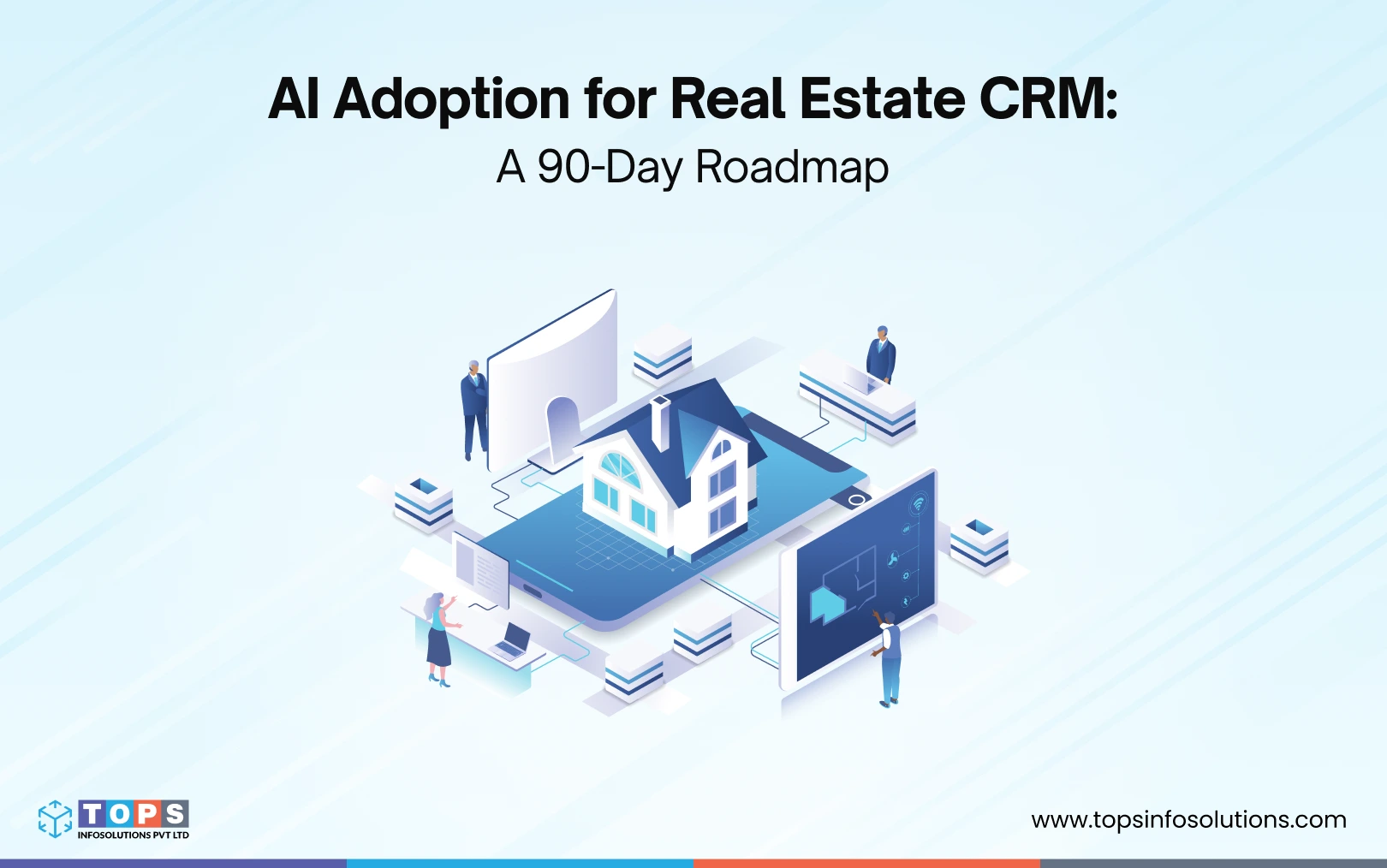
You can be running a legacy CRM or a mid-size brokerage that’s outgrown its current setup. This 90-day real estate AI adoption roadmap gives you a clear, phased path to transforming real estate operations with AI, without building everything from scratch.
Quick Summary
Most real estate firms adopt AI tools without a plan. They end up paying the price in failed implementations and low team adoption. This guide breaks down a practical 90-day AI adoption roadmap for real estate firms ready to upgrade their CRM without rebuilding everything from scratch.
Here’s what it covers:
- How to run an honest readiness assessment across data quality, workflows, team capability, and tech stack compatibility
- A three-phase roadmap: building the foundation, integrating AI layer by layer, and scaling into agentic automation
- What to look for in a real estate software development partner, so the implementation actually sticks
Why Your Legacy CRM Is Quietly Costing You Deals
Your CRM was built to store information. Today’s market demands a system that acts on it.
While legacy CRMs hold the data such as contact details, log past interactions, and send follow-up reminders, what they don’t do is think.
And in a market where response speed and personalization decide who closes, that’s a serious gap. Here’s where the cost adds up:
Slow lead response. A lead submitted through your IDX website at 9 PM sits untouched until morning. By then, a competitor with an AI-powered real estate CRM has already responded, qualified, and scheduled a showing.
Follow-ups that fall through. Agents juggling showings, negotiations, and paperwork can’t manually track every lead in the pipeline. Without automation, follow-ups get missed, and most deals require at least six to eight touchpoints before a client commits.
Data silos and disconnected tools. Your CRM doesn’t talk to your IDX. Your email platform doesn’t sync with your pipeline. Your marketing runs separately from your lead management. The result is a fragmented view of every client relationship and a team spending hours on admin instead of deals.
No predictive intelligence. Legacy systems tell you what happened. AI-powered CRMs tell you what’s likely to happen next, like which leads are warming up, which are going cold, and where to focus your team’s energy today.
The good news: you don’t need to tear everything down. The shift to AI-powered operations is about layering intelligence on top of what you already have, the foundation of truly intelligent AI in real estate operations.
Things to Consider Before Real Estate AI Adoption
Before you spend a dollar on any AI tool or platform, you need an honest look at where you stand today. Skipping this step is the single most common reason an AI adoption roadmap for real estate derails before it delivers
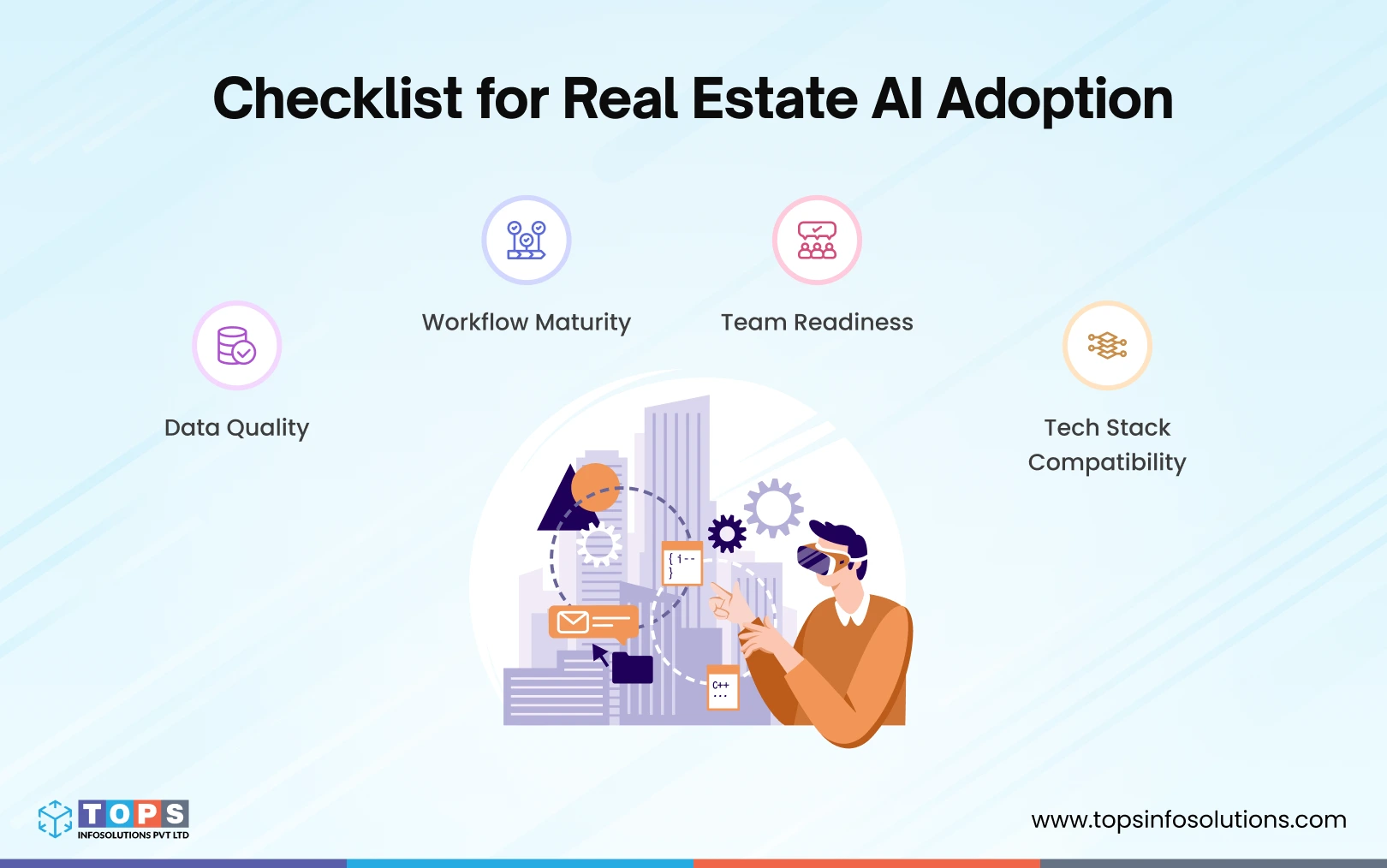
Think of the readiness check as your foundation audit. Four pillars to evaluate:
Data quality
Research says that real estate firms with structured and clean data, such as organized lease files and rent rolls, achieve 3 to 5 times faster AI adoption than firms with fragmented data.
Your data is going to be the base for your AI. If your CRM is full of duplicate contacts, incomplete records, outdated leads, and inconsistent field formats, your AI tools will produce unreliable outputs from day one. Before anything else, your data needs to be clean, standardized, and structured.
Workflow maturity
Are your current processes documented, or do they live in your agents’ heads? AI can automate a workflow, but it can’t automate a broken process. You need to know how leads currently move through your pipeline before you can redesign that pipeline around AI.
Team readiness
Resistance from experienced agents is one of the top reasons AI implementations stall. If your team sees AI as a threat rather than a tool, even the best platform will sit unused. Early buy-in and clear communication about what’s changing matter as much as the technology itself.
Tech stack compatibility
What tools are you currently running? Do your CRM, IDX website, MLS feed, or marketing tools expose REST APIs or webhooks that allow integration? This API audit is a non-negotiable step. It determines whether you can layer AI capabilities on top of your existing stack or whether selective replacements are necessary. Tools that lack accessible APIs become integration bottlenecks regardless of how good your AI layer is.
Real Estate AI Adoption: The 90-Day Roadmap
This is where strategy meets execution. The roadmap is built around three phases, each one building on the last.
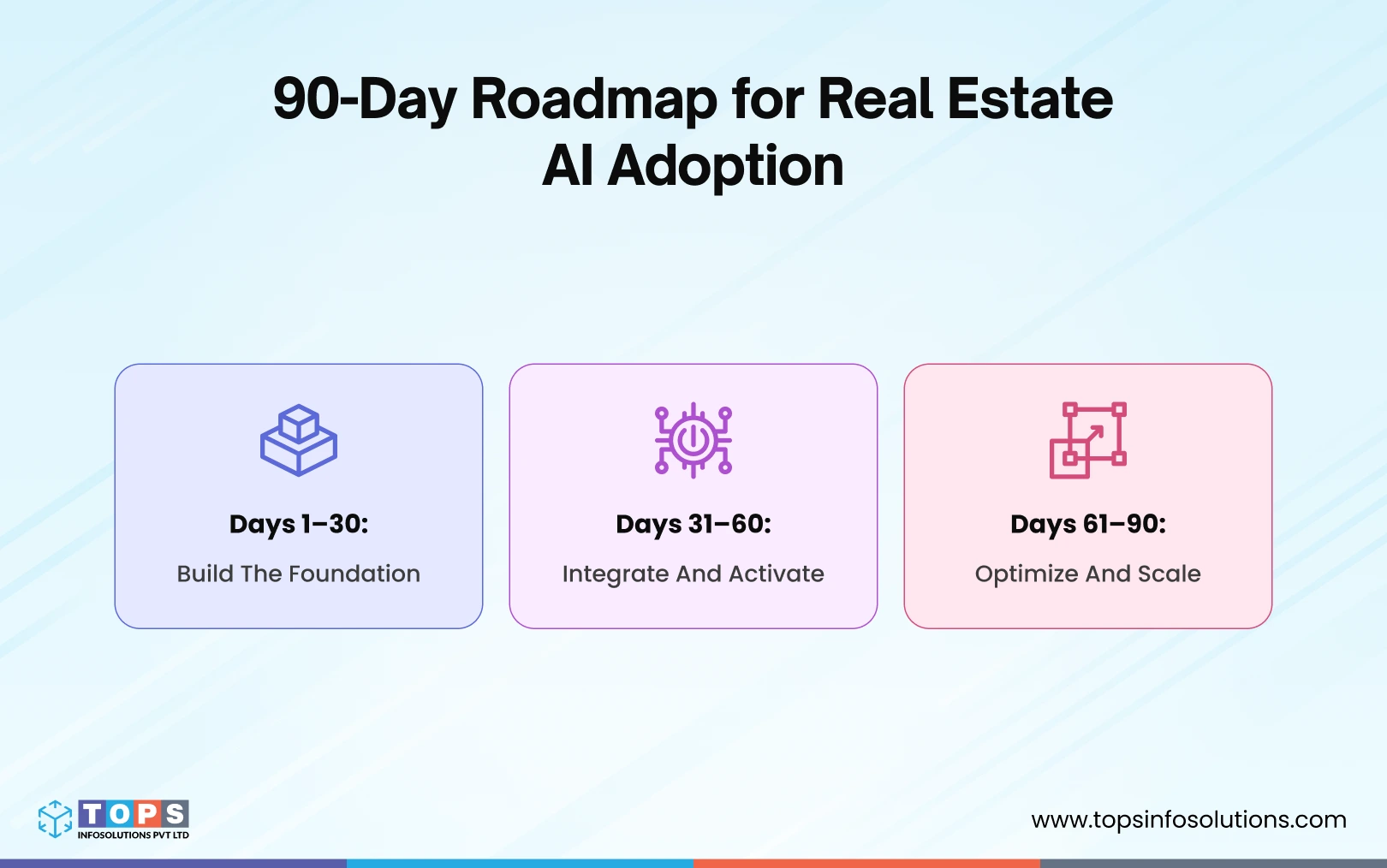
Days 1–30: Build the Foundation
The first 30 days are not about AI. They are about getting your house in order, so vibe coders have something solid to work with.
Clean your CRM data
Go through your database methodically, merge duplicate contacts, standardize field formats, remove dead leads, and verify contact information. This isn’t glamorous work, but it’s the most high-leverage thing you can do before any migration begins.
Map your workflows
Document how leads currently enter your system, how they are assigned, how follow-ups are triggered, and how deals move through your pipeline. Write it out. Every step. This becomes your blueprint for what gets automated in Phase 2.
Define your AI objectives
What specific problems are you solving? Faster lead response? Automated follow-up sequences? Smarter lead prioritization? Document automation with RAG? Each objective points to a different set of AI capabilities, and prevents you from buying tools you don’t need.
Decide on your integration approach
Based on your tech stack audit, determine whether you’re adding AI capabilities to your existing CRM via API integrations, switching to an AI-native platform, or building a custom solution.
Days 31–60: Integrate and Activate
With clean data and documented workflows, you’re ready to start layering in AI. The key principle here: run old and new systems in parallel. Keep your legacy CRM as a read-only reference while the new system becomes your active system of record.
Connect your core tools first. Prioritize integrations that give your AI the most signal, such as your IDX website, MLS feed, marketing automation tools, etc. The more data your CRM can see in real time, the more accurately it can score, route, and respond.
Activate your first AI capabilities. Start with the highest-impact, lowest-complexity wins:
- AI lead scoring – so agents know exactly who to call first
- Automated follow-up sequences – triggered by lead behavior, not manual reminders
- 24/7 chatbot on your IDX or website – so no inquiry goes unanswered regardless of time zone or hour
Train your team on workflows, not the platform. The biggest mistake during this phase is overwhelming agents with full platform training. Instead, train each role on the specific workflows they use daily. Show them the time they’re saving within the first week. Early wins drive adoption more than any onboarding session.
Days 61–90: Optimize and Scale
By Day 61, your system is live, your team is using it, and you have real data coming in. Now you shift from setup to refinement. You’re going from generative AI assistance to agentic AI execution.
Activate advanced capabilities. With baseline data established, you can now turn on more sophisticated features:
- Predictive lead scoring – identifying which prospects are most likely to transact in the next 90 days based on behavioral signals
- AI-drafted communications – personalized emails and follow-ups generated and sent automatically based on where each lead sits in the pipeline
- Document automation – lease drafts, contract pre-fills, and compliance checklists handled without manual input
Review, retrain, and refine. AI models improve with feedback. Review your lead scoring accuracy, follow-up response rates, and pipeline conversion data. This iterative loop is what separates firms that plateau at Phase 2 from those that build a compounding operational advantage over time.
By Day 90, you’re not just using AI tools. You’re running an AI-powered real estate operation, one where your CRM is actively working on leads, your agents are focused on high-value conversations, and your pipeline has full visibility from first inquiry to close.
What to Look for in an AI Development Partner?
The 90-day roadmap above assumes one critical variable: the right AI partner executing it with you. Not every AI solution for the real estate business is built with your specific workflows, data structures, or integration requirements in mind.
Off-the-shelf platforms work for standard real estate AI use cases. But the moment your needs involve custom integration, complex pipeline logic, MLS data syncing, or multi-market operations, a generic tool hits its ceiling fast.
This is where choosing the right real estate software development company becomes one of the most consequential decisions in your AI journey. Here’s what to evaluate:
1. Real estate domain expertise
There’s a meaningful difference between an AI vendor who has worked across industries and one who understands real estate from the ground up. The latter will build faster, integrate cleaner, and anticipate problems the former won’t even know to look for.
2. CRM migration and data integrity experience
Moving data from a legacy system is where most migrations go wrong. Your partner should have a documented process for data extraction, field mapping, deduplication, and validation, ensuring nothing critical is lost or corrupted in transit.
3. Integration depth
A purpose-built real estate software solution should connect natively with the tools your team already uses. Ask specifically about API capabilities and how integrations are maintained when third-party tools update.
4. Post-launch support and model retraining
AI doesn’t stop needing attention after go-live. Lead scoring models drift as market conditions change. Automation sequences need refinement as you gather real performance data. Your partner should offer ongoing support, not just a handoff document.
5. Phased delivery and transparent roadmap
A credible partner will plan in phases, set clear milestones, and adjust based on results. Anyone promising a full AI transformation in two weeks without a readiness assessment is selling you a shortcut that doesn’t exist.
Conclusion
90 days is enough time to go from a legacy CRM to a system that scores leads, automates follow-ups, drafts communications, and surfaces insights your team can act on, if you follow the right sequence.
The firms pulling ahead in 2026 aren’t necessarily the ones with the biggest budgets or the most AI subscriptions. They’re the ones that started with clean data, documented their workflows, trained their teams on specific use cases, and built AI-powered real estate operations around outcomes rather than features.
If you’re ready to map out your next 90 days, our team at TOPS Infosolutions has helped real estate businesses build intelligent CRM systems and advance features.
Frequently Asked Questions (FAQs)
A real estate AI adoption roadmap is a structured, phased plan that guides your firm from legacy systems to AI-powered operations in a defined timeline. Without one, most firms fall into the “pilot trap.” It means buying tools without a strategy and seeing adoption rates collapse within six months. A roadmap sequences the right actions in the right order: data cleanup first, integration second, optimization third. It’s the difference between AI that sits unused and AI that actively drives revenue.
For most mid-sized brokerages, a structured migration takes 90 days from readiness assessment to a fully operational AI-powered real estate CRM. The first 30 days cover data cleanup and workflow mapping, the next 30 integration and activation, and the final 30 optimization. Firms that skip the readiness phase often find migrations dragging well past six months with poor adoption at the end. A phased approach with the right technical partner significantly compresses that timeline.
Yes. Through REST API integrations and middleware tools, AI capabilities like lead scoring and automated follow-up sequences can be layered onto your existing CRM without a full platform switch. This approach preserves your current data structure, reduces migration risk, and gets your team seeing results faster. A full platform migration only becomes necessary when your existing CRM lacks API accessibility or your workflows have outgrown what it can support.
The highest-impact AI use cases in real estate operations include automated lead scoring, 24/7 chatbot-driven inquiry handling, predictive follow-up sequencing, and document automation — lease drafts, contract pre-fills, and compliance checklists. On the frontier, agentic AI is handling multi-step workflows like lead qualification, showing scheduling, and pipeline updates autonomously.
The right real estate software development company should have experience in both AI development and real estate domain specifics, such as MLS data structures, IDX integration, transaction workflows, and compliance. Evaluate their approach to data migration, post-launch model retraining, and team adoption. A credible partner conducts a readiness assessment before recommending any tools and delivers in phases with clear milestones. Avoid vendors who lead with platform recommendations before understanding your workflows.
Generative AI responds to prompts. It drafts a follow-up email, summarizes a call, or generates a property description when asked. Agentic AI goes further: it plans across multiple steps, executes sequences autonomously, and self-corrects without manual triggers. In practice, an AI agent can detect buying intent, initiate follow-up, book a showing, and update the pipeline entirely on its own. For real estate firms scaling operations, agentic AI is what turns a CRM from an automation tool into an active business participant.