

Quick Summary
Vibe coding helps teams launch applications quickly using AI-generated code, but long-term success depends on maintainability, security, scalability, and operational control. As AI-built apps grow, businesses must address technical debt, inconsistent architecture, security risks, and production reliability to keep software stable and scalable.
Key Takeaways:
-
- Vibe coding accelerates software development and MVP launches
- AI-generated apps require structured maintenance and architecture planning
- Security gaps and technical debt increase as applications scale
- Human oversight is essential for debugging and long-term stability
- Documentation and code ownership reduce dependency on AI-generated logic
- Scalable infrastructure and testing are critical for production-ready AI-built apps
You’ve done it. You’ve built your software with vibe coding.
But now you want to add a feature. Or worse, something breaks in production.
What now?
Vibe coding gets you to a working product fast. But it doesn’t end there.
If your solution needs long-term vibe coding app maintenance, the LLM cannot be the only entity that remembers your architecture.
So how do you scale, secure, and maintain an AI-built app? Here’s what that actually looks like.
What Happens after Vibe Coding?
The first few weeks of a vibe-coded project feel almost unfair. You’re shipping features faster than any traditional dev cycle would allow. The AI handles the boilerplate, the logic, and the integrations. You’re focused on the product, not the plumbing.
But around month three or four, things start to quietly shift. The codebase has grown beyond your original prompts. A new developer joins and spends weeks just figuring out what’s happening. You try to add a feature, and the AI suggests a pattern it has already used differently elsewhere in the same project.
This is what happens when software grows without deliberate structure. And the vibe coding honeymoon phase ends when the speed that made vibe coding attractive starts working against you.
Core Maintenance Challenges of AI-Built Apps
Once your vibe-coded app is in production, the post-development challenges in vibe coding tend to surface, not all at once, but reliably over time.
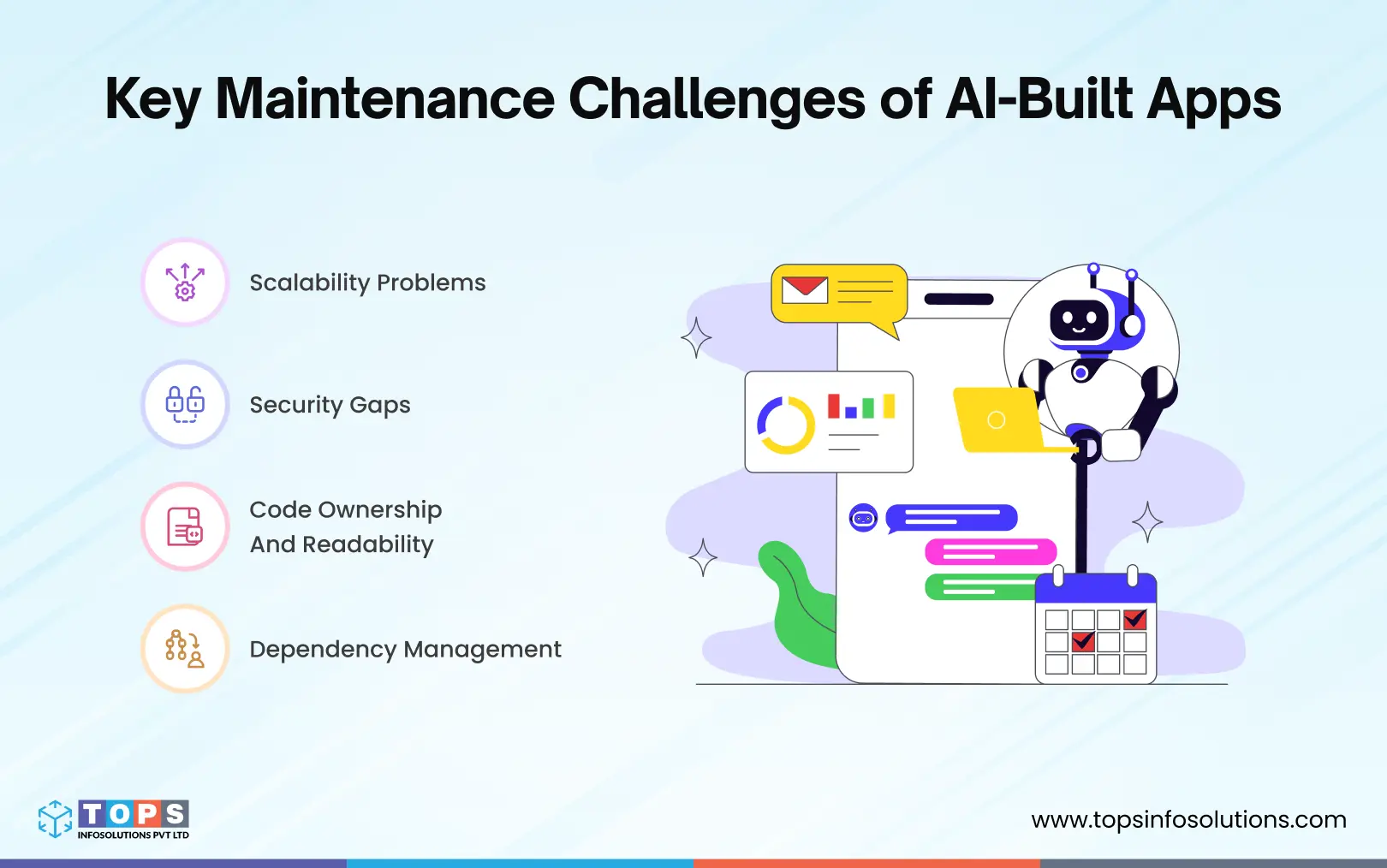
1. Scalability Problems
AI-generated code optimizes for the immediate requirement, not future load, and scaling applications built with AI requires more deliberate planning than most teams anticipate. What handles 200 users smoothly can buckle at 20,000.
Common signs include:
- Inefficient database queries that worsen as data grows
- Missing caching layers that create unnecessary server load
- Monolithic structures that resist horizontal scaling
For e-commerce platforms, this shows up during peak seasons. For healthcare apps, it surfaces when onboarding spikes. The code isn’t wrong. It just wasn’t built with growth in mind.
2. Security Gaps
Vibe coding tools don’t inherently apply security best practices unless you explicitly ask for them. And even then, gaps slip through.
Common vulnerabilities in AI-built apps include:
- Exposed API keys in generated code
- Missing input validation
- Overpermissive roles and access controls
- Outdated dependencies with known exploits
For industries like healthcare and finance, data privacy in AI applications is more than a technical glitch. It’s a compliance problem. It’s a full-blown compliance problem. HIPAA and PCI-DSS violations don’t care how the code was written. AI cannot audit itself. Human review is non-negotiable.
3. Code Ownership and Readability
Who understands this codebase when something breaks at 2 AM?
AI-generated code can be syntactically clean but logically opaque, especially when built across multiple prompting sessions with no consistent architectural thread. The numbers back this up. Research suggests that 63% of developers have spent more time debugging AI-generated code than writing equivalent code manually would have taken.
The real risk isn’t messy code. It’s a team that can’t reason about what the code is doing or why.
Maintainability with AI coding is rarely about the code quality. It’s about understanding your architecture. If you know how the AI tool built the way it did, you can always fix things. If you blindly trust AI and let it go wild, it will come back in terms of a broken architecture and starting from scratch.
4. Dependency Management
AI tools generate code based on what they know. This may include outdated libraries or deprecated methods. Without active tracking, this creates a slow-building problem.
- Routine updates trigger unexpected breaking changes
- Security patches get missed because no one owns the dependency list
- Third-party integrations drift out of compatibility
No AI tool automatically monitors your production environment. That responsibility sits with your team.
What a Sustainable Vibe Coding Workflow Looks Like
Following AI app deployment best practices from day one is what separates teams that scale from teams that rebuild. The developers who ship stable, maintainable vibe-coded apps aren’t doing anything mystical. They’re following a set of deliberate practices that keep both the AI and the codebase under control. Here’s what that looks like in practice.
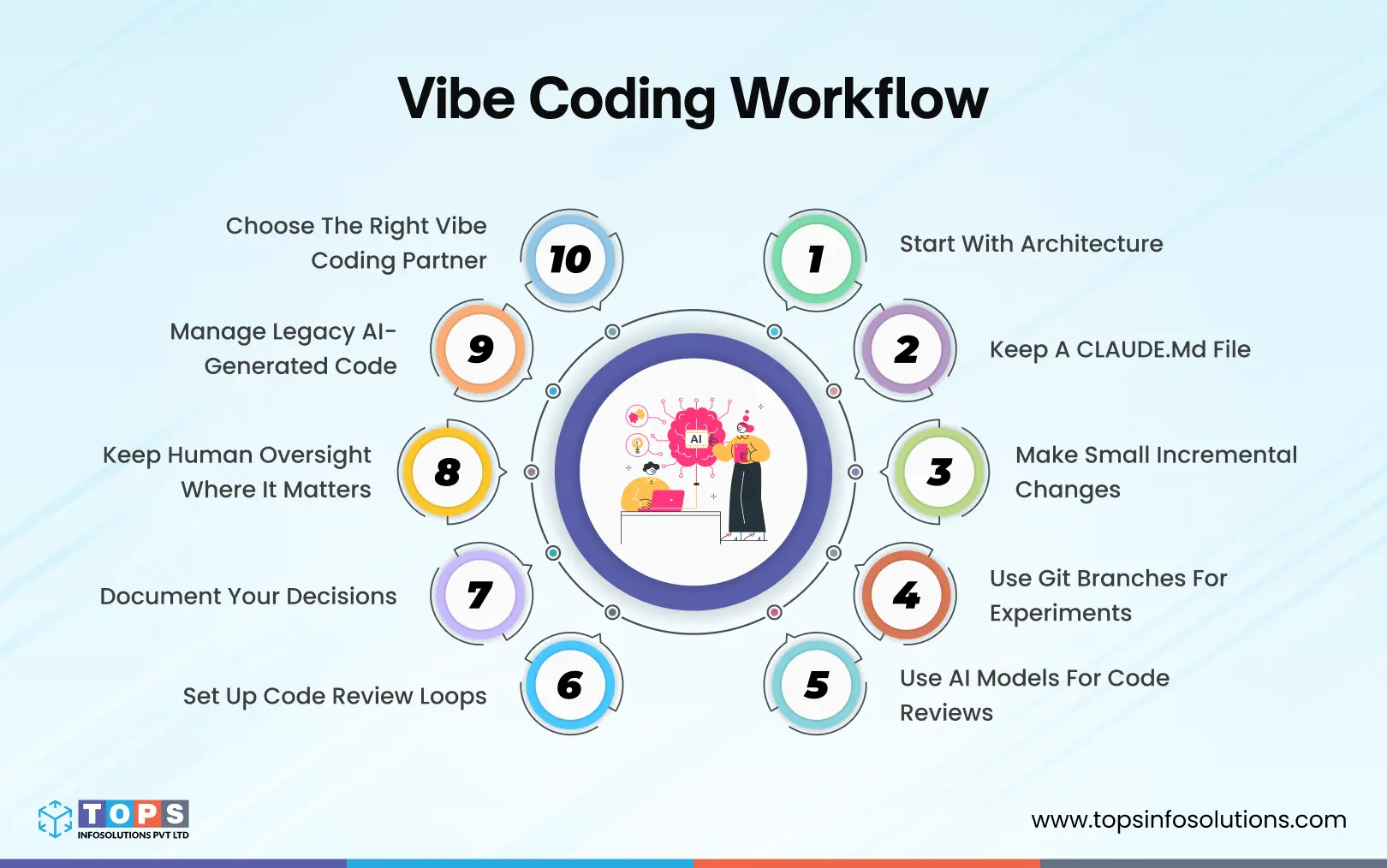
Start With Architecture
Before you write a single prompt, define your system’s structure. Data models, service boundaries, API contracts, and authentication flow; these decisions should exist on paper before the AI touches them.
Think of it this way: if you’re building a multi-tenant SaaS platform, the AI should not be deciding how tenant data is isolated. That’s an architectural decision with security and scalability implications. You define it. The AI implements it.
This is also where traditional development experience becomes a genuine advantage. Engineers who understand system design like separation of concerns, RESTful principles, and secure data handling, use vibe coding accelerator and not a crutch.
Keep a CLAUDE.md File
If you’re using Claude code, you can create a file in your project root that documents your architecture decisions, coding conventions, and context. Every time you start a new session on Claude, the AI picks up where it left off instead of reinventing patterns.
Without this, every new session is a blank slate. The AI might solve the same problem three different ways across three different files, and you won’t notice until something breaks.
Make Small Incremental Changes
Vibe coding makes big refactors tempting. Resist it. Large sweeping changes are hard to debug when something goes wrong, and something always goes wrong.
For example, if you’re migrating a payment flow in a fintech app, break it into stages: update the data model first, test it, then update the service layer, test it, then update the UI. Each step is reviewable and reversible. One giant AI-assisted rewrite is neither.
Use Git Branches for Experiments
Let the AI try ambitious ideas on a separate branch. Test it thoroughly, then decide whether to merge or discard. This keeps your main branch stable while still allowing experimentation.
A real estate platform adding an AI-powered property recommendation engine, for instance, should never prototype that directly on main. Branch it, stress test it, then integrate it deliberately.
Let Models Review Each Other’s Code
Different models have different strengths and blind spots. Running code written by one model through another for review catches issues that a single model pass often misses. Treat it like a second opinion before merging anything significant.
Set Up Code Review Loops
AI-written code should go through the same review process as human-written code, in fact, arguably more rigorous. Establish linting rules, automated testing pipelines, and periodic security scans from day one. “The AI wrote it” is not a reason to skip review. It’s a reason to be more thorough.
Document Your Decisions
Use lightweight Architecture Decision Records to capture why something was built a certain way, not just what was built. This becomes your safety net when AI-assisted changes ripple through the system unexpectedly. Also, document what didn’t work. Failed approaches are as valuable as successful ones.
Know Where Human Oversight Is Non-Negotiable
Define which parts of your system are too critical for AI autonomy. Payments, authentication, data privacy, compliance logic; keep human engineers closely involved in these layers regardless of how AI-assisted the rest of your workflow is.
Deal With Code Built on Older Models
If your app was built on an older model like GPT-4 or Claude Sonnet 3.7, you’re not starting from zero, but you do need a plan. Older models had weaker reasoning about architecture and were more prone to inconsistent patterns across a growing codebase. Here’s how to approach it:
- Audit before you add. Before building any new feature, map out what already exists. Understand the patterns the old model used, even if they’re not the ones you’d choose today.
- Refactor incrementally. Don’t attempt a full rewrite. Pick the most problematic areas like auth, data models, or core business logic, and clean them up in small, tested steps.
- Re-prompt with better context. When using a newer model to maintain older code, give it the full picture. Share the existing structure, known issues, and what you want to preserve. Don’t let it guess.
- Prioritize security first. Older model output is more likely to have security gaps. Run a vulnerability scan before anything else and address those findings before adding new functionality.
The good news: newer models maintaining older code is a solvable problem. The risk is assuming the old code is fine without ever verifying it.
Opt for the Right Vibe Coding Partner
There’s vibe coding, and then there’s vibe coding done with long-term maintainability in mind. For developers who truly understand the logic behind what the AI is generating, maintenance isn’t a challenge but rather a part of the workflow.
But that kind of comprehensiveness doesn’t come from prompting alone. It comes from years of working on complex, enterprise-grade projects where architecture decisions have real consequences. The right vibe coding partner brings that experience to the table so your app doesn’t just ship fast, it holds up.
The Hard Truth About Maintainability
Here’s what most vibe coding content won’t tell you: the quality of your AI-built app is a direct reflection of how well you understand it.
It Is About Your Understanding, Not the Code Quality
The AI can generate clean, functional code. But if you don’t understand what it was built for and why, you don’t actually own the codebase. You’re renting it.
Every time something breaks, you’ll be starting from scratch, re-explaining context to the AI, hoping it gives you the same answer it did six months ago, and patching problems without understanding their root cause.
The developers running stable Vibe-coded apps in production share one thing in common: they understand their architecture deeply. They use the AI to execute, not to think for them.
Optimize for Understanding, Not Speed
Vibe coding is fast. That’s the point. But optimizing purely for speed in the early stages creates compounding costs later.
Slowing down to document decisions, review AI output thoroughly, and understand every significant change before merging it. That overhead pays for itself by month four or five. The teams that skip it are the ones rebuilding from scratch at month six.
Maintenance Is an Ongoing Practice
Maintenance is not a phase that comes after building. It’s a core part of the AI software lifecycle. It’s built into the process.
A few non-negotiables to build into your regular workflow:
Monthly dependency audits. Track what libraries your app relies on, check for deprecations, and apply security patches before they become vulnerabilities.
Quarterly security reviews. Especially critical for healthcare, finance, and any app handling sensitive user data. Schedule it before it becomes an incident.
Regular load testing. Run this before peak seasons, major feature releases, or any significant infrastructure change. Don’t wait for traffic to expose your bottlenecks.
Incident retrospectives. When something breaks, trace it back to its origin. Was it an AI-suggested pattern that introduced the issue? Document it and update your conventions accordingly.
The cost of skipping these practices is rarely immediate. It’s a slow accumulation until one unpatched vulnerability or one scaling failure costs more than an entire development cycle.
Choosing TOPS as your Go-To VIbe Coding Partner
Vibe coding has changed how software gets built, and the businesses winning with it are the ones treating post-launch as seriously as pre-launch.
Speed without structure is a liability. Someone needs to own the architecture, understand the decisions, and be accountable when things break.
That’s where we come in. At TOPS, we bring years of enterprise AI software development experience across healthcare, finance, real estate, and e-commerce to every AI-powered project we take on. We don’t just prompt and ship. We build systems that last.
Vibe coding gets you there faster. The right expertise keeps you there.
Frequently Asked Questions (FAQs)
Vibe coding app maintenance starts with owning your architecture. Keep a documentation file like CLAUDE.md, set up automated testing and code review loops, run monthly dependency audits, and make incremental changes rather than large refactors. The AI helps you build and update, but a human needs to understand every significant decision.
The most common challenges when scaling applications built with AI include inefficient database queries, missing caching layers, and monolithic structures that weren’t designed for high traffic. Since AI generates code for the immediate requirement, scaling requires deliberate architectural planning — ideally before the first line of code is prompted.
It can be, but not by default. Securing AI-built applications requires active effort — AI tools don’t automatically apply security best practices. Common gaps include exposed API keys, missing input validation, and overpermissive access controls. For regulated industries like healthcare and finance, human security review and periodic penetration testing are non-negotiable.
This is one of the more overlooked post-development challenges in vibe coding. Apps built on older models like GPT-4 or Sonnet 3.7 tend to have inconsistent patterns and weaker architectural reasoning. The recommended approach is to audit before adding new features, refactor incrementally, starting with high-risk areas like auth and data models, and prioritize a security scan before anything else.
Not necessarily for minor updates — but for anything involving data privacy, payments, authentication, or significant feature changes, experienced developer oversight is critical. The AI software development lifecycle doesn’t end at deployment. Someone with architectural understanding needs to own the codebase, review AI output, and be accountable when things break.