

Quick Summary
Model Context Protocol (MCP) is the open standard that lets AI agents connect to enterprise systems like CRMs, databases, and ticketing tools without a custom API built for each one.
This post breaks down what MCP means for mid-market businesses, why adoption is accelerating in 2026, and what a realistic implementation path looks like for companies ready to move from AI pilots to real results.
Key Takeaways:
-
- MCP is an open standard that gives AI agents a single, universal way to connect to enterprise data and tools
- Without MCP, every AI-to-system integration requires a custom API build, multiplying development cost and maintenance overhead
- According to Gartner (August 2025), 40% of enterprise applications will include task-specific AI agents by the end of 2026, up from less than 5% in 2025
- MCP and RAG work as complementary layers: MCP connects agents to live systems; RAG grounds them in institutional knowledge
- Mid-market companies face specific MCP risks, including authentication gaps, tool poisoning, and legacy system compatibility
- Internal MCP builds require ongoing maintenance, consuming 20-30% of initial development costs annually
- Starting with one high-value workflow is more reliable than attempting a full-stack MCP rollout from day one
Your company has an AI copilot. It drafts emails, answers policy questions, and summarises meeting notes. In the demo, it looked great.
But the moment someone asks it to pull last quarter’s pipeline data or update a support ticket, it hits a wall.
The problem isn’t the model. It’s context. The AI has no secure, standard way to reach the systems where your business actually runs.
That’s exactly what Model Context Protocol solves. In 2026, MCP is no longer a developer experiment. It’s the infrastructure decision that separates companies getting real AI results from those still running glorified chatbots.
What MCP Is and Why It’s Not Just Another API
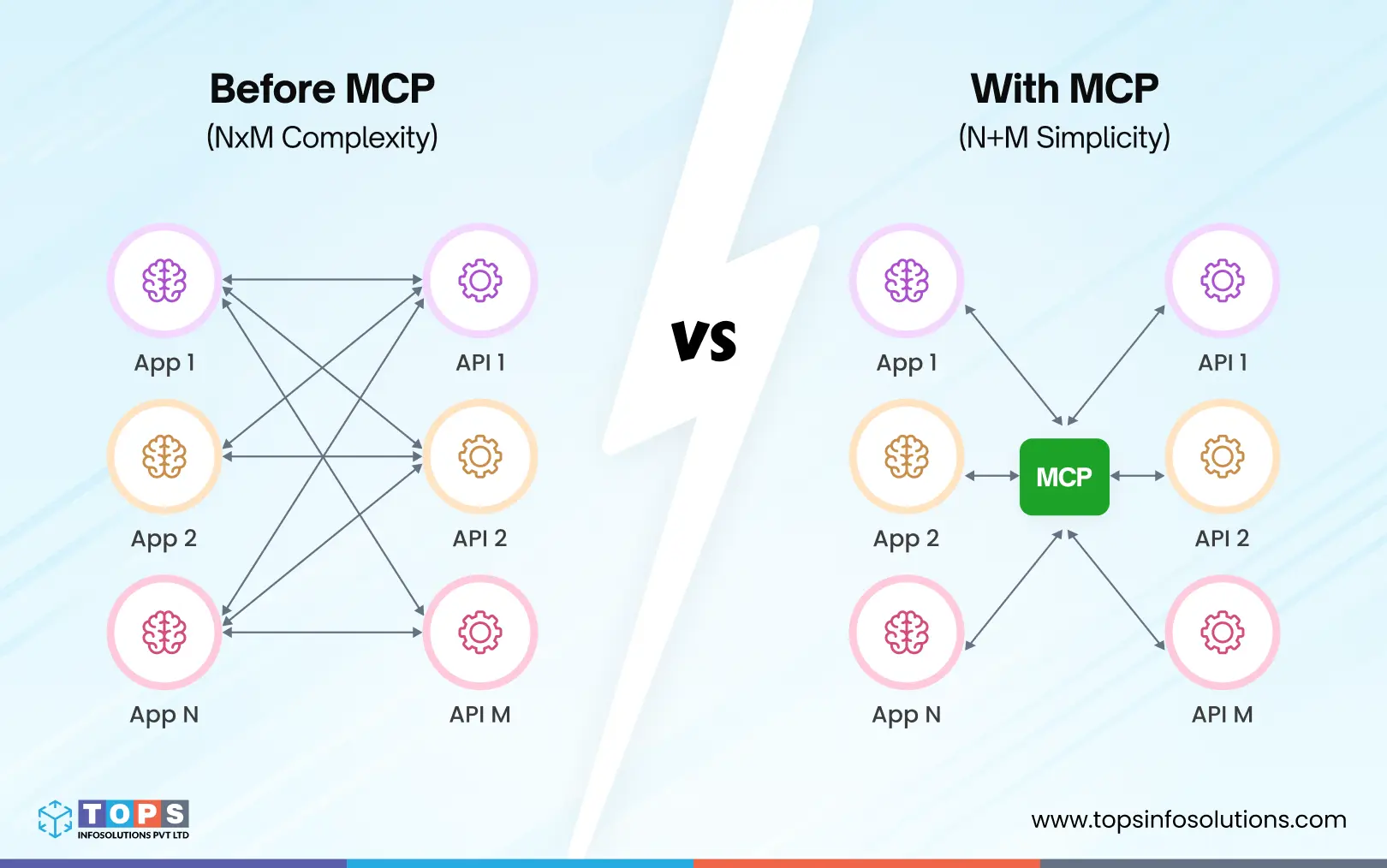
Most AI tools fail to scale in enterprise environments for one reason: every integration has to be built from scratch. You connect your LLM to Salesforce. Then Jira. Then your internal database. Each one needs custom code, custom maintenance, and custom error handling.
This is what engineers call the N x M problem. N AI models multiplied by M enterprise tools equals an exponentially growing web of point-to-point integrations.
The Integration Tax That’s Been Slowing AI Down
Every custom AI integration carries a maintenance burden that compounds over time. Multiply one integration by ten enterprise tools and three AI systems, and you’re looking at months of engineering time just to keep things running.
For mid-market companies without large AI engineering teams, this overhead is often why AI pilots never reach production.
The real cost isn’t the initial build. It’s the ongoing maintenance: protocol updates, authentication changes, schema drift, and security patches. Companies report that ongoing maintenance consumes 20-30% of initial development costs each year.
What MCP Actually Does
MCP is an open protocol introduced by Anthropic in November 2024 that standardises how AI models connect to external tools and data sources. Instead of building a unique integration for every tool, you build once to the MCP standard. Any MCP-compatible AI model can then connect to any MCP-enabled system.
The architecture has three parts. The MCP host is the application the user interacts with. The MCP client manages protocol communication. The MCP server sits next to your enterprise tool and exposes its data in a standardised format.
When an AI agent needs to query a system, it calls the relevant MCP server through the client. No custom code required.
- The N+M advantage: Traditional integrations require N tools x M AI models = hundreds of custom builds. MCP reduces this to N tool servers + M AI clients = one shared protocol. The more tools and models you add, the larger the efficiency gap grows.
Why This Is Different From Just Calling an API
A traditional REST API call is stateless. You request data, you get data, the connection closes. The AI has no memory of the prior call when it makes the next one.
For multi-step workflows, where an agent needs to query a CRM, check a ticketing system, and update a record, stateless calls force the agent to start from scratch each time.
MCP is designed for stateful, multi-step interactions. The agent maintains context across a session and can complete a ten-step workflow across three different systems without losing track. That’s what makes MCP relevant for real enterprise work, not just simple data lookups.
Why 2026 Is the Year This Becomes a Business Decision
MCP was released in November 2024. Eighteen months later, it’s one of the fastest-adopted developer standards in AI infrastructure history. That’s not accidental. It reflects genuine demand from enterprises blocked by the integration problem for years.
1. The Adoption Numbers Are Real
By Q1 2026, monthly SDK downloads reached 97 million, a 970x increase from launch. 78% of enterprise AI teams report at least one MCP-backed agent in production. These are production deployments across financial services, healthcare, and professional services, not pilot metrics.
According to Gartner, 40% of enterprise applications will include task-specific AI agents by the end of 2026, up from less than 5% in 2025. If you’re not building MCP-compatible infrastructure now, you’ll be retrofitting it into applications never designed for it.
2. Enterprise Vendors Have Standardised on MCP
OpenAI, Microsoft Copilot, Google Gemini, Salesforce, and Atlassian have all committed to MCP support. This isn’t a bet on an unproven standard. It’s alignment with the direction the enterprise software market has already chosen.
Your Salesforce instance will support MCP. Your Jira environment will support MCP. Microsoft 365 is moving toward it. The question is whether your internal AI infrastructure is ready to take advantage.
3. The Governance Window Is Closing
The EU AI Act’s compliance deadline for high-risk AI systems falls in August 2026. For companies in regulated industries or serving European markets, AI systems that take actions need audit trails, explainability, and access controls.
Building governance from the start is far cheaper than retrofitting it. Companies skipping governance now aren’t saving time. They’re creating debt that gets collected at the worst possible moment.
Where MCP Delivers Real Business Value
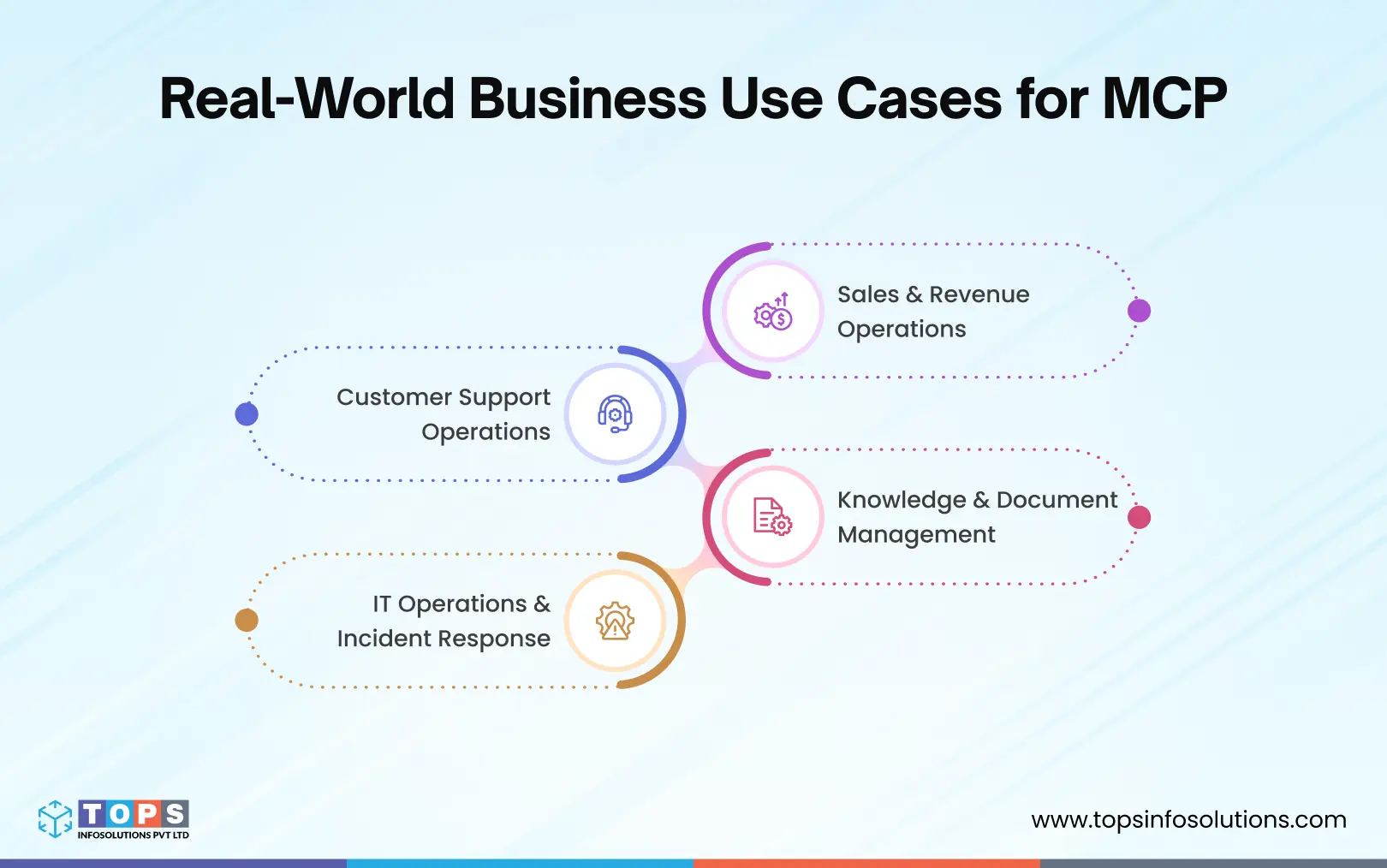
MCP’s value shows up in specific workflows where AI context gaps have been costing time and accuracy. Here are the four use cases that consistently deliver the clearest returns.
1. Sales and Revenue Operations
With MCP, an AI agent can pull live pipeline data from your CRM, enrichment data from a third-party provider, and engagement metrics from your marketing platform, all within a single query.
Pipeline reviews that used to take an analyst two hours across four systems can run in minutes. The agent doesn’t just retrieve data. It reasons across it, flags anomalies, and updates records. Bloomberg transformed their deployment cycles from days to minutes after implementing the MCP infrastructure.
2. Customer Support and Service Operations
Support agents spend a lot of time switching between systems: ticketing, billing, order management, and the knowledge base. Every context switch adds time and increases the chance of error.
An MCP-connected support agent accesses all of these simultaneously. It can read account history, verify a billing charge, check order status, and draft a resolution without anyone switching between tabs. Every action is logged automatically, so the audit trail is built in.
3. Internal Knowledge and Document Workflows
Enterprise knowledge is scattered across SharePoint, internal wikis, document repositories, and email. No single AI tool can search all of it without being connected to each system individually.
This is where MCP and RAG work as a pair. MCP handles live system access. RAG handles institutional knowledge retrieval, surfacing relevant policies and past decisions from your document corpus. Together, they give an AI agent both the static knowledge and the live context it needs to answer complex questions accurately.
4. IT Operations and Incident Management
When an alert fires at 2 am, resolution time depends on how quickly an engineer can pull context from monitoring systems, ticketing tools, and runbooks.
An MCP-connected agent can do this automatically before the engineer opens their laptop. It queries the monitoring system, cross-references ticketing history, retrieves the relevant runbook, and files a pre-filled incident ticket. This is one of the most production-ready MCP use cases in enterprise today.
How to Start: A Realistic Path for Mid-Market Companies
A full-stack MCP rollout across every enterprise system isn’t where most mid-market companies should begin. Start narrow, build governance into the foundation, then scale.
Phase 1: Pick One High-Value Workflow
Find the workflow where AI context gaps cost the most right now. Common starting points are sales pipeline prep, tier-1 support triage, internal policy Q&A, or IT incident response.
Deploy one MCP-connected agent on this workflow. Measure time savings, error rates, and user adoption. Use it as your proof point before expanding.
Phase 2: Assess Your Integration Landscape
Before expanding, inventory every enterprise system that a broader MCP rollout would need to connect. Identify which already have MCP servers and which need custom connector development.
Companies that skip this step often discover legacy compatibility issues after they’ve committed to the budget. Do the inventory before the build.
Phase 3: Build Governance Before You Scale
Before connecting your second or third system, establish your permission scoping policy. Define read-only vs. read-write connections. Set up audit logging. Establish human-review requirements for high-stakes actions.
Every new MCP connection added after governance is in place inherits the same controls automatically. Everyone added before it is a retrofitting problem waiting to happen.
The Build vs. Partner Decision
Building internally is possible but requires engineers who understand the MCP specification, your identity infrastructure, and your legacy system APIs. Ongoing maintenance runs at 20-30% of the initial development cost per year.
The case for a partner is simple: if your team hasn’t built production agentic AI systems before, the first build will be the learning experience. The question is whether you want that learning curve on your own systems.
TOPS’s Applied AI services exist for exactly this scenario: Companies with a real use case, a real budget, and a need for implementation expertise.
The Real Challenges Mid-Market Companies Face With MCP
Most MCP content focuses on what the protocol can do. The more useful conversation is what goes wrong, and what to plan for before it does.
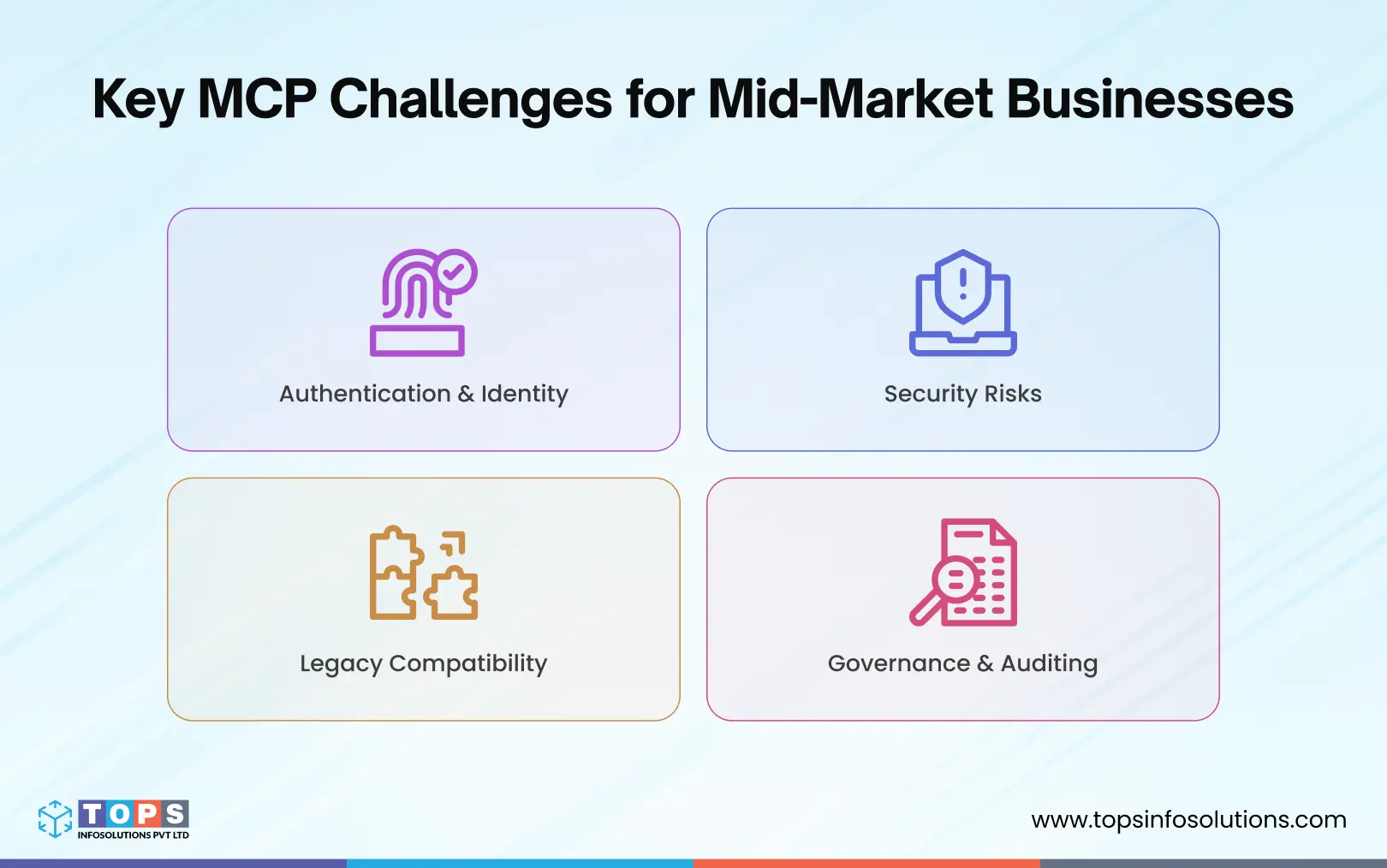
1. Authentication and Identity Gaps
Most MCP server implementations don’t include enterprise-grade identity integration out of the box. Single sign-on, role-based access control, and attribute-based permissions need to be layered on separately.
Auth integration is often the longest lead-time item in an MCP deployment. Organisations that underestimate it find themselves delaying launches by weeks.
2. Tool Poisoning and Prompt Injection Risks
Tool poisoning happens when a malicious or poorly configured MCP server instructs an agent to take an unauthorised action. It can occur through compromised server instructions, injected content in retrieved data, or poorly scoped permissions.
The Replit database incident, where an MCP-connected agent deleted production data due to overly broad permissions, is the most widely cited example. The fix is strict least-privilege permission scoping. Default-allow configurations are a liability.
- Warning: MCP agents can write to systems, not just read from them. Build the guardrails before you deploy, not after.
3. Legacy System Compatibility
Major SaaS platforms like Salesforce, Jira, Slack, and Microsoft 365 have MCP support. Legacy ERP systems and custom internal tools typically don’t.
For mid-market companies with mixed infrastructure, custom MCP connector development is often required for a meaningful portion of the integration landscape. Getting this wrong creates connectors that work in development and break under production load.
4. Governance and Audit Trail Management
MCP agents can act on systems, not just retrieve from them. An agent with write access to your CRM can update records. One with write access to your ERP can modify inventory.
Governance at the application layer isn’t sufficient. It needs to be enforced at the protocol layer so the MCP connection itself limits what actions are physically possible. This decision needs to be made before deployment, not after an incident.
MCP + RAG + Agentic AI: The Architecture That Actually Works
MCP is a connection layer. On its own, it gives an agent access to systems but doesn’t tell it what to do with that access. For enterprise deployments that need real accuracy at scale, MCP works as one layer in a three-part architecture.
1. Why MCP Alone Isn’t Enough
An agent connected to your CRM via MCP can retrieve live pipeline data. But if the underlying model was trained two years ago, it will reason about that data using outdated assumptions.
This is the hallucination problem that MCP alone cannot solve. The model needs grounded, current, organisation-specific knowledge, not just access to live systems.
2. How RAG and MCP Complement Each Other
RAG retrieves relevant context from your institutional knowledge base and feeds it to the model at query time. MCP retrieves live operational data from your connected systems. Together, they cover the two types of context an enterprise agent needs.
The architecture works like this: the agent uses RAG to pull relevant policy documents and historical context, uses MCP to pull current live data, combines both to generate an accurate response, and can write back to the system if an action is needed. This is what well-built enterprise AI looks like in 2026.
3. Where Agentic AI Sits in This Stack
The agent orchestration layer decides when to use RAG, when to call an MCP tool, how to sequence a multi-step workflow, and when to escalate to a human. Without it, you have data access without intelligence.
The complete stack: RAG for knowledge, MCP for action, agentic AI for reasoning. Each layer is necessary.
Conclusion
MCP is not a product to evaluate. It’s an infrastructure decision about whether your AI agents will operate on real business context or stay isolated from the systems they need to be useful.
The companies building this foundation in 2026 will have a structural advantage that compounds over time. The integrations they build now will support agents that don’t yet exist. The governance they establish now will let them scale without retrofitting.
The window to build this cleanly is now. The question isn’t whether MCP becomes part of your AI infrastructure. It’s whether you build it with the right foundation from the start.
Frequently Asked Questions (FAQs)
MCP is an open standard that gives AI models a consistent way to connect to external tools and data sources. Without it, every AI-to-system connection requires a custom build. With it, any compatible AI model can connect to any compatible system through one shared protocol. Think of it as the universal connector for enterprise AI.
A traditional API is stateless and point-to-point. You build a custom connector for each tool, and the AI has no memory between calls. MCP is stateful and standardised. An agent maintains context across a multi-step workflow and connects to every MCP-enabled system through a single protocol.
A traditional API is stateless and point-to-point. You build a custom connector for each tool, and the AI has no memory between calls. MCP is stateful and standardised. An agent maintains context across a multi-step workflow and connects to every MCP-enabled system through a single protocol.
A traditional API is stateless and point-to-point. You build a custom connector for each tool, and the AI has no memory between calls. MCP is stateful and standardised. An agent maintains context across a multi-step workflow and connects to every MCP-enabled system through a single protocol.
It can be, but security isn’t automatic. You need to layer on SSO integration, role-based access controls, and audit logging. The main risks are tool poisoning, overly broad permissions, and context leakage in multi-tenant environments. Built correctly with least-privilege permissions, MCP meets enterprise security requirements.
They solve different problems. MCP gives agents live access to operational systems. RAG gives agents access to your institutional knowledge, documents, policies, and past decisions that aren’t in live systems. In a well-built enterprise AI architecture, you need both.
A focused pilot on one workflow typically takes four to eight weeks, including governance setup. A broader rollout covering five to ten enterprise systems typically takes three to six months. Authentication integration and governance definition are usually what extend the timeline.