




Your team has already added AI tools and automated some of the busywork. Costs, though, keep climbing anyway.
Yet, the operating costs keep climbing. The AI pilot looks promising in the demo, but a quarter later, you cannot gauge where AI is actually making a difference in terms of cost.
That gap is where AI cost savings often get lost.
Research shows that 89% of companies now use AI in at least one business function, but only 37% report an impact on earnings at the enterprise level.
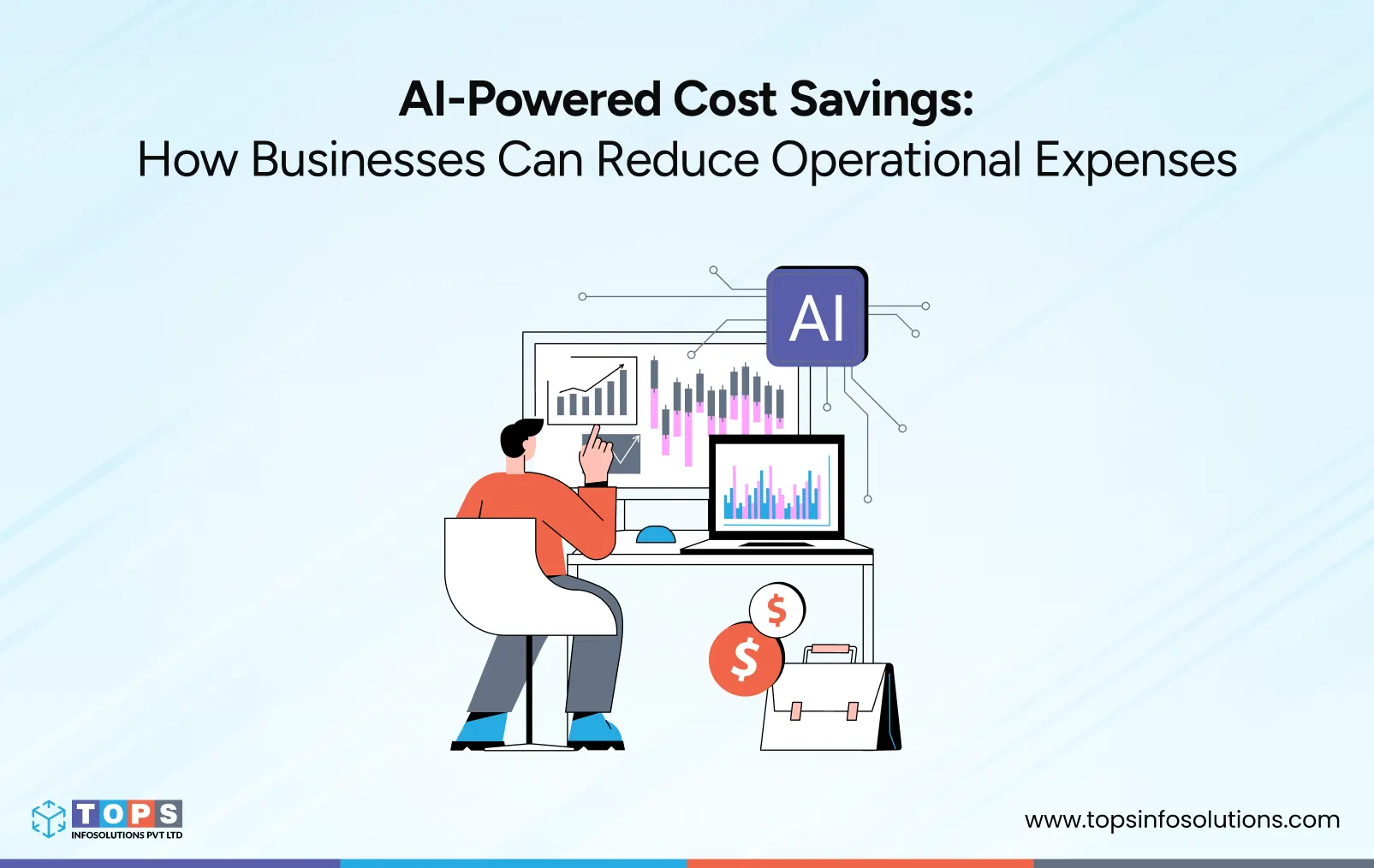
The challenge is no longer adopting AI. It is turning AI-Powered Cost Savings into measurable reductions in operational expenses.
This blog explores AI-driven cost reduction across business functions, what those savings look like in practice, and how to scope AI initiatives around outcomes that show up in the budget.
Why AI Adoption Doesn’t Automatically Mean AI Cost Savings
While most companies are embracing AI, they still haven’t seen the cost benefits. The two problems below explain why that gap exists, and both need to be solved before AI cost savings become real numbers instead of a demo.
The Adoption Gap: Everyone’s Using AI, Few Are Saving Money
Two-thirds of organizations using AI are still stuck in the piloting phase, and only about a third report they’ve begun scaling AI across the enterprise.
That distinction matters. A pilot can prove a concept works. It rarely proves the concept saves money at a scale that shows up in the budget, because pilots are usually sized to minimize risk, not to maximize savings.
Why AI Budgets Overrun Before Savings Show Up
Even companies that do scale run into a second problem: cost. The McKinsey report shows that ninety-three percent of organizations that move from isolated AI use cases to enterprise-wide adoption report exceeding their AI budgets.
That figure reframes the whole conversation. AI cost savings aren’t a byproduct of buying the right tool. They come from spend discipline applied after the tool is in place, tracking usage, cutting what isn’t earning its cost, and redirecting that budget toward the use cases that matter. Organizations that build this discipline in can cut AI costs by 20% to 30%.
For a business founder, that’s the practical takeaway from this section: budget for governance, not just for the tool.
How Does AI Reduce Costs?
Cost savings from AI don’t map cleanly to departments. They map to specific processes that happen to sit inside different departments. Here are the five where the money most consistently shows up.
Repetitive Task and Document Automation
This is the fastest, most common entry point. Generative AI has since made this kind of document automation even easier to stand up, which is where generative AI services usually enter the picture.
Because data entry, reconciliation, reporting, and on-boarding paperwork are all high-volume, low-variance tasks that AI handles without the errors or delays that come from manual processing.
The savings math here is simple: time saved on repetitive work is salary cost saved, and that adds up quickly once you multiply it across a team instead of one person.
Demand Forecasting and Inventory Planning
Better forecasting means less money tied up in the wrong inventory at the wrong time. But the discipline to capture that value is still catching up to the investment. A Gartner study found that more than half of the organizations remain unclear on the actual return from AI.
This is even though 67% of digital investment in supply chain now goes toward it. That gap is exactly why the process needs a defined baseline before it gets scoped, not just an AI tool.
Predictive Maintenance
Predictive maintenance catches equipment or system issues before they cause downtime or an expensive emergency fix. Downtime is one of the most expensive line items a business can carry, so catching problems early has an outsized effect on operational expenses relative to the cost of the tooling.
Downtime is one of the most expensive line items a business can carry. So catching problems early has an outsized effect on operational expenses relative to the cost of the tooling.
Customer Query Deflection and Self-Service
AI-handled queries cost a fraction of what a human-handled interaction costs. This makes it a natural place to look for savings. But the honest picture is more nuanced than AI replacing your support team.
A Gartner survey of customer service leaders found only 20% have actually reduced agent staffing because of AI, with the majority instead handling more volume at stable headcount.
AI-handled queries, often powered by RAG as a Service retrieving answers from your own knowledge base, cost a fraction of what a human-handled interaction costs.
The real savings here come from absorbing growth without adding headcount and not reducing the staff. That’s a more defensible number to bring into a budget conversation than a headcount-reduction claim.
Error and Exception Detection
We’ve always optimized for reducing mistakes and detecting them early before they become expensive.
Fraud detection, compliance flagging, and quality control checks all fall here. Analytical AI use consistently produces measurable AI cost optimization in the functions that rely on it most, including HR and finance-adjacent processes.
These savings are harder to headline in a single percentage, since the value is in the mistakes that never happened. That doesn’t make them less real, just harder to point to on a slide.
Example of AI Cost Savings
The processes above are the theory. Here’s what one of them looks like when it’s actually implemented, not just modelled in a slide deck.
In one of our mid-market operations engagements, the client’s team was manually processing repetitive order and reporting workflows across multiple disconnected tools: the kind of work that doesn’t require judgement but does require hours.
We built workflow automation that handled the repetitive steps end to end, from data intake through to the reporting output the team was previously assembling by hand. The result was a 20% AI-driven cost reduction in the operational cost of running that process.
The savings didn’t come from cutting headcount. They came from redirected capacity: the same staff who’d been buried in manual processing were freed up to work on the parts of the job that actually needed a person, like exception handling and client-facing work that generates revenue rather than just keeps the lights on.
What Changed, and What It Took to Get There
This wasn’t a quick swap. Getting the automation right took mapping the existing workflow in detail first, including the exceptions and edge cases that don’t show up until you look closely, before any of it could be automated reliably.
That upfront mapping is the part most companies underestimate. It’s also exactly why scoping one process well beats trying to automate everything at once.
How to Approach AI-Driven Cost Reduction Without Overspending
The processes and examples above show where the money is. But it’s important to know how to actually capture it without becoming one of the majority of organizations that end up exceeding their AI budget.
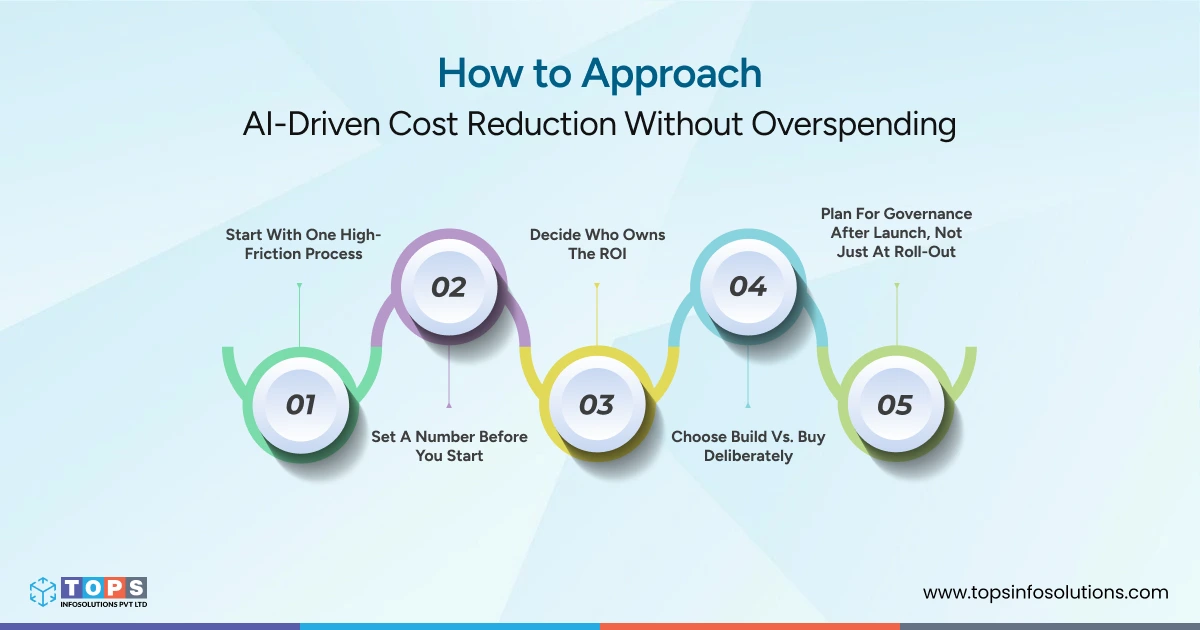
Start With One High-Friction Process
Pick the single process causing the most manual pain right now, not the most impressive-sounding use case. A narrow, well-scoped pilot is easier to measure, easier to fix when something’s wrong, and far less likely to blow past budget than a rollout spanning five departments at once.
This is the direct antidote to the overspending problem. Scope discipline up front prevents the budget creep that shows up later.
Set a Number Before You Start
Define the current cost of the process you’re automating before any tooling gets chosen. Without a baseline, there’s no way to know if the AI initiative actually saved money or just changed how the work gets done.
That number also becomes the standard the project gets measured against later.
Decide Who Owns the ROI
Someone specific needs to be accountable for tracking whether the savings materialize, not a committee, not the AI vendor, one person. Programs that scale successfully tend to have this kind of ownership built in from the start rather than added after the fact.
Without it, a project can look successful in the demo and quietly fail to show up in the budget six months later.
Choose Build vs. Buy Deliberately
An off-the-shelf tool is often enough for a well-defined, high-volume process like document processing or basic query deflection. A custom workflow is worth the investment when the process is specific to how your business actually operates, which is usually when a purpose-built, AI-powered application makes more sense than a generic tool.
Filling your stack with every AI tool is one of the fastest ways to end up with subscriptions that never get fully used. This is part of what drives that 93% budget-overrun figure in the first place.
Plan for Governance After Launch, Not Just at Rollout
Savings from AI erode quietly if nobody keeps checking that the tool is still being used the way it was scoped.
Companies that build in this kind of ongoing review are the ones seeing the 20% to 30% AI cost reductions McKinsey’s spend-discipline research found, compared with those that treat launch as the finish line.
Most of the mistakes that erase AI business cost savings happen after launch, not during it.
Read Also:- AI Agent Security Checklist: Before You Give Agents Access to Production
Common Mistakes That Erase AI-Powered Cost Savings
Most of the savings this article has covered aren’t lost during implementation. They’re lost afterward, through two patterns that show up again and again.
Automating multiple processes at once instead of proving out one first: Each additional use case adds its own integration work and review overhead, and those costs compound faster than expected.
Letting tracking lapse after launch: Savings that looked real in the pilot quietly disappear if nobody keeps checking that the process is still running the way it was scoped.
Why Partner with TOPs Infosolutions for AI Cost Savings
It’s tempting to start AI without a clear plan, but most companies that do end up with cost-intensive experiments instead of savings. They fail because nobody scoped the process, set a baseline, or stayed accountable for the number after launch.
We work with businesses to identify the one process actually worth automating first, then build AI automation services around how the business really operates. From workflow mapping through post-launch tracking, we treat AI business cost savings as something to prove, not assume.
Read Also:- Why Your LLM App Needs an Evaluation Layer
Wrapping Up
AI cost savings aren’t automatic, but they’re not out of reach for a business team either. The businesses seeing real reductions in operational expenses are the ones treating AI as a scoped initiative with a baseline, an owner, and a review cadence.
That’s the part of the work most companies underestimate: the scoping, the mapping of exceptions and edge cases, and the discipline to prove out one process before expanding to the next.
It’s also where we spend most of our time with clients. As a company that provides AI development services, we help teams identify which process is actually worth automating first, build the workflow around how the business really operates, and set up the tracking that keeps the savings visible past launch instead of quietly fading six months in.
Frequently Asked Questions (FAQs)
A mid-market company that scopes one or two high-friction processes well could realistically expect a 10% to 20% reduction in the operational cost of those specific processes within the first year.
A well-scoped single process can show initial efficiency signals within 3 to 6 months. Turning that into a savings figure that actually shows up in the budget typically takes 6 to 12 months. Scaling beyond that one process to a company-wide impact generally takes longer than a year.
AI cost savings refers to the actual reduction in operational expense a business achieves. AI cost optimization is the ongoing practice of managing where and how AI is applied so those savings are maximized and don’t erode over time. One is the outcome; the other is the discipline that protects it.
No. Many of the highest-value starting points, like document automation or query deflection, can begin with an off-the-shelf tool rather than a custom build. A larger investment only makes sense once you’ve proven the process out and confirmed the workflow is specific enough to your business to justify it.
Repetitive, high-volume, low-variance work tends to show returns fastest, things like data entry, reconciliation, and reporting. Demand forecasting and predictive maintenance also show strong results, but they typically require more setup than a pure automation use case.
Scope one process at a time instead of automating broadly from the start, set a cost baseline before choosing any tooling, and assign a specific person to own tracking the ROI. Those three habits are the most direct way to avoid the budget overruns that trip up most organizations moving past isolated pilots.
It’s realistic for mid-market companies, and arguably more achievable, since a smaller organization can scope and launch a single-process pilot faster than an enterprise can move through its approval layers. The same discipline that makes AI cost savings work at enterprise scale (one process, a clear baseline, an accountable owner) applies just as well at mid-market size.