



































Quick Summary
Enterprise AI spend is rising even as token prices fall, and the reason is model choice, not pricing. This post breaks down when a smaller, task-specific model beats a frontier LLM on cost, speed, and accuracy — and gives engineering leaders a framework for deciding.
-
- Token prices have dropped up to 280x since 2022, yet enterprise AI budgets grew from $1.2M to $7M between 2024 and 2026
- NVIDIA researchers argue small models are the natural default for agentic systems, with frontier models reserved for genuinely general-purpose reasoning
- The right model choice depends on task frequency, specificity, and risk tolerance, not on chasing the newest frontier release
Your per-token price has collapsed. So have you wondered why your AI bill has tripled?
That gap is the story most engineering leaders miss.
According to Stanford HAI’s AI Index, the cost to run a fixed level of AI capability fell as much as 280-fold since 2022. Yet according to industry FinOps reporting, enterprise AI budgets have climbed from an average of $1.2 million in 2024 to $7 million in 2026.
The math doesn’t add up until you look at what’s actually consuming those tokens: agentic workflows that chain five, ten, sometimes thirty calls to complete a single task, most of them routed through the same frontier model regardless of how simple the task is.
That’s the applied AI pattern quietly reversing at companies paying attention. Task-specific small language models are handling the routine, high-volume work that frontier models were never built to do efficiently, and the cost difference isn’t marginal.
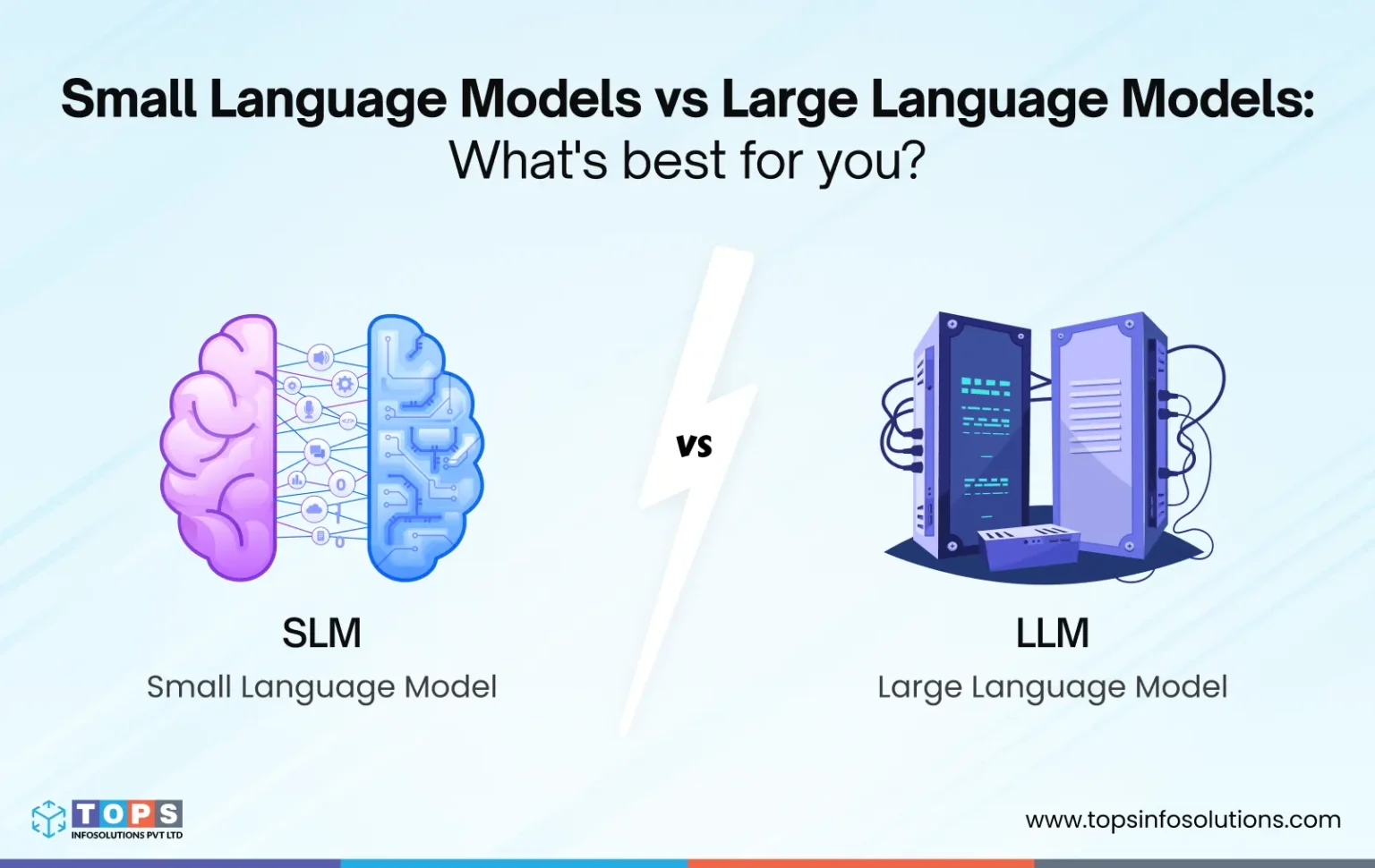
Here’s what the research shows about what a small language model is, when a smaller model wins and when it doesn’t, and how it resolves the dilemma of small language models vs large language models.
What Are Small Language Models?
Small language models (SLMs) are applied AI models that can process, understand, and generate natural language content. They’re like LLMs in terms of capabilities but are much smaller in scale and scope.
Most production tasks don’t need a model built to handle anything you throw at it; they need one built to handle one thing well, cheaply, and fast. Small language models exist to close that gap, giving teams a model sized to match what the task actually requires instead of defaulting to the most capable option available, the same principle behind applied AI implementations that use pre-trained, task-specific models instead of building from scratch.
SLMs generally range from a few hundred million to a few billion parameters, compared to the hundreds of billions in frontier models. The distinction that matters more than parameter count is purpose. Frontier models are trained to generalize across almost any task. Small models are trained or fine-tuned to do one type of task well, and nothing else.
Why Your LLM AI Bill Keeps Rising
Falling prices should have made AI cheaper to run. Instead, most engineering teams are watching the opposite happen, and the reason has less to do with pricing than with how that budget is actually being spent.
Falling Prices Didn’t Lower the Bill
The prices of the tokens are a unit cost. What determines the actual bill is how many units get used, and that number has grown far faster than prices have fallen. A cheaper model per call doesn’t help much when the number of calls per task keeps rising. Most budgeting still happens as if AI spend behaves like a fixed software license, when it actually behaves like a metered utility that scales with usage no one is tracking closely.
Agentic Workflows Burn Far More Tokens
A simple chatbot answers a question in one exchange. Agentic AI completing the same task reasons through the problem, calls tools, checks its own output, and often revisits earlier context before it’s done.”Each of those steps is a separate model call, and a single user request can quietly trigger a dozen of them behind the scenes. Teams that priced their AI budget around chatbot-era usage patterns are now running agentic workflows on top of that same estimate, and the estimate hasn’t caught up.
You’re Paying Frontier Prices for Routine Work
The deeper issue is that most teams route everything, simple and complex alike, through the same model. Classifying a support ticket and drafting a nuanced legal summary get sent to the same frontier model. It gets priced the same way, even though one of those tasks doesn’t need frontier-level reasoning at all. More than pricing, it’s an architecture decision made once that never gets revisited.

What the AI Research Actually Shows
The small language models vs large language models comparison isn’t a cost-cutting workaround dressed up as strategy. Researchers studying model performance across task types have found a consistent pattern, and it points toward a real shift in how AI systems should be built, not just how they should be priced.
Small Models Match or Beat Frontier Models on Narrow Tasks
For well-defined, repetitive work like classification, extraction, summarization, routing, and formatting, a small model trained or tuned for that specific job performs comparably to a frontier model, and sometimes better. Frontier models are generalists. Their strength is handling problems they haven’t seen a version of before. That strength is wasted on a task that repeats the same pattern thousands of times a day.
The Performance-Efficiency Trade-Off
The relationship between model size and usefulness isn’t linear. Past a certain point, adding more parameters keeps making a model marginally more capable while making it disproportionately slower and more expensive to run. For narrow tasks, that trade-off stops making sense well before you reach frontier scale. The smaller model isn’t a compromise; it’s a better fit for the job.
NVIDIA Is Betting on Small Models for Agentic AI
NVIDIA researchers have argued that small language models are not just sufficient but the more natural default for agentic systems, with frontier models reserved for the smaller share of tasks that genuinely require broad, general-purpose reasoning. That’s the framing worth holding onto: this isn’t small models replacing frontier models; it’s each one being used for what it’s actually good at, inside the same system, whether you’re running a single agent or a multi-agent setup.
The numbers back this up. A 2026 analysis of enterprise API traffic found organizations routing every task to a frontier model paid a blended $18.40 per million tokens, while organizations using a tiered architecture, small models for routine work, frontier models for the rest, paid $2.31. Same workload, an 87% cost difference, based entirely on how tasks were routed.
The Benefits of Switching from LLM to SLM
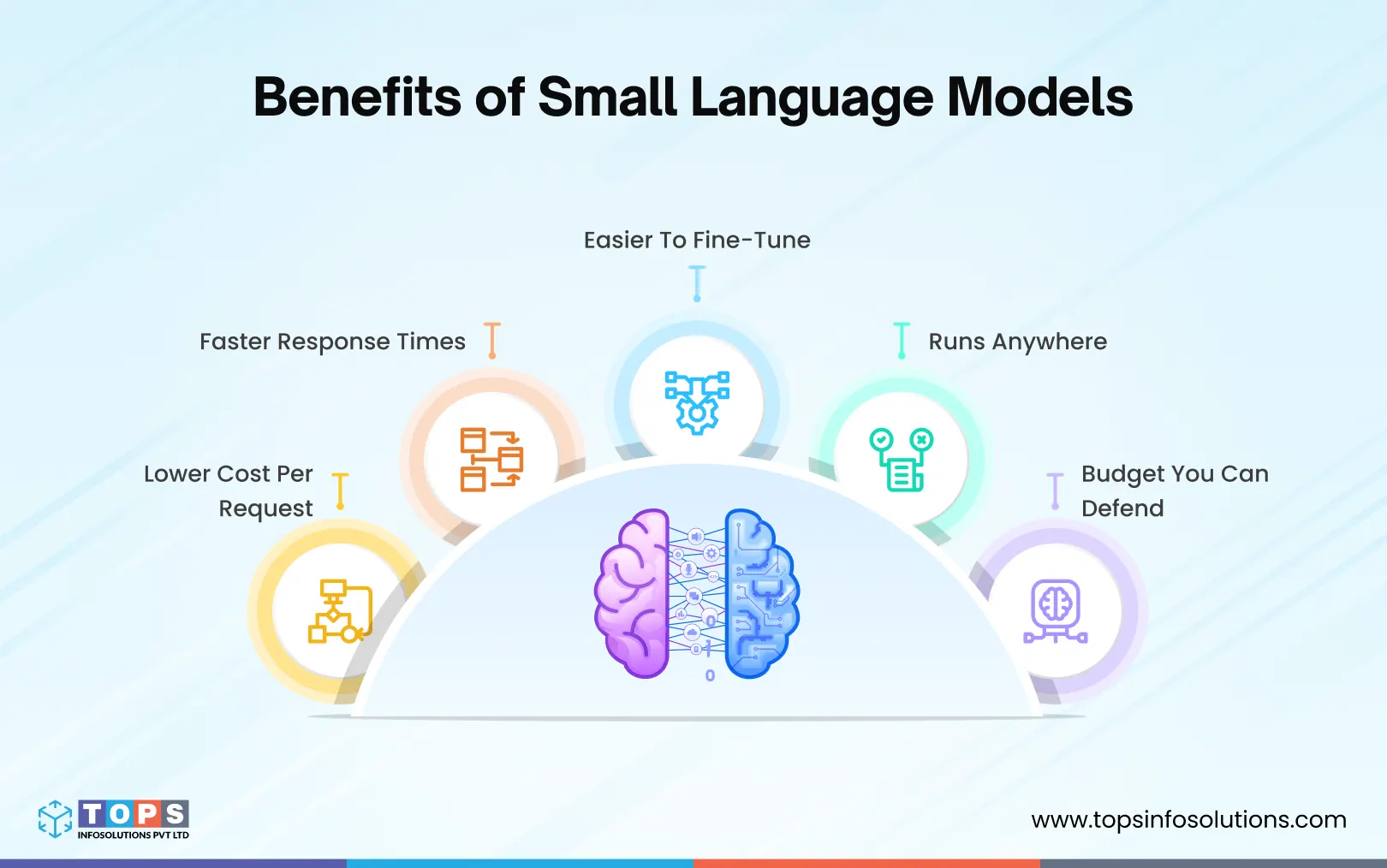
Once a team stops routing every task through the same frontier model, the gains show up in more than one place. They’re not just financial; they change how the product feels and how the team plans around it.
Lower Cost Per Request
This is the most immediate change that you’d notice. However, the lower cost is not just about a smaller number on the invoice. It’s about a cost that finally scales the way it should and in proportion to what a task actually requires. It’s better than a flat-frontier-model rate applied to everything regardless of complexity.
Faster Response Times
Smaller models return answers faster, largely because there’s simply less computation happening per request. For high-volume, latency-sensitive work like ticket triage, in-app suggestions, real-time classification, that speed difference is often more noticeable to users than any accuracy trade-off.
A Budget You Can Actually Explain
Frontier-model spend is hard to explain because it doesn’t map cleanly to value. A tiered model architecture does. When cost scales with task complexity instead of applying uniformly, it becomes possible to explain, in one sentence, why the AI budget looks the way it does. That’s a very different conversation than “usage went up.”
Easier to Fine-Tune
A small model trained on a narrow, well-defined task is far easier to tune, retrain, and correct than a frontier model. When the output drifts or the task changes slightly, adjusting a small model is a contained, fast iteration. Adjusting behavior on a frontier model usually means re-prompting and hoping, since there’s no direct lever to pull.
More Flexibility in Where It Runs
Small models have a light enough footprint to run on lower-cost infrastructure, and in some cases, on-premises or at the edge, rather than depending entirely on an external API. That gives teams more control over data handling, latency, and uptime, without being tied to a single provider’s availability or pricing changes.
How to Decide What Your Product Actually Needs
Not every task belongs on a small model, and not every task needs a frontier one either. The decision comes down to what the task actually demands, not which model is newest or most capable in general.
| Small Language Model | Frontier LLM | |
|---|---|---|
| Best for | Classification, extraction, summarization, routing, formatting, repetitive tool-calling | Open-ended reasoning, novel problems, complex multi-step judgment |
| Task pattern | High-volume, repetitive, well-defined | Low-volume, variable, unpredictable |
| Cost per request | Low | High |
| Response speed | Fast | Slower |
| Accuracy on narrow tasks | Matches or exceeds frontier models | Often unnecessary overhead |
| Accuracy on broad reasoning | Limited | Strongest option |
| Where it fits in an agentic system | Handles the majority of routine steps | Reserved for the steps that genuinely need it |
Questions to Ask Before Choosing Between SLM and LLM
Model selection isn’t a single decision. It’s a set of smaller questions that, together, point clearly toward one option. Here’s what’s worth asking before assigning a task to either model.
How often does this task run?
Frequency changes the math entirely. A task that runs ten times a day barely moves the budget no matter which model handles it. A task that runs ten thousand times a day turns even a small per-request cost difference into a significant monthly number. High-frequency tasks are usually where a small model has the biggest impact, because the savings compound with every call.
Does the task require reasoning, or does it follow a pattern?
This is the clearest signal of all. If the outcome is one of a known, limited set, approve or flag, categorize into existing buckets, extract a specific field, that’s pattern-matching, and a small model handles it well; the same logic behind how tool-calling works in agent-to-platform integrations. If the task requires weighing context that changes case by case, it needs broader reasoning, which is where frontier models still lead.
What does it cost to get this wrong?
Not every mistake carries the same weight. A misclassified support ticket gets corrected easily. A wrong answer in a compliance or financial workflow doesn’t. Tasks with low-risk, easily reversible outcomes are safer to route to a smaller model. Tasks with high-stakes outcomes justify paying for the most capable model available, even at higher cost.
Will this task’s volume grow as the product scales?
A task that’s manageable today at low volume can become the largest line on the AI budget once usage scales. It’s worth asking not just what a task costs now, but what it will cost at ten times the volume. Tasks on a clear growth trajectory are worth moving to a smaller model early, before the cost becomes hard to unwind.
Does this task need to run close to real time?
Latency-sensitive tasks, live suggestions, in-app classification, real-time triage, benefit directly from a smaller model’s faster response time. If speed matters to the user experience, that’s another point in favor of sizing the model down.
The Bottom Line
The small language models vs large language models choice was never really about which one is better. It’s about matching the model to what the task actually requires. Frontier models remain the right call for open-ended reasoning and problems your system hasn’t seen before. Small models are the right call for the routine, high-volume work that makes up most of what production AI actually does. The choice usually depends on your latency budget, privacy constraints and cost ceiling – the same three factors that shape any AI software development decision
Teams that treat this as a one-time architecture decision, rather than a default they revisit as usage grows, are the ones watching their AI bill outpace their AI value. The fix isn’t a bigger budget. It’s routing each task to the model sized for it.

Frequently Asked Questions (FAQs)
For open-ended reasoning, yes. For narrow, well-defined tasks like classification or extraction, a fine-tuned small model often matches or exceeds a frontier model’s accuracy, at a fraction of the cost.
Start with frequency, specificity, and risk. If a task repeats often, has a well-defined range of outcomes, and a wrong answer isn’t costly, it’s a strong candidate.
Yes, and this is one of their strongest use cases. Most steps in an agentic workflow are narrow and repetitive, which makes them well suited to a small model, with a frontier model reserved for the steps that need broader reasoning.
No. Most production systems that make this switch use both, routing each task to whichever model fits it. It’s a tiered architecture, not a replacement.
Setting up model routing takes upfront engineering work, but it’s a contained project, not a rebuild. The ongoing savings on inference cost typically outweigh the initial setup within a few months for high-volume workloads.
Yes, and that’s one of their advantages. Small models are far easier and faster to fine-tune on your own data than a frontier model, which makes them well suited to niche or company-specific tasks.
Not necessarily. Their smaller footprint means they can run on lower-cost infrastructure, and in some cases on-premises or at the edge, giving teams more control over data and latency.