






































Quick Summary
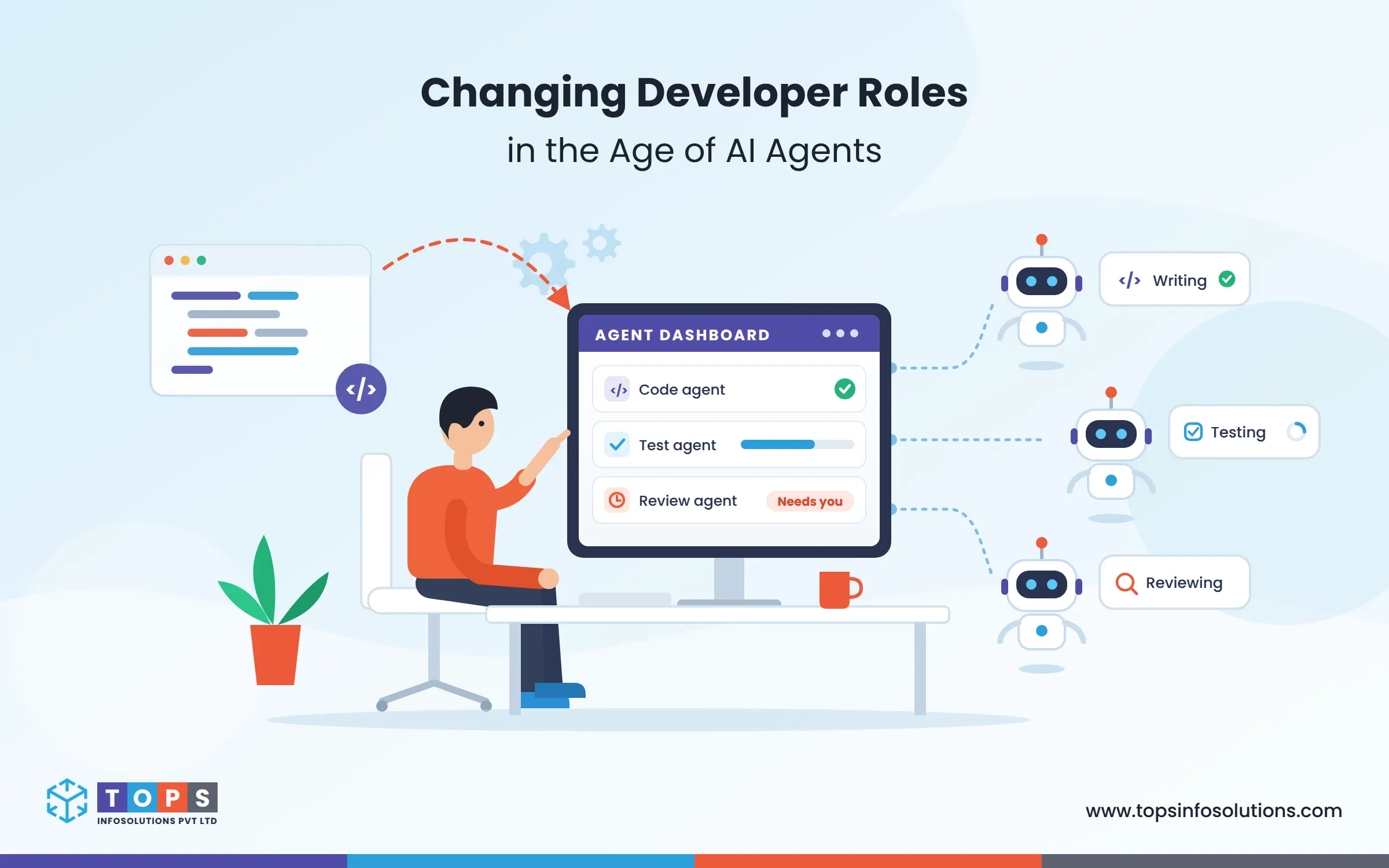
The developer’s job in 2027 is shifting from writing code to supervising the agents that write it. This article covers what that shift looks like day-to-day, the skills separating AI-fluent developers from those being left behind, and what it means for how companies hire.
-
- Agent coding sessions grew from 4 minutes to 23 minutes in a year, a sign this shift is already structural, not experimental
- The real skill gap isn’t using AI tools; it’s validating the reasoning behind what an agent produces, not just the output
- Junior developers who can’t direct or review agent work are losing ground fast in the hiring market
- Companies hiring in 2027 need to rewrite job requisitions and interview loops around supervision, not typing speed
A few years ago, a developer’s job was single-faceted: write the code, ship the software, move on.
Now that AI can write code too, it’s tempting to ask whether that job just became obsolete.
Not necessarily. But the AI-fluent developers are surely doing something different than they were a few years ago.
Developers used to lean on the logic of the code without interrogating the reasoning behind it. But agents have flipped that.
The developer’s job has shifted from writing logic to validating reasoning, and the agentic AI shift is what’s reshaping how companies hire, structure teams, and decide who counts as senior in 2027.
Why Is the Developer’s Role Shifting From Coding to Agent Supervision?
The progression has moved fast. Coding tools went from autocomplete to conversation, then to collaboration, and now to delegation. An agent doesn’t wait for the next instruction; it takes a task and finishes it. That’s the line between an assistant and an agent, and it’s why the industry has started calling this agentic coding instead of AI-assisted coding.
From Autocomplete to Delegation: How Fast the Shift Happened
While the term AI-assisted coding has floated around for a while, it isn’t until recently that coding became completely delegated. The developer’s role hasn’t disappeared in that gap; it’s moved up a level, from author of every line to reviewer of the outcome.
That’s the core of what supervising AI agents actually means in practice: less time typing, more time deciding whether the output deserves to ship.
The Data Behind the Shift: Agent Session Length and Tool Calls
According to Anthropic’s 2026 Agentic Coding Trends Report, average coding agent session length grew from 4 minutes to 23 minutes between Q1 2025 and Q1 2026, with the average session now involving 47 tool calls as the agent reads files, writes code, runs commands, and iterates across dozens of steps on its own.
That’s a five-fold jump in how long a developer trusts an agent to work unsupervised on a single task. Sessions that short used to mean one autocomplete suggestion. Sessions that long now mean an agent working through a feature the way a junior engineer would, minus the questions in Slack.
What Does Supervising AI Agents Actually Look Like for Developers?
Supervision isn’t a vaguer version of coding. It’s a distinct skill, and Anthropic’s own researchers describe it plainly: the shift is from writing code to reviewing, directing, and validating AI-generated code. That distinction shapes everything else in this section.
Reviewing Outcomes Instead of Every Line of Code
A developer supervising an agent doesn’t read every line the way a code reviewer might. They check whether the outcome matches the intent, whether the edge cases were actually handled, and whether the reasoning behind an approach holds up. Passing tests confirm the code does what it was told. They don’t confirm it was told the right thing.
This is where AI-fluent developers separate from developers who are just using AI tools. One group treats a green test suite as permission to ship. The other treats it as the starting point for a real review.
Vibe Coding vs. Agentic Engineering: What’s the Difference?
The terms get used interchangeably, and they shouldn’t be. Vibe coding, a term popularized by Andrej Karpathy, describes free-form prompting where a developer nudges an AI toward working code without much structure around goals or constraints. It draws a sharper line with agentic engineering. It means a structured, intentional use of agents where the engineer defines the goal, the constraints, and the quality bar before the agent starts working.
The difference matters for hiring vibe coding developers, not just for workflow. A developer who can vibe code got something working. A developer doing agentic engineering can tell you why it works, what it’s allowed to touch, and what would make them stop and check it by hand.
Writing Specifications an Agent Can Actually Execute
An agent can do everything a developer can, but only if the developer knows how to give the right context to the agent. If the prompt is vague, so will the output. But with clear specification, constraints, success criteria, and what’s explicitly out of scope, it gives the agent something concrete to build against. It also gives the developer something concrete to check the output against afterward.
This is a skill in its own right: translating a problem into something precise enough to act on. Developers who are strong at supervising AI agents tend to be the ones who were already strong at breaking a problem down clearly. The skill hasn’t changed; it’s just doing more work earlier in the process than it used to.
What Skills Do AI-Fluent Developers Need in 2026-2027?
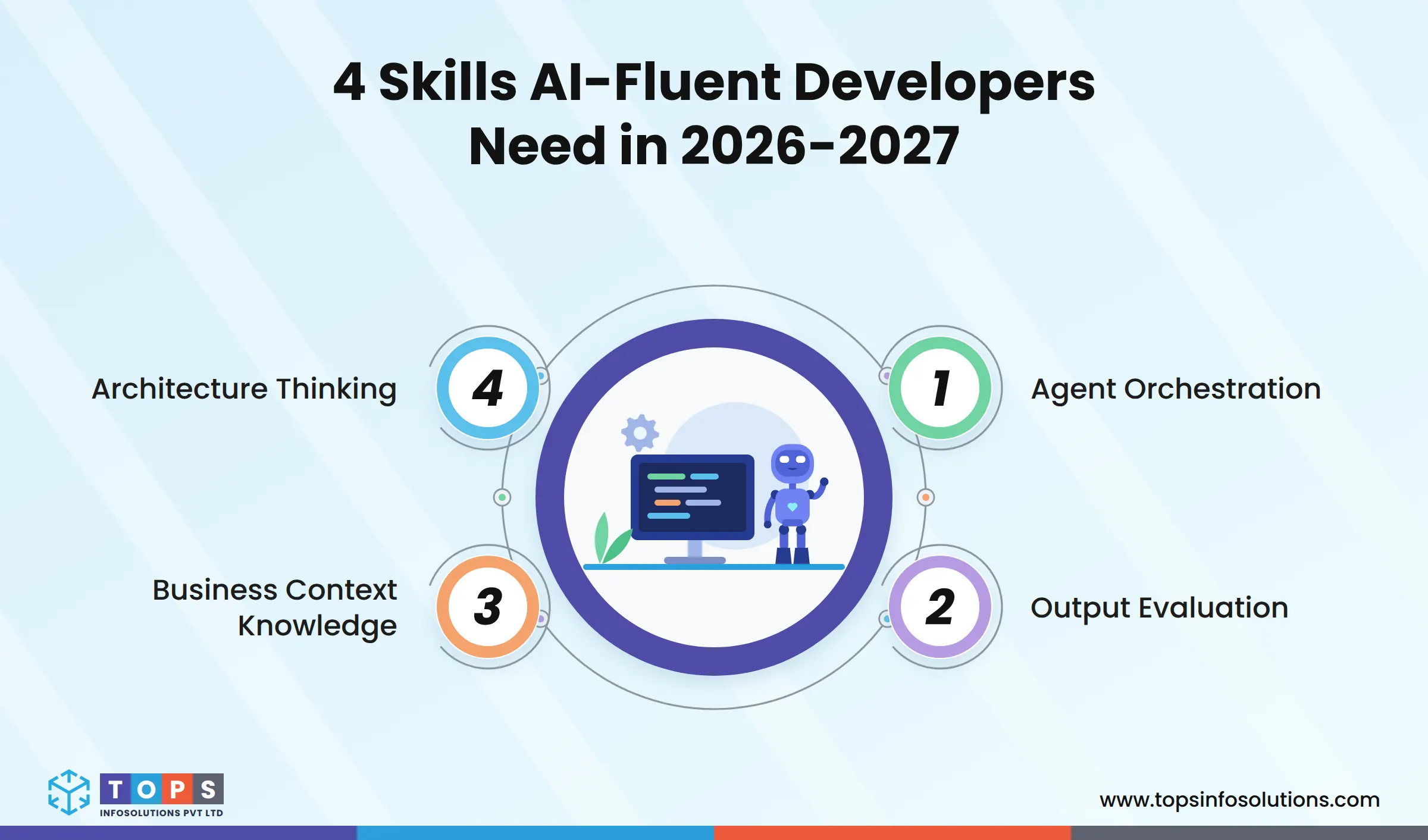
The skills that define an AI-fluent developer in 2027 aren’t a replacement for engineering fundamentals; they sit on top of them. Engineers are becoming more full-stack in their capabilities, working effectively across front-end, back-end, databases, and infrastructure because AI fills in knowledge gaps while they provide oversight and direction. Four AI developer skills show up consistently across teams making that shift well.
Agent Orchestration
Coordinating a single agent is table stakes now. Teams that have learnt to work with AI agents are coordinating multiple agents working in parallel. One is handling implementation, another is running tests, a third is checking agentic security, and synthesizing their output into something coherent.
Output Evaluation
An agent can produce code that compiles, passes its tests, and can still fail at its job. Strong evaluation means checking whether the reasoning behind an approach holds up, not just whether the output looks correct on the surface. This is the delegation gap that researchers found in Anthropic’s coding report. Engineers use AI in roughly 60% of their work but report being able to fully delegate only 0 to 20% of tasks.
Business Context Knowledge
An agent doesn’t know why a feature matters to the business, what trade-off a stakeholder actually cares about, or which shortcut would create a compliance problem six months out. That judgment still sits with the developer directing the work. The developers getting the most out of agentic workflows are often the ones who understand the “why” behind a build well enough to catch when technically correct code is still the wrong answer.
Architecture Thinking
As agents absorb more of the implementation work, the value of a developer’s contribution shifts toward system architecture, design decisions, and strategic problem decomposition. Engineers who can shepherd multiple features through development at once, applying judgment across a broader scope than hands-on coding previously allowed, are the ones agentic workflows are built to amplify.
How Should Companies Hire AI-Fluent Developers Right Now?
Hiring AI engineers is fairly new territory. Most software engineering job descriptions were written for a time when coding speed and language proficiency were the main filters.
Neither tells you whether a candidate can supervise an agent well, which means most companies hiring right now are optimizing for the wrong thing without realizing it.
Rewriting Job Requisitions
A requisition built for 2027 needs to test for judgment rather than just output. Instead of listing years of experience in a given language, effective postings now describe the kind of decisions a candidate will need to make. For example, reviewing agent-generated pull requests, deciding what’s safe to auto-approve, and catching a subtle bug in code that technically works.
Platforms like GitHub’s Agent HQ, which lets teams run multiple agents from different providers inside one governed workflow, are becoming the environment developers are actually hired into. It’s worth naming the tools and workflow explicitly in the posting rather than assuming candidates will infer it.
What To Test
Coding challenges built around solving a problem from scratch measure a skill that matters less every year. A stronger signal is handing a candidate a piece of agent-generated code with a subtle issue buried in it and watching how they find it, or asking them to write a specification precise enough for an agent to execute correctly. That tests the exact judgment the job now requires.
Build, Train, or Augment
Not every company hiring for this shift has the bandwidth to build an AI-native engineering team from scratch or retrain an existing one fast enough to keep pace. For mid-market teams facing a real roadmap deadline, augmenting with engineers who already work this way, orchestrate agents, evaluate output, and hold business context closes the gap faster than a lengthy hiring cycle, and it’s often the more realistic path when the skill is this new across the market.
What Mistakes Do Teams Make When Adopting Agentic Development?
Most of the teams struggling with this shift aren’t struggling because the technology failed. They’re struggling because the habits and guardrails around it haven’t caught up to how capable agents have become. Three mistakes show up repeatedly.
Passing Tests Myth
A green test suite feels like a finish line. For agent-generated code, it’s closer to a first checkpoint. Tests confirm the code does what it was told to do, not that it was told the right thing, and not that the approach holds up under conditions the tests didn’t anticipate. If you treat it as passed or done, you’ll likely be surprised later by a decision nobody actually reviewed.
Missing Agent Governance
Giving an agent file-write access, git commit permissions, and CI/CD control without clear boundaries on what it can do autonomously is a common early mistake. The cost of skipping it shows up fast.
In December 2025, an internal AI coding agent at AWS was granted broader permissions than intended due to a misconfiguration, contributing to roughly 13 hours of downtime. Amazon later confirmed the root cause was a human configuration error rather than a flaw in the agent itself, which is really the point: governance isn’t about distrusting the agent; it’s about scoping what any actor, human or AI, can do before something goes wrong.
Wrong Hiring Signal
Hiring based only on familiarity with a specific AI tool is a risky shortcut. These tools change rapidly, often within a few months. A more durable skill is good judgment. Can the person evaluate an agent’s output and write clear specifications? Do they understand enough business context to recognize when a technically correct answer is not actually the right one? Teams that hire for that judgment build a bench that adapts as the tools evolve. Teams that hire for tool familiarity end up retraining every time the landscape shifts.
Wrapping Up
The twelve-minute pull request from the intro isn’t the exception anymore. It’s becoming the norm. What separates real progress from a problem nobody’s found yet is whether a developer with real judgment reviewed that PR and knew what to check before it shipped. That’s the developer’s job in 2027, not writing every line, but making sure the lines that ship are the right ones.
Companies getting ahead of this shift aren’t waiting for the perfect training program or a hiring market that’s caught up. They’re building around supervision, evaluation, and business context now, while the skill is still rare enough to be an advantage.
If that’s the gap you’re closing, whether it’s hiring, training, or augmenting your team, TOPS Infosolutions builds custom AI software with AI-fluent engineers already working this way.
Frequently Asked Questions (FAQs)
It means spending less time writing every line of code and more time reviewing what an agent produced, checking whether the reasoning behind it holds up, and deciding what’s safe to ship. The coding hasn’t disappeared; it’s shifted toward direction and evaluation rather than pure implementation.
No. Vibe coding describes free-form prompting toward working code with little structure around goals or constraints. Agentic engineering, a term Andrej Karpathy has used to describe the more disciplined version of this work, involves defining clear goals, constraints, and quality criteria before an agent starts, which is closer to how professional teams are approaching this shift in 2026.
Agent orchestration, the ability to evaluate AI output critically, enough business context to catch when correct code solves the wrong problem, and architecture-level thinking as implementation work shifts toward agents. Tool familiarity matters less than the judgment behind how a candidate uses the tool.
Job requisitions and interview loops are shifting away from raw coding speed and toward supervision skills, testing whether a candidate can catch a subtle issue in agent-generated code or write a specification precise enough for an agent to execute correctly.
Job requisitions and interview loops are shifting away from raw coding speed and toward supervision skills, testing whether a candidate can catch a subtle issue in agent-generated code or write a specification precise enough for an agent to execute correctly.
It depends on timeline and bandwidth. Building from scratch and retraining an existing team both take time that few roadmaps can absorb. Augmenting with developers who already work this way is often the faster path for teams facing a near-term deadline, without ruling out training internally over the longer term.
Agents given broad permissions without clear boundaries on autonomous action have contributed to real production incidents, including a 2025 AWS outage tied to a misconfigured internal coding agent. Governance defines what an agent can do on its own versus what needs a human checkpoint, and skipping it tends to surface as an incident rather than a gradual problem.
No, it depends on them. Evaluating whether an agent’s approach is sound, writing a specification an agent can execute correctly, and knowing when output isn’t good enough to ship all rest on the same fundamentals developers have always needed. Agentic workflows put those fundamentals to different use, not less use.