



































Quick Summary
AI agents have moved from experiment to boardroom priority, and the next question every technical leader faces is whether one agent is enough or whether the job calls for a team. This post breaks down single-agent vs multi-agent systems in plain terms, shows where each one wins, and gives you a practical framework for deciding based on your actual workflow instead of what a vendor demo made look impressive.
-
- Single agents and multi-agent systems solve different problems. Neither one is the “advanced” version of the other.
- Multi-agent systems can cost up to 15x more in tokens than a single chat interaction, and coordination failures are a real, documented risk.
- The right question isn’t “how many agents do we need.” It’s whether your work is sequential and stateful, or parallel and exploratory.
- A simple checklist can tell you, in five minutes, which architecture your business actually needs.
Every vendor pitch this year seems to end the same way: “and it’s powered by a multi-agent system.” It’s become shorthand for sophistication, the AI equivalent of a Formula 1 engine strapped onto a delivery van.
Single-agent vs multi-agent systems is quickly becoming one of the most consequential technical decisions a business will make this year, and most companies are making it the wrong way.
Instead of starting with the problem they want to solve, they’re fast-forwarding straight to the architecture.
A single-agent customer support ticket handler is rebuilt into a five-agent orchestration layer. Six months later, the team is debugging coordination failures for a task that never needed more than one focused agent in the first place.
The reverse mistake happens just as often. A business sticks with a single agent long past the point where it’s straining against context limits and sequential bottlenecks, because “adding more agents” sounds like unnecessary complexity.
Both mistakes come from the same root cause: treating agent count as a maturity signal instead of an engineering decision. This article walks through what agentic AI is, where each one wins, and how to decide which one fits your business right now.
What Is a Single Agent System?
A single-agent system is an AI model that acts as a continuous decision-maker from start to finish. It reads a request, decides what tool or data source to use, acts on it, and carries the full history of that reasoning into every next step.
Think of it as one highly capable employee working a task end to end, rather than handing pieces of it off to different people because it holds the entire context in one continuous thread.
Common enterprise use cases:
- Internal knowledge assistants answering policy or HR questions
- Customer support agents resolving a single ticket end to end
- Document processing (extracting, summarizing, classifying)
- CRM assistants drafting follow-ups or logging activity
These are largely “one system, one thread of logic” problems. When evaluating AI agents for business use, the task is well-defined, the steps are sequential, and there’s no real benefit to splitting the work across separate agents.
What Is a Multi-Agent System?
A multi-agent AI replaces the single decision-maker with a small team. Typically, a lead agent breaks a goal into subtasks and delegates them to specialized worker agents, each with its own scope, tools, and context.
Orchestration is simply the coordination layer that manages this: which agent does what, in what order, and how their outputs get combined into a final result. Some architectures use this lead-and-worker model, while others let agents collaborate more like peers.
Enterprise examples where this pattern earns its keep:
- A logistics operation where one agent tracks shipments, another manages carrier communication, and a third flags exceptions
- A finance workflow where separate agents handle data extraction, compliance checks, and reporting in parallel
- A healthcare system coordinating intake, triage, and scheduling agents across a single patient journey
The appeal is real: specialized agents, parallel execution, and the ability to tackle problems too broad for one continuous thread to handle efficiently.
Why More AI Agents Don’t Always Mean Better Results
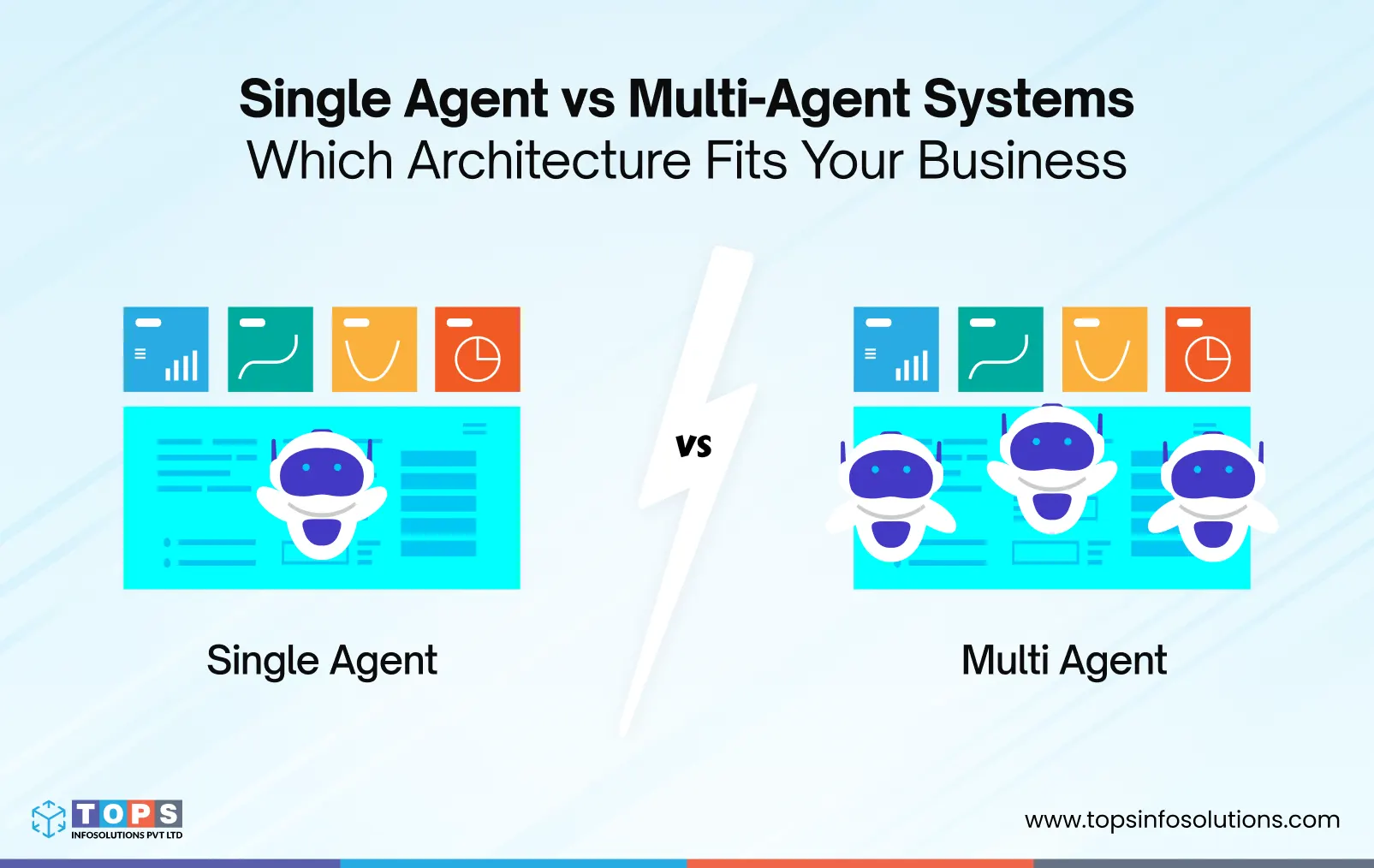
The agentic AI hype cycle has made “multi-agent” sound like an upgrade path. But the single agent vs multi-agent systems decision isn’t about which one is more advanced. It’s a different set of tradeoffs, not a strictly better one.
Anthropic’s research says that its own engineering team, who built one of the more well-documented multi-agent research systems in production, found that agents typically use about four times more tokens than a standard chat interaction. Multi-agent AI use roughly fifteen times more. That cost has to be justified by the value of the task, not absorbed by default.
Coordination introduces its own failure modes. Worker agents can duplicate effort, disagree, or lose critical context that never made it across the handoff. Monitoring, testing, and debugging a five-agent system is a fundamentally harder problem than tracing one continuous decision path.
None of this means multi-agent systems aren’t worth building. It means the complexity has to buy you something real: parallelism, specialization, or scale you genuinely can’t get otherwise. Simplicity wins by default. Complexity has to earn its place.
When a Single AI Agent Is the Right Choice
A single agent is the right call when the work is fundamentally sequential and stateful, meaning each step depends directly on everything that came before it.
Look for these signals:
- Sequential workflows: steps happen one after another, not in parallel
- Limited tool integrations: the agent touches one or two systems, not a dozen
- Centralized knowledge: one source of truth, not fragmented across departments
- Internal assistants: answering questions from a defined knowledge base
- Customer support: resolving a ticket from open to close
- Document processing: reading, extracting, and summarizing a single document
- CRM assistants: logging activity, drafting outreach, updating records
If you can describe the task as “one worker doing one job from start to finish,” a single agent will almost always be faster to build, easier to debug, and cheaper to run than the multi-agent alternative. Making that call before you build is one of the affordable decisions in any AI application development project.
When a Business Actually Needs a Multi-Agent System
A multi-agent system earns its complexity when the work genuinely spans multiple domains, tools, or teams, and when parts of it can run in parallel without depending on each other.
This shows up in scenarios like:
- Cross-functional workflows that touch several departments in a single process
- Multiple business systems (ERP, CRM, WMS) that all need to feed into one decision
- Parallel task execution, where waiting for one step before starting the next would be wasteful
- Specialized domain expertise, where one agent optimized for compliance shouldn’t also be optimized for customer tone
- Long-running workflows that span hours or days, not a single session
- Human approval steps built into the process at multiple checkpoints
- Enterprise-scale automation where volume alone justifies distributed processing
We see that the businesses that get the most value from multi-agent architecture are the ones who could point to a specific coordination problem, not a general desire to “have agents.” The architecture followed the problem, not the other way around.
Single Agent vs Multi-Agent Systems: Side-by-Side Comparison
| Factor | Single Agent | Multi-Agent System |
|---|---|---|
| Complexity | Low, one continuous logic path | High, requires coordination logic |
| Cost | Lower, roughly 4× standard chat token usage | Higher, up to 15× standard chat token usage |
| Development effort | Faster to build and ship | Longer build cycle, more architecture upfront |
| Scalability | Limited by context window and sequential speed | Scales well for parallel, high-volume work |
| Speed | Sequential, can be slower for broad tasks | Parallel, faster for multi-part problems |
| Coordination | Not needed | Critical to success, a real risk if unmanaged |
| Maintenance | Simpler to debug and monitor | More moving parts to test and observe |
| Best-fit scenarios | Support tickets, CRM tasks, document processing | Cross-system workflows, parallel research, enterprise-scale automation |
How to Decide Which Architecture Fits Your Business
Before committing engineering time to either direction, run your use case through these five questions. Getting the single agent vs multi-agent systems call right at this stage saves months of rework later, and each one is designed to surface a concrete signal, not a gut feeling.
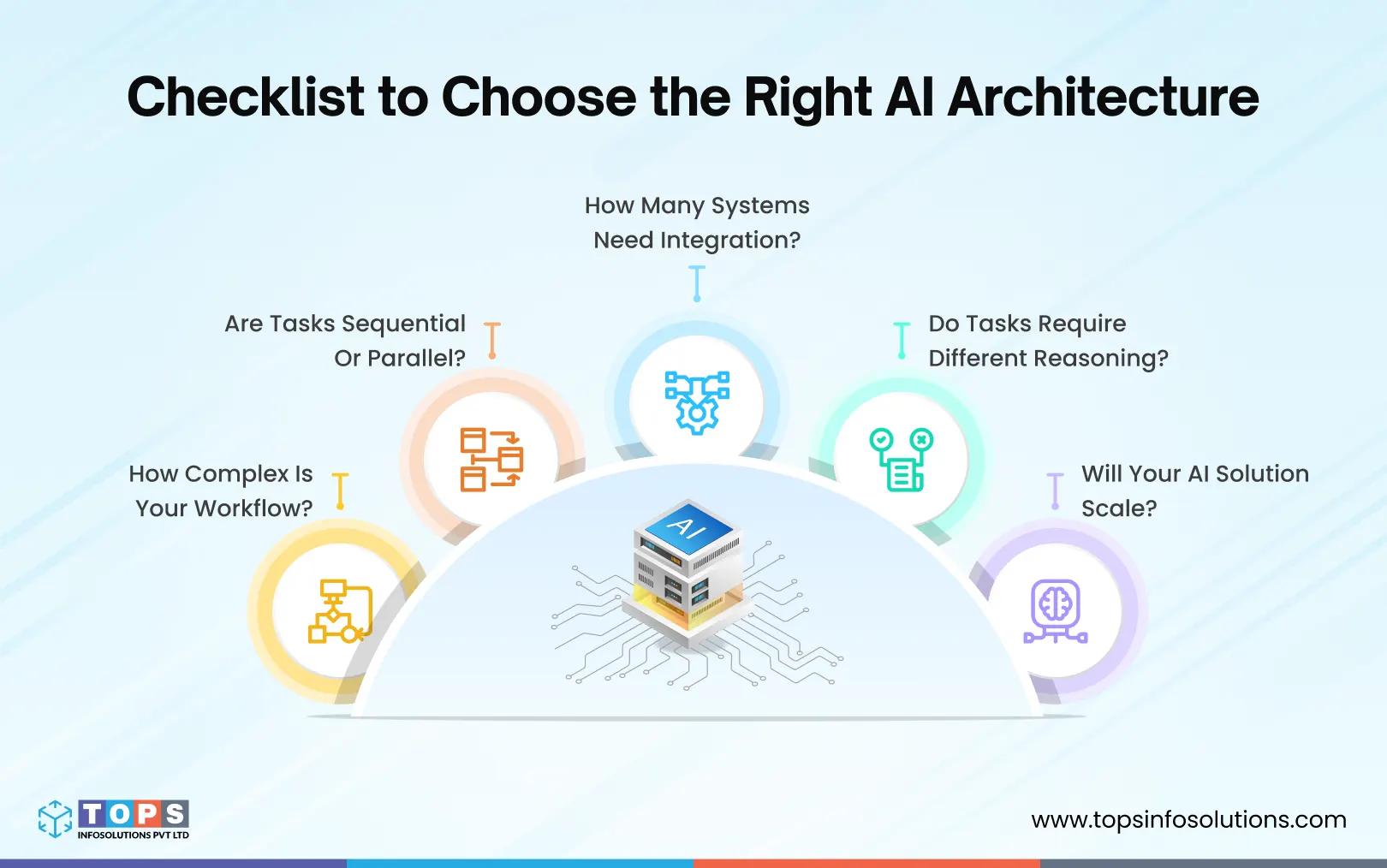
- How complex is the workflow?
Consider the actual steps involved and not the idealized version. A workflow with three to five clear steps handled by one role means a single agent is ideal. On the contrary, a workflow that splits across multiple roles, each requiring different judgment calls, is a signal for a multi-agent. Instead of making it too complex, just think that if a task requires more than one type of expertise to execute well, a multi-agent system is the way to go. - Are tasks mostly sequential or parallel?
Sequential means step two cannot start until step one finishes, and every step depends on full context from what came before. Parallel means multiple parts of the work could happen at the same time without waiting on each other. If your workflow is sequential, adding agents adds coordination overhead without adding speed. If it’s genuinely parallel, splitting the work is where multi-agent earns its cost. - How many systems need to be integrated?
Count the actual number of distinct systems the workflow touches: your CRM, ERP, inventory platform, support desk, and so on. One or two systems can usually be handled cleanly by a single agent with the right tool access. Four or more systems, each with different data structures and logic, tend to benefit from dedicated agents that specialize in one integration each rather than one agent trying to hold all of it in its head. - Do different tasks require genuinely different reasoning?
This is about tone, risk tolerance, and depth, not just topic. A compliance check needs to be conservative and exhaustive. A customer-facing response needs to be fast and warm. Asking one agent to switch between these modes reliably is harder than it sounds, and it’s one of the clearest signals that specialized agents will outperform a single generalist. - Will the solution need to scale over time?
Think in terms of volume, not ambition. If the workload is going to grow from dozens to thousands of transactions a month, or if new use cases will keep getting added to the same system, building the coordination layer now is usually cheaper than retrofitting it later once the single agent has become a bottleneck everyone depends on.
Putting it together: if your answers lean toward “a few clear steps, mostly sequential, one or two systems, similar reasoning throughout, and modest near-term growth,” start with a single agent and prove the use case works before adding complexity. If three or more of your answers lean the opposite way, the coordination overhead of a multi-agent system is likely worth the investment.
Wrapping Up
Mid-market teams are under real pressure to move fast on AI, but speed without the right architecture creates rework and risk. The businesses that get this decision right are the ones who mapped their actual workflow first and let that shape the build.
That’s the approach we bring to every AI engagement: understand what the workflow actually demands, then architect toward that, whether it’s one focused agent or a coordinated team. We’ve built both for operations teams who needed a system that fit their business, not a system built to impress.
As an agentic AI company, we help operations leaders make this call with evidence, not guesswork, and build whichever approach fits, scaling it as the business grows.
Frequently Asked Questions (FAQs)
Not always. Multi-agent systems tend to outperform on broad, parallelizable tasks like research or cross-system analysis. For narrow, sequential tasks, a well-built single agent is often just as accurate and far cheaper to run.
Multi-agent systems can use significantly more tokens than a single agent handling the same category of task, since each worker agent maintains its own context. The exact multiplier depends on how many agents are involved and how much they need to communicate.
Yes, and this is usually the right approach. Starting simple lets you validate the use case before investing in orchestration, and most well-architected single agents can be extended into a lead-agent pattern later without a full rebuild.
Coordination failure. Agents can duplicate work, act on stale or incomplete context, or produce conflicting outputs if the handoffs between them aren’t carefully designed and tested.
Generally, yes. More agents means more integration points to monitor, more failure modes to test for, and a harder debugging path when something goes wrong compared to a single continuous agent.
If your current process already involves multiple specialized roles working across separate systems, and you’re hitting real bottlenecks trying to force that into one agent, that’s a strong signal you’re ready.
Not quite. Traditional AI workflow automation tools orchestrate fixed steps in a predefined sequence. Multi-agent systems involve AI agents making independent reasoning decisions within their piece of the workflow, which can then be connected to automation tools for execution.
Industries with cross-functional, high-volume workflows tend to benefit most, including logistics, healthcare operations, financial services, manufacturing, and e-commerce fulfillment.