




Quick Summary
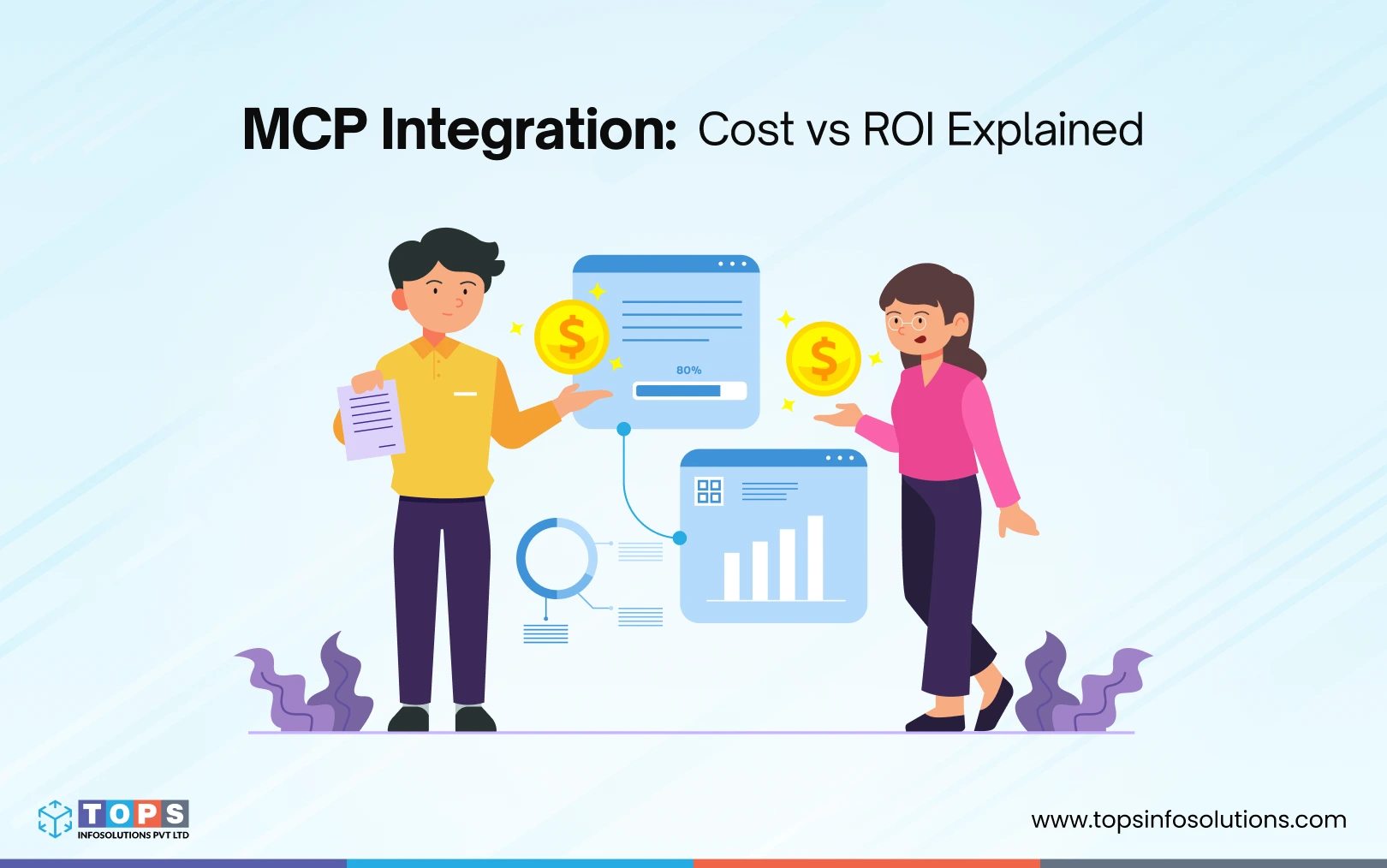
MCP integration enables AI systems like Claude to securely access business data, tools, and workflows in real time. For most companies, implementation costs stay within the $6,000–$36,000 range, while the long-term value comes from faster decisions, streamlined operations, and improved team efficiency.
Key Takeaways:
-
- Integration costs vary based on system complexity
- Clean APIs reduce development time and effort
- With MCP, teams spend less time switching between platforms
- AI-assisted workflows powered by MCP improve operational speed
- Compliance requirements can increase MCP implementation costs
- Businesses often recover investment within months
Most teams hear about Model Context Protocol or MCP integration and picture a months-long engineering project with a six-figure budget.
But that’s rarely the reality.
In modern, API-accessible systems, there’s typically no need for a full infrastructure overhaul. You’re building a bridge between what you already have and Claude or other MCP-compatible AI systems.
For most software companies, the MCP integration cost comes down to developer time, while the return shows up quickly in recovered productivity.
Here’s what that cost-to-return equation actually looks like in practice.
What MCP Integration Actually Involves
When a software development company wants to connect its product to Claude using MCP, the work is more focused than most people expect.
- An MCP integration is built to expose your system’s data and tools to AI in a structured way. If you’re not fully familiar with how MCP works, it helps to understand the core concept before diving deeper.
- Claude connects to it, understands what’s available, and can query or act on it mid-conversation.
- For a mid-scale software product connecting one to three internal systems, a focused team with MCP experience can go from kickoff to a working integration in roughly one week.
That timeline shapes everything about the cost conversation.
What Does MCP Integration Actually Cost?
Here’s how the MCP integration cost breaks down by complexity.
| Complexity | Systems Connected | Estimated Hours | Approximate Cost |
|---|---|---|---|
| Basic | 1 system, simple data reads | 60 – 110 hours | $6,000 – $15,000 |
| Medium | 2–3 systems, business logic | 160 – 260 hours | $16,000 – $36,000 |
| Complex | 4+ systems, compliance, access control | 400 – 650 hours | $40,000 – $90,000 |
integrations fall into the basic to medium range. Hence, the cost of MCP integration would range from $6,000 – $36,000
Beyond development, ongoing costs are straightforward:
- API usage: Claude charges per token. For moderate usage, expect $300 – $800/month
- Infrastructure: Cloud hosting for your MCP server runs $150 – $500/month
MCP Integration ROI: What You Get Back
The return on a focused MCP integration is faster than most technology investments because the productivity impact is immediate and visible.
Knowledge workers such as analysts, coordinators, support teams, and operations staff who currently switch between systems to gather context before making decisions can recover that time the moment the integration is live.
Based on the latest AI adoption data, teams consistently report saving 40 to 60 minutes per day per user through context-aware AI tools.
Take a conservative 30 minutes recovered per person per day. Across a team of 25 people at a $50 loaded hourly cost:
25 × 0.5 hrs × $50 × 250 days = $156,250/year in recovered productivity
Against a medium-complexity integration cost of roughly $16,000–$36,000, that’s a payback period of two to three months.
What Affects the MCP Integration Cost?
Not every integration is the same. The variables that move the number up or down most significantly include:
- Number of systems being connected: Each additional data source adds development time
- Data structure quality: Clean, well-documented APIs integrate faster than legacy systems with inconsistent data
- Access control requirements: Role-based permissions and audit logging add meaningful engineering time
- Compliance needs: Regulated industries add testing, documentation, and security review time
- Industry-wise MCP use cases: Regulated industries like healthcare or finance require stricter compliance, auditability, and data handling, which increases development and testing effort
If your existing systems are well-structured and API-accessible, you’re likely looking at the lower end of the range. If you’re working with legacy infrastructure or have strict compliance requirements, budget accordingly.
How to Get Started
Before you burn expenses and wait for results to show up, prepare a pilot plan and consider the following points:
- Start with one high-value workflow instead of a platform transformation
- Audit your existing systems and know which data sources you want Claude to access and whether they have documented APIs
- Define what success looks like, such as hours recovered, query resolution time, error rate reduction, etc
- Work with an AI service partner who has shipped MCP in production
Is MCP Integration Right for Your Organization?
Three questions to apply to your own context before committing:
1. Is context the bottleneck in your highest-value workflows? If your teams are switching systems, re-briefing the AI every session, or making decisions with incomplete information, you have a context problem with a calculable cost.
2. Do you have the data infrastructure to support integration? MCP connects AI to existing systems. If your operational data is fragmented or poorly structured, that’s the prerequisite conversation.
3. What is the cost of not solving this in the next 12 months? Every month without a solution is recoverable productivity left on the table and a widening gap between your AI maturity and your competitors’.
The Bottom Line
Model Context Protocol ROI at the enterprise level is real and predictable. But the more important number is what you recover. MCP integration cost is more accessible than most people assume.
For a focused, single-workflow integration connecting your software to Claude, an AI development company like TOPS Infosolutions can deploy a solution in days to weeks, not months.

Frequently Asked Questions (FAQs)
MCP integration connects your existing software systems to AI models like Claude through a structured interface. Think of it as an API for AI as it allows the AI to connect to external systems to access real-time data, understand context, and take actions within your product.
A basic working MCP prototype can be built in about a week. Production-ready integrations typically take two to four weeks, depending on the number of systems, data complexity, and compliance requirements.
In most cases, no. MCP works by adding an interface layer on top of your existing system. However, older or tightly coupled systems may require additional work like API wrappers, redirects, or middleware.
Any system with accessible data and APIs can be connected. This includes CRMs, ERPs, internal tools, analytics platforms, and customer support systems.
The biggest MCP integration cost factors include:
- Number of systems being connected
- Quality and structure of existing APIs
- Access control and permission requirements
- Compliance and security needs
Most integrations fall between $6,000 and $36,000 for basic to medium complexity. More complex implementations involving multiple systems and compliance requirements can go higher.
Teams often see productivity gains from reduced context switching and faster decision-making. Even a conservative estimate of 30 minutes saved per user per day can lead to significant annual cost savings of more than $100, 000.
Yes, but with some additional effort. Legacy systems may require API layers or middleware to make them compatible with MCP, which can increase implementation time.
Start with a single high-impact workflow. Identify the systems involved, ensure API access, and define clear success metrics before expanding further.