

Quick Summary
AI in logistics has moved past pilot projects and into daily operations, but most of that value comes from three specific applications: route optimization, demand forecasting, and predictive maintenance. This post breaks down how each one actually works, what separates a custom-built system from an off-the-shelf tool, and how to start without overhauling your entire tech stack at once.
-
- Rule-based route planning and demand spreadsheets break down under real-world variability. AI systems adapt because they learn from live data instead of following fixed logic.
- Off-the-shelf AI tools are trained on generic data. Custom AI accounts for your specific fleet, routes, and existing systems.
- Successful adoption starts with one high-friction process and clean data, not a full-stack AI rollout.
Most logistics businesses have already embraced technologies in their processes, be it a Warehouse Management System, Transportation Management System, or GPS Tracking.
But here’s the thing: these systems follow fixed rules. And fixed rules don’t hold up well against traffic changes, demand spikes, or equipment wearing down in ways no schedule accounts for.
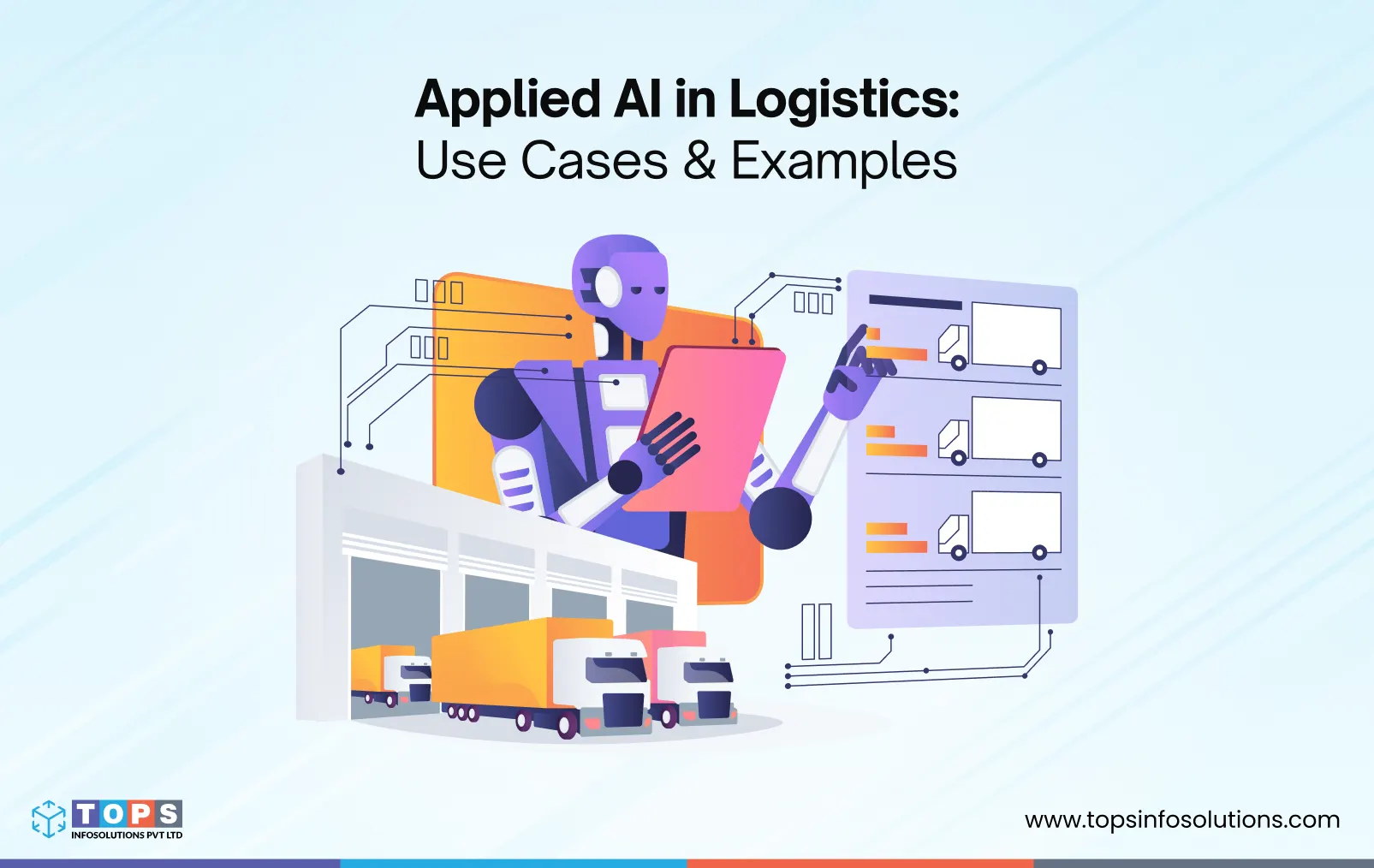
Applied AI in logistics now touches three areas that directly affect cost and service reliability: route optimization, demand forecasting, and predictive maintenance.
For operations leaders managing tight margins and rising delivery expectations, these three applications are no longer experimental. They’re becoming the baseline for how competitive logistics operations run.
This blog walks through how each one actually works, why custom-built AI tends to outperform generic tools in this space, and how to get started without betting the whole operation on a single rollout.
What is applied AI in logistics?
Applied AI in logistics refers to using AI and machine learning with operational data to improve transportation, fleet, warehouse, inventory, and supply-chain decisions. Common applications include route optimization, demand forecasting, predictive maintenance, carrier selection, and shipment planning.
| AI Application | Primary Goal |
|---|---|
| Route optimization | Reduce travel time and transportation costs |
| Demand forecasting | Predict future shipment/order volumes |
| Predictive maintenance | Reduce unexpected equipment downtime |
| Carrier selection | Improve cost and delivery reliability |
| Load optimization | Improve vehicle utilization |
| Fleet management | Improve vehicle performance and availability |
Why Logistics Companies Are Adopting AI
The logistics industry has no shortage of technology. Transportation Management Systems (TMS), Warehouse Management Systems (WMS), GPS tracking, and planning software have helped streamline day-to-day operations for years. Yet many critical decisions still rely on static rules and manual intervention.
That approach works when operations are predictable. But logistics rarely is.
Traffic conditions change without warning. Customer priorities shift. Vehicles break down. Weather disrupts schedules. Demand spikes faster than planners expect.
When several of these factors occur simultaneously, rule-based systems can only react within the limits of the instructions they were given.
This is exactly where AI in supply chain and logistics is starting to close the gap. Instead of following predefined rules, it continuously analyzes operational data, identifies changing patterns, and recommends better decisions as new information becomes available. Rather than replacing dispatchers or planners, it gives them better insights to act on.
The Difference Between Rule-Based Automation and Applied AI
| Rule-Based Automation | Applied AI |
|---|---|
| Follows predefined rules | Learns from historical and live data |
| Produces the same output for the same inputs | Continuously adapts as conditions change |
| Requires manual rule updates | Improves recommendations over time |
| Responds after disruptions occur | Identifies patterns that may signal problems earlier |
| Best for repetitive tasks | Best for complex, changing operational decisions |
What’s Actually Driving Urgency in 2026
Several operational challenges are making AI in logistics a higher priority:
- Rising transportation costs: Fuel, labor, and maintenance expenses continue to squeeze margins, making efficiency more important than ever.
- More frequent disruptions: Traffic congestion, severe weather, supplier delays, and shifting customer demand make static planning increasingly unreliable.
- Higher customer expectations: Faster deliveries and real-time shipment visibility leave little room for operational delays.
- Pressure to do more with existing resources: Many companies need to improve service levels without expanding fleet size or headcount.
For many organizations, the tipping point is a costly operational failure, such as a missed SLA, an unexpected vehicle breakdown, or a peak-season forecast that misses demand. These events expose the limits of legacy systems, prompting leaders to explore Applied AI and custom software development solutions that can adapt to changing operational needs, improve decision-making, and support more efficient logistics operations.
Use Cases of Applied AI in Logistics
Route Optimization: Beyond Static Route Planning
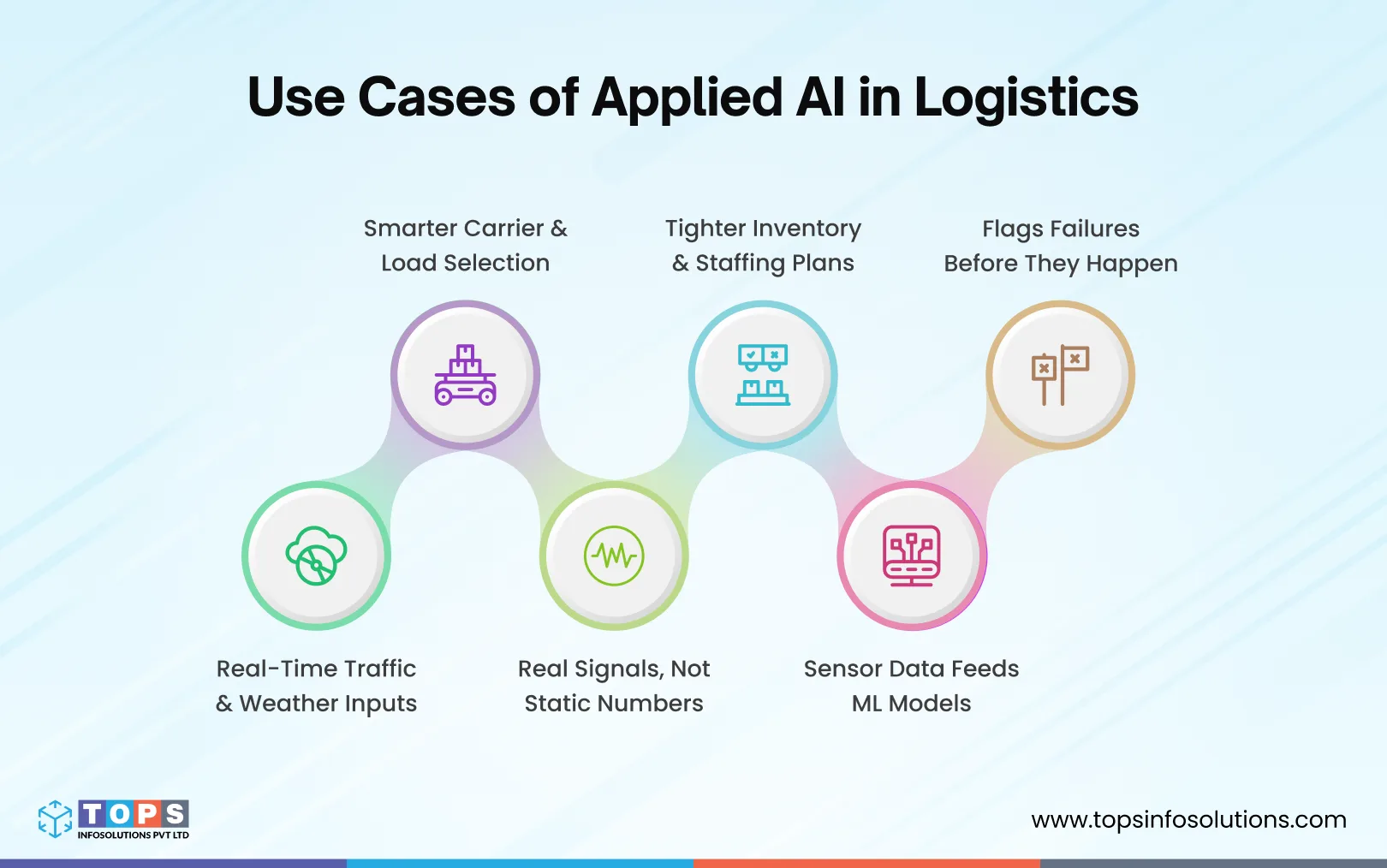
Traditional route planning software calculates a route once, based on distance and maybe historical traffic averages, and sticks with it. That works fine until a road closes or a delivery window shifts.
Real-Time Inputs That Static Planning Tools Miss
AI-driven route optimization pulls in live traffic data, weather conditions, and delivery time windows. It then recalculates continuously rather than once at the start of the day. This is closer to how a highly experienced dispatcher thinks, except it can process far more variables at once and never gets fatigued by hour ten of a shift.
Carrier Selection and Load Optimization
Beyond routing, machine learning models can score carriers to determine which is likely to deliver the best combination of cost, speed, and reliability for a specific shipment, rather than defaulting to whichever carrier has the standing contract. The same models can determine how to pack a delivery vehicle to maximize capacity without risking damage to goods, which directly affects how many trips a fleet needs to make.
What Changes for Dispatchers Day to Day
The practical shift is from constant manual planning to exception-based management. Dispatchers stop re-plotting every route by hand and start reviewing the small percentage of cases where the system flags something unusual, like a delivery window that’s about to be missed. That’s a meaningfully different job, and it’s part of why adoption often stalls: the tool has to earn trust before dispatchers stop double-checking every recommendation.
Demand Forecasting: Planning Around Real Signals
Ask most ops leaders how their team forecasts demand, and the honest answer usually involves a spreadsheet, last year’s numbers, and some amount of gut feel. That approach works reasonably well until volume spikes.
Why Traditional Forecasting Breaks Down
Statistical methods like exponential smoothing were built for relatively stable, predictable demand. They struggle with high-variability conditions, which describe most logistics operations during peak season, promotional periods, or any kind of market disruption.
What AI Forecasting Models Actually Ingest
AI-based forecasting models combine historical sales data with real-time signals such as seasonality, promotional calendars, and shifting market trends to produce forecasts that update as conditions change, rather than a static number set once a quarter. Instead of a single forecast, this looks more like a continuously adjusting picture that gets more accurate the closer you get to the delivery date.
Downstream Impact on Inventory and Staffing
Better forecasts don’t just prevent stockouts. They let operations teams set safety stock and reorder points more precisely, reducing capital tied up in excess inventory, and they let staffing plans reflect actual anticipated volume instead of rough estimates, cutting both overtime costs and the risk of being short-staffed during a spike.
Read Also : – Choosing between Single-Agent vs Multi-Agent Systems
Predictive Maintenance for Logistics Fleets
Every fleet knows the difference between a breakdown in the yard and a breakdown mid-route. The first is an inconvenience: swap the vehicle, service it, move on. The second is a missed delivery window, a customer call, and a dispatcher rerouting live loads under pressure.
Predictive maintenance aims to move failures from the second category to the first, or to prevent them altogether, by catching early signs of wear before they become a roadside event.
How Sensor Data and ML Models Predict Failure
As a core component of fleet management AI, predictive maintenance systems collect data from sensors that monitor vibration, temperature, and usage patterns on vehicles or equipment. They then feed that data into machine learning models trained to recognize the early signals of an impending failure. The goal isn’t to guess when something might break. It’s to catch the specific pattern that precedes a known failure mode, often weeks before it would otherwise be noticed.
Reactive vs. Preventive vs. Predictive: Why the Distinction Matters
Reactive maintenance fixes things after they break, which is the most expensive and disruptive option. Preventive maintenance services equipment on a fixed schedule regardless of actual condition, which reduces some risk but wastes money replacing parts that didn’t need it yet. Predictive maintenance services equipment based on its actual condition, which is where most of the cost savings show up.
Reduce Downtime for Maintenance
The potential impact can be significant, but the results vary by fleet, equipment type, data quality, and implementation. For example, a recent study of AI- and machine-learning-based condition monitoring for logistics equipment reported a 30–50% reduction in equipment downtime and a 20–40% reduction in maintenance costs. The study also found improvements in equipment availability and maintenance planning.
For logistics companies, the bigger opportunity is not simply reducing maintenance costs. Predictive maintenance can help teams identify potential failures earlier, schedule repairs before breakdowns occur, reduce emergency maintenance, and keep critical vehicles and equipment available for operations. The actual results, however, depend on the quality of sensor and maintenance data, the equipment being monitored, and how accurately the AI model can identify failure patterns.

Why Custom AI Delivers More Value Than One-Size-Fits-All Solutions
Off-the-shelf AI tools for route optimization or demand forecasting can be a reasonable starting point, especially for smaller operations. But most logistics businesses eventually hit a ceiling with them, and it’s worth understanding why before you commit a budget to one.
Where Off-the-Shelf Tools Hit a Ceiling
Most logistics automation software on the market is trained on generic patterns, pulled from a broad mix of fleets, regions, and business models that don’t necessarily resemble yours. A route optimization tool built for last-mile parcel delivery in dense urban areas won’t perform the same way for a regional freight operation running mixed truckload routes across rural highways.
What Custom AI Can Account For That Packaged Tools Can’t
A custom-built system can be trained on your actual fleet mix, your regional constraints, your existing TMS, WMS, and telematics data, and the operational rules specific to how your business runs. That matters more than it sounds. A generic forecasting model doesn’t know that your busiest lane shuts down for three weeks every winter because of a mountain pass closure. Yours can.
Build, Buy, or Blend: How to Think About the Decision
Off-the-shelf tools make sense for smaller operations with straightforward routes and limited internal engineering capacity. Custom AI tends to make more sense once you’re managing enough complexity (multiple facilities, varied fleet types, tight margins) that generic assumptions start costing real money. Many logistics operations land somewhere in between: a packaged tool for one function and a custom build for the process that’s genuinely unique to how they operate.
How to Get Started with AI in Logistics
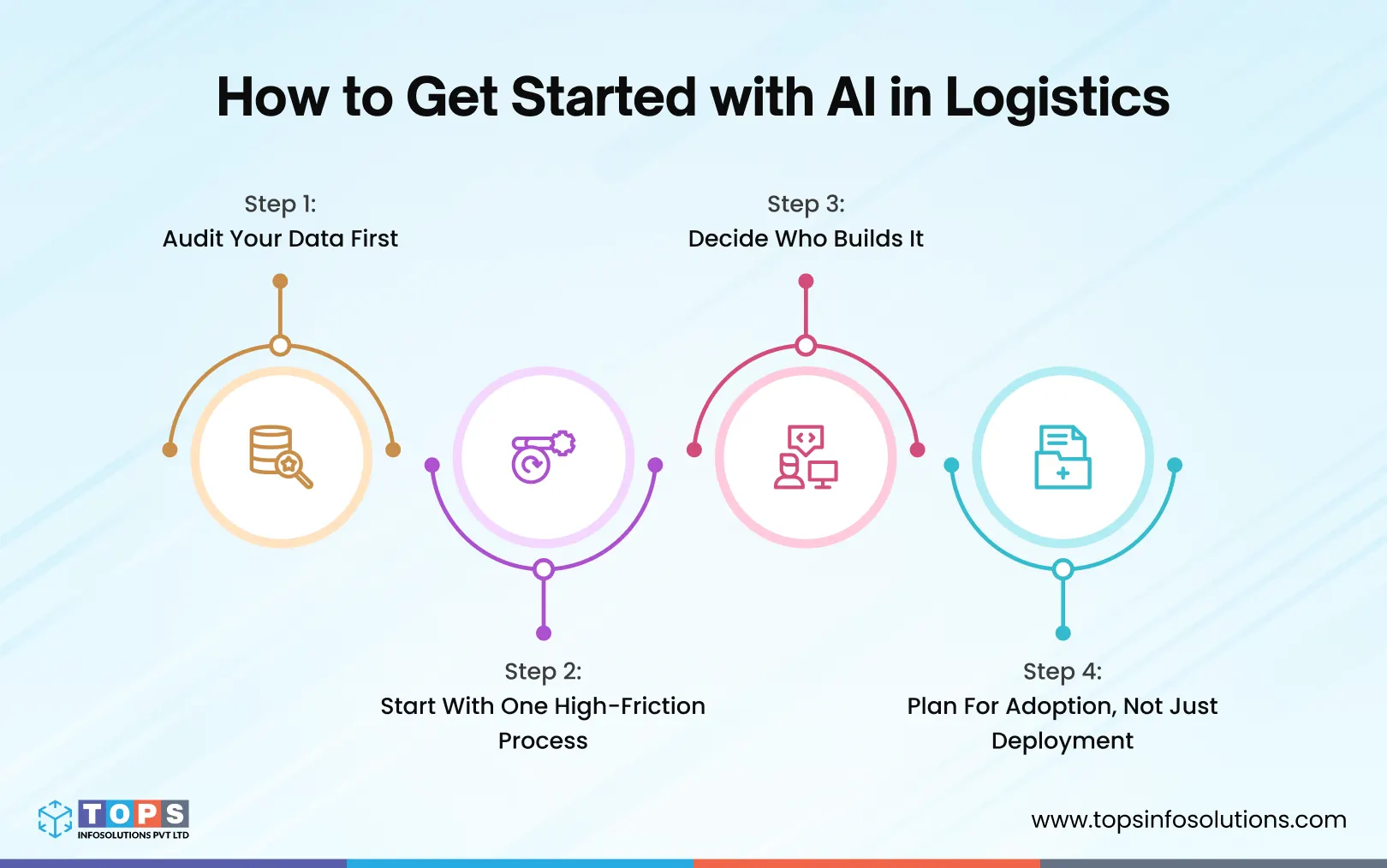
Getting started doesn’t mean deploying AI across every function at once. It means picking the right entry point and building from there.
Step 1: Audit Your Data Before You Audit Vendors
Before evaluating any tool or partner, take stock of what data your TMS, WMS, and telematics systems actually capture, how clean it is, and whether it lives in silos that don’t talk to each other. This step alone often surfaces the real blocker to AI adoption, and it’s rarely the AI itself.
Step 2: Pick One High-Friction Process, Not Everything at Once
Choose the single process causing the most operational pain, whether that’s route planning, demand forecasting, or maintenance scheduling, and start there. A focused pilot within your logistics software solutions can build internal confidence and provide a clear before-and-after comparison, rather than trying to prove value across three systems simultaneously.
Step 3: Decide Who Builds It
Some logistics companies have the internal engineering capacity to build and maintain AI systems in-house. Most don’t, and that’s where a logistics software development partner comes in that can optimize the cost of AI in software development. This is the kind of problem custom software is built to solve. Rather than replacing an existing TMS or WMS outright, a custom dashboard and workflow automation layer built on top of those systems can surface AI-driven recommendations without disrupting what already works operationally.
Step 4: Plan for Adoption, Not Just Deployment
A model that’s technically accurate but that dispatchers don’t trust isn’t delivering value yet. Build in a transition period where AI recommendations run alongside human judgment, and give the team a way to see why the system made a given call. Trust gets built through visible, consistent accuracy, not through a launch announcement.
Read Also :- Why Your LLM App Needs an Evaluation Layer for AI in Production
Common Mistakes Logistics Companies Make with AI Adoption
Even the best AI solution can fall short if it’s introduced without the right strategy. Here are some common pitfalls to avoid:
- Treating AI as a plug-and-play solution: AI delivers the best results when it’s tailored to your workflows, data, and operational goals.
- Ignoring data quality: Inaccurate, incomplete, or siloed data leads to unreliable recommendations and poor outcomes.
- Trying to automate everything at once: Start with one high-impact use case, prove the ROI, and scale gradually.
- Overlooking frontline adoption: Dispatchers, planners, and maintenance teams need to understand and trust AI recommendations for successful implementation.
- Expecting instant results: AI models improve over time as they learn from new data. Measuring success requires realistic timelines and continuous refinement.
- Failing to integrate with existing systems: AI works best when connected to your TMS, WMS, ERP, and other operational platforms, creating a seamless flow of data across the business.
Wrapping Up
Route optimization, demand forecasting, and predictive maintenance are no longer separate initiatives. Together, they represent a shift from reactive planning to systems that adjust as conditions change.
The operations teams that benefit will be the ones that start with clean data, one high-friction process, and a partner who can build around their existing systems rather than replace them. As a custom AI and software development company, we help operations leaders figure out where that starting point actually is.
Frequently Asked Questions (FAQs)
Applied AI in logistics refers to using artificial intelligence and machine learning to solve specific operational challenges across transportation, warehousing, fleet management, and supply chain operations. Instead of simply automating predefined tasks, Applied AI uses real-world business data to identify patterns, make predictions, and recommend actions. Common applications include route optimization, demand forecasting, ETA prediction, fleet management, inventory planning, and predictive maintenance. Businesses can integrate these capabilities into existing logistics systems or build them into custom logistics software solutions based on their operational needs.
Route optimization and demand forecasting can show measurable improvements within a few weeks of deployment, since they work with data you likely already have. Predictive maintenance takes longer, typically a few months, because the models need enough sensor history to reliably recognize failure patterns.
No. Most mid-market logistics companies partner with an AI or software development firm rather than building an internal data science function from scratch. What you do need is clean, accessible data from your existing systems.
AI route optimization works differently, recalculating continuously as conditions change. AI-powered route optimization continuously factors in real-time conditions like traffic and weather, adjusting recommendations as circumstances change.
It scales down further than most people expect. Even a mid-sized fleet with a dozen vehicles can benefit from sensor-based failure prediction, particularly if unplanned downtime is already a recurring cost.
It depends heavily on scope. A phased pilot focused on one process (route optimization, for example) costs significantly less than a full predictive maintenance rollout across a fleet, and most companies start with the smaller scope intentionally.
It can, but results improve significantly once data quality issues are addressed. Part of a proper implementation includes assessing and cleaning up data sources before the forecasting model goes live, which is often where the real work happens.
It depends on the complexity of your operation. Simpler, single-facility operations often do fine with packaged tools. Companies managing multiple facilities, varied fleet types, or unique operational constraints tend to see more value from a custom-built system.
The data you need depends on the AI use case, but most logistics AI projects typically require historical and real-time operational data. This can include shipment and delivery records, GPS and vehicle data, route history, traffic information, warehouse and inventory data, maintenance records, fuel consumption, customer orders, delivery times, and weather conditions. For predictive maintenance, equipment sensor data and past failure records are especially useful. Before implementation, it’s important to assess the data for accuracy, completeness, consistency, and accessibility. Clean, well-structured data gives AI models a stronger foundation for making reliable predictions and recommendations.
Yes. AI can integrate with an existing Transportation Management System (TMS) or Warehouse Management System (WMS) without replacing the entire system. Using APIs, data connectors, and integration layers, AI can work with existing shipment, inventory, vehicle, warehouse, and operational data. This allows businesses to add capabilities such as route optimization, demand forecasting, ETA prediction, inventory insights, and predictive maintenance while keeping their current systems in place. A phased integration is often the better approach, starting with one high-impact use case and expanding once the results are validated.
AI can be applied across different areas of logistics to improve efficiency, reduce costs, and support faster decision-making. Common use cases include route optimization, demand forecasting, predictive maintenance, ETA prediction, fleet management, load optimization, warehouse automation, inventory planning, and shipment risk prediction. For example, AI can analyze traffic, delivery windows, and historical routes to recommend more efficient routes, while predictive models can identify potential vehicle or equipment failures before they cause unexpected downtime. Businesses can start with one high-impact use case and gradually expand AI across their logistics operations.