

Quick Summary
TensorFlow Lite (now LiteRT) is Google’s runtime for on-device machine learning that runs AI models directly on mobile and embedded devices without cloud connectivity. It delivers instant results, offline functionality, data privacy, and cross-platform support across Android, iOS, and IoT devices.
Key Takeaways:
-
- LiteRT enables on-device inference, eliminating the need for a network round trip and helping applications deliver low-latency responses
- Works offline, making it ideal for apps in remote areas or low-connectivity environments
- Data never leaves the device, making it suitable for healthcare, fitness, and location-sensitive apps
- Supports model conversion from TensorFlow, PyTorch, JAX, and other frameworks via AI Edge tools
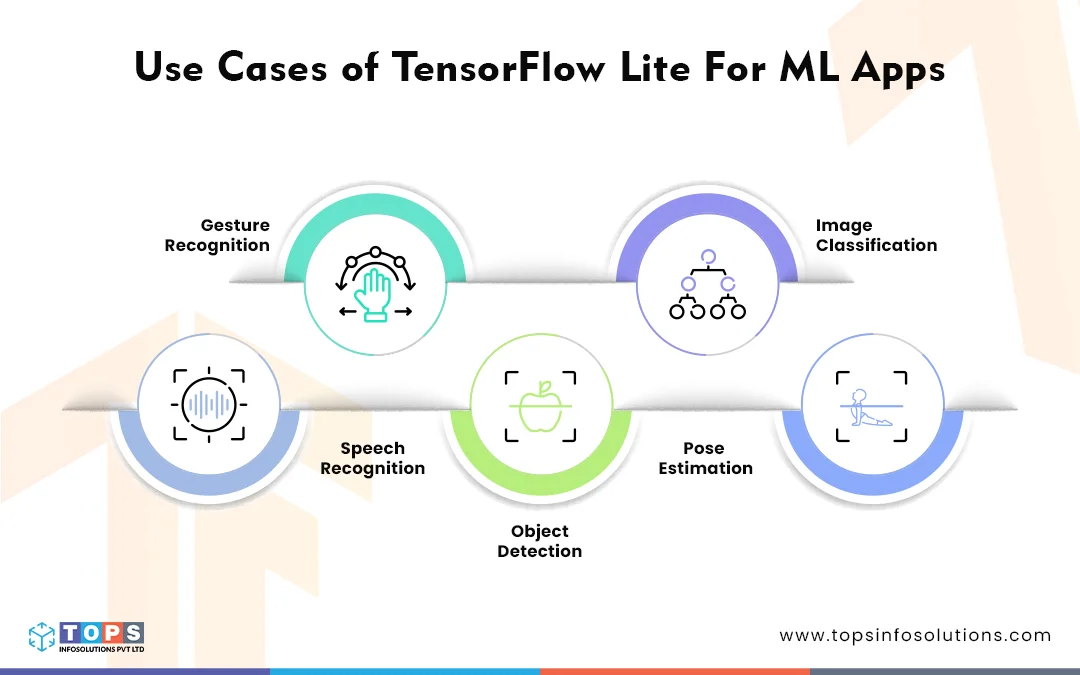
- Key use cases include gesture recognition, image classification, speech recognition, object detection, and pose estimation
- Tools like GPU acceleration and model quantization reduce model size without compromising accuracy
On-device machine learning allows mobile, wearable, embedded and edge devices to run trained AI models locally instead of sending every inference request to a cloud server. TensorFlow Lite, now known as LiteRT, was designed for this type of deployment.
By bringing inference closer to the user, LiteRT can help applications reduce network dependency, improve responsiveness, operate in offline environments and limit the amount of input data that needs to be transmitted to remote infrastructure.
Whether you are building next-gen AI/ML apps or embedding intelligence into hardware, dive into the real benefits and the trend setting use cases of TensorFlow Lite.
What Is TensorFlow Lite (LiteRT) and How Does On-Device ML Work?
LiteRT is built for real-world, on-device ML (ODML). It is super optimized to address the common hurdles developers face when developing AI on mobile and embedded devices.
For instance, you want to add a smart feature to your app like recognizing images or understanding spoken commands, without relying on a suitable internet. LiteRT helps developers run ML models right on the user’s device, making the functionality faster and more efficient.
That’s not all! Let’s break down why TensorFlow Lite is useful for deploying machine learning models on resource-constrained devices for integrating on-device AI and ML capabilities.
Key Benefits of TensorFlow Lite (LiteRT) for On-Device AI
The advantages are practical rather than theoretical. Here is what makes LiteRT the default choice for teams shipping ML features to mobile and embedded devices.
Low-latency inference
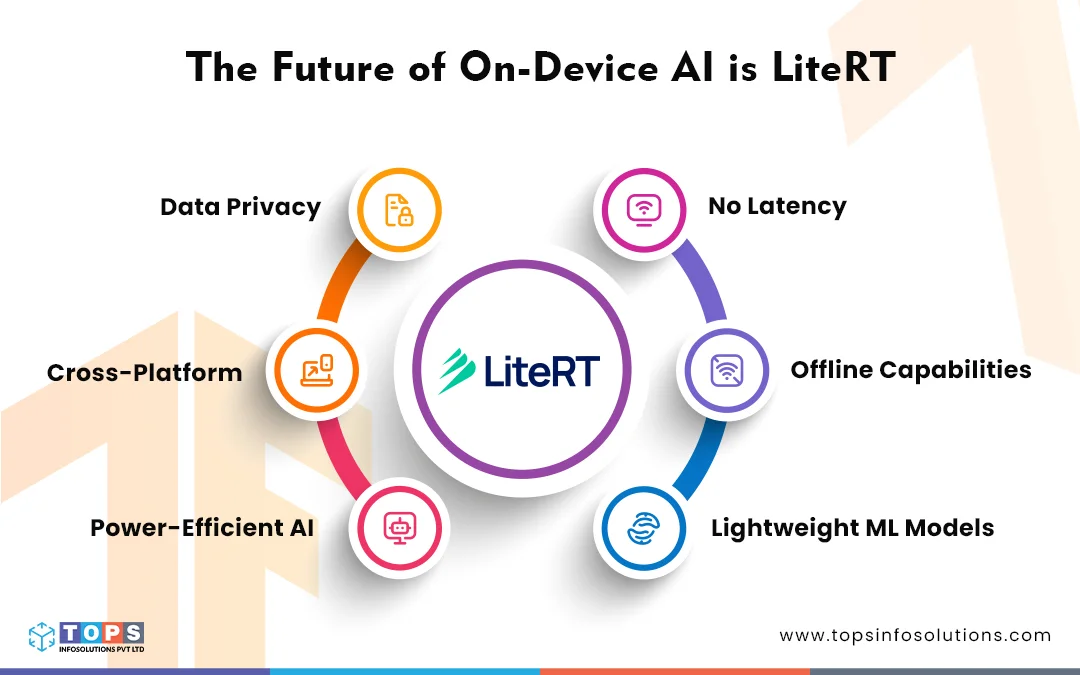
Because inference runs locally, applications can avoid the network round trip required by cloud-based inference. This can improve responsiveness for real-time experiences such as image classification, object detection, speech processing and gesture recognition.
Offline Capabilities
You can use Machine Learning features without needing a constant internet connection, which is perfect for users on the go. TensorFlow Lite is highly used to build apps that need to work in remote areas or for users on the go who don’t always have reliable access to the internet.
Smaller models
TFLite reduces the size of models and binary files, making it perfect for devices with limited storage and processing power. Think of smartwatch, fitness tracker, surveillance apps, or any other IoT device — LiteRT helps run AI tasks smoothly, even in small, resource-constrained environments.
Your Data Stays Private
When inference runs locally, applications can process certain inputs without sending them to a remote server. This can help protect sensitive data. However, application privacy still depends on factors such as architecture, telemetry, storage, and data-sharing practices.
Cross-Platform
Whether you are developing Android, iOS, or IoT devices, TensorFlow Lite works seamlessly across platforms. It’s adaptive and versatile, making it easy to integrate with mobile apps, embedded systems, and edge devices.
Power-Efficient AI
TensorFlow Lite is designed to run Machine Learning models with minimum power consumption. By eliminating the need for constant network connections, it helps extend the battery life of mobile devices and embedded systems.
Ready-To-Run LiteRT Models and Multiple Framework Support
LiteRT makes it easier by offering a library of ready-to-run models for common Machine Learning tasks like language processing, image recognition, and more. But that’s not all – LiteRT also supports conversion tools that allow you to bring in models from other popular frameworks like TensorFlow, JAX, PyTorch, and more.
Using AI Edge conversion tools, developers can quickly optimize and convert these models into TensorFlow Lite format, making them lightweight and efficient for on-device use.
8 Practical TensorFlow Lite (LiteRT) Use Cases
The practical value of LiteRT becomes clearer through its real-world use cases. Here are a few ways it is already transforming everyday experiences.
Gesture Recognition
Have you ever used your phone to recognize a swipe, wave, or tap? TensorFlow Lite can help apps recognize these gestures in real-time. This makes the user interface more intuitive, allowing smooth navigation and a better overall experience.
The steps include collecting sensor data during gestures, using the data to train the ML model, converting the model to TensorFlow Lite format, and integrating it into the mobile app.
Image Classification
Heard of an app that can identify objects in photos instantly? TensorFlow Lite enables mobile apps to classify images using pre-trained models. This automates various tasks in multiple fields like retail apps that can recognize products or healthcare apps that analyze medical images.
With a series of steps which include obtaining a pre-trained model and converting it into TensorFlow Lite format, integrating this format into the mobile app, input images preprocessing, and smoothly running the interface on the model, developers can leverage ML and AI on mobile and embedded devices. This helps build intelligent and innovative mobile apps that can classify and analyze the Images.
Speech Recognition
With TensorFlow Lite, developers can build apps that understand voice commands and convert spoken words into text instantly. This is a game-changer for virtual assistants and transcription apps, making them more efficient and user-friendly.
The steps include gathering speech data as audio files and labeling them with corresponding text, helping the model learn the relationship between sounds and words. This data is used to train the ML model to recognize the audio signals and map them in text. The trained ML model is converted to TensorFlow Lite format, preprocessing the audio input and running the model effortlessly.
Object Detection
TensorFlow Lite is used to build mobile applications that can detect and locate multiple objects in images or videos. This technology is highly useful for security applications like surveillance, in retail for managing inventories, and in a wide range of niche business use cases.
A series of steps include training your own object detection model using annotated images or pre-trained models, converting this model into the LiteRT format, and integrating it into the mobile app.
Pose Estimation
LiteRT is highly used to build next-gen apps for fitness and gaming. It helps apps detect human poses in real-time from images and videos based on the user’s movements, creating an interactive and fun experience.
The steps to integrate pose estimation capabilities involve using a pre-trained pose estimation model, converting it into a TensorFlow Lite format, and integrating it into the mobile app.
TensorFlow Lite Simplifying AI Development For Everyone
Ready to turn your apps into intelligent systems that think on their own? With TensorFlow Lite the future of mobile machine learning is already here. Let’s explore some of its demanding applications.
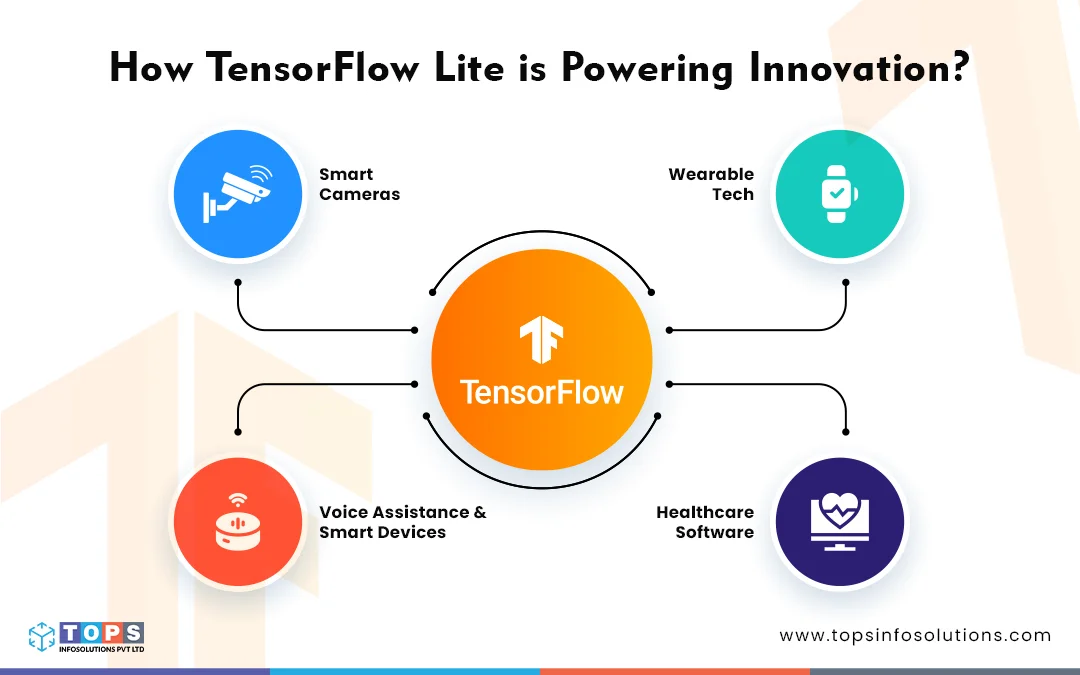
Smart Cameras
From instant object detection to advanced photo editing, LiteRT enables powerful image processing right on your device. Think about the AR filters, face recognition, or real-time object tracking, all without requiring a cloud inference request for every frame.
Wearable Tech
Health monitoring devices and fitness trackers rely on TensorFlow Lite to analyze motion, detect heart rates, and deliver personalized health insights while consuming minimal power.
Voice Assistance And Smart Devices
With LiteRT’s ability to process voice commands in real-time, your smart home assistants can become faster and more responsive even offline.
Healthcare Software
The Medical Imaging apps can now analyze data directly on the device, allowing for faster diagnoses in areas with limited connectivity. Be it scanning X-rays or monitoring vital signs, LiteRT opens the door to real-time healthcare solutions.
How to Build an On-Device ML Application
Whether it’s automating tasks, enhancing app performance, or creating entirely new functionalities, the possibilities with LiteRT are endless.
TFLite’s simple architecture makes it easy to convert and optimize existing models for on-device use. In addition, developers can use pre-trained models to quickly build intelligent apps that not only react to user input but also adapt in real time.
Moreover, the LiteRT framework provides tools such as GPU acceleration and model quantization. As a result, developers can improve performance and reduce ML model size while maintaining accuracy. It brings cutting-edge ML right into the heart of mobile and IoT innovation.
Frequently Asked Questions (FAQs)
TensorFlow Lite is Google’s former name for LiteRT, a runtime designed to deploy machine learning and AI models on mobile, embedded and edge devices.
TensorFlow is designed for training and running large ML models on servers or cloud infrastructure. TensorFlow Lite is optimized for on-device inference, with smaller model sizes and lower power consumption for mobile and edge devices.
Zero-latency on-device processing, offline ML capabilities, data privacy since no data leaves the device, cross-platform support for Android, iOS, and IoT, and power-efficient operation for battery-constrained devices.
Gesture recognition, image classification, speech recognition, object detection, and pose estimation are the five main use cases, with applications in smart cameras, wearables, voice assistants, and healthcare imaging.
Yes. Using AI Edge conversion tools, models from TensorFlow, PyTorch, JAX, and other frameworks can be converted into TensorFlow Lite format for on-device deployment.
Since all ML processing happens on the device with no external server involved, user data never leaves the device, which is critical for apps handling healthcare, fitness, or location data.
Yes. TensorFlow Lite is optimized for resource-constrained environments including smartwatches, fitness trackers, surveillance systems, and other IoT devices with limited storage and processing power.
TensorFlow Lite includes GPU acceleration and model quantization tools that reduce ML model size and improve inference speed without compromising accuracy, making it efficient for real-time on-device applications.
Post-training quantization can reduce model size by about 4× when converting from FP32 to INT8, with only a small accuracy drop in many vision models. Float16 cuts size by roughly half with minimal accuracy impact but usually provides less CPU speedup than INT8. If accuracy drops too much, quantization-aware training can help recover it.
Results vary by model, so always benchmark your model on your own evaluation dataset before and after quantization.
Not typically. LiteRT (formerly TensorFlow Lite) is mainly designed for compact on-device AI tasks such as vision, audio, and sensor processing.
For on-device LLMs, options include Google’s MediaPipe LLM Inference API, Gemini Nano, llama.cpp, ExecuTorch, and MLC LLM. These models are often heavily quantized, such as 4-bit, to reduce memory and heat.
For most apps, a practical approach is to use a small on-device model for routine tasks and a cloud model for more complex requests.