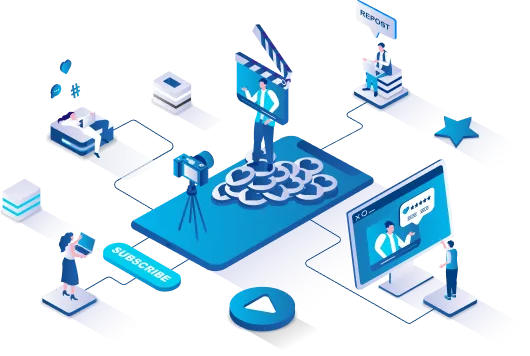










AI-Powered Streaming Platforms Built for Performance, Retention, and Scale

Off-the-shelf video conferencing tools are built for the widest possible audience, which means they rarely fit how a specific team, product, or platform actually needs people to collaborate. Custom video collaboration software solves this by building the meeting experience around your workflow, your existing tools, and the kind of presence you want distributed teams to feel.

TOPS builds AI-powered meeting intelligence, low-latency live streaming, peer-to-peer meeting infrastructure, and integrations with the conferencing and scheduling tools your organisation already runs on. If video and real-time collaboration are core to your product or your internal operations, we build the infrastructure around your specific requirements rather than fitting you into a generic platform's limitations.

Types of Video Collaboration Solutions We Build

Collaboration platforms vary significantly depending on team size, use case, and how "presence" needs to feel. We build every solution around your specific meeting experience and technical requirements.
AI-Powered Meeting Platforms

AI-Powered Meeting Platforms

Meeting platforms with intelligence built directly into the core experience, including automatic meeting summaries, live Q&A responses generated during the session, and AI assistance layered into collaborative whiteboards. Built for teams that want meetings to produce searchable, actionable output, not just a recording nobody watches back.
Live Streaming & Broadcast

Live Streaming & Broadcast

Low-latency, WebRTC-based streaming for town halls, webinars, and large-audience broadcasts. They’re built for near real-time interaction rather than the standard delay of typical broadcast streaming. Covers viewer scaling, live engagement features, and the infrastructure to handle a large audience without degrading call quality.
Peer-to-Peer Video Calling

Peer-to-Peer Video Calling

Direct device-to-device video calling for one-on-one and small group meetings, built on custom WebRTC implementations. Lower latency and full control over the calling experience, without routing every call through a central media server.
On-Demand Session

On-Demand Session

Recording, replay, and searchable archives that make live meetings and sessions accessible after they happen. Built for organisations where a meeting's value doesn't end when the call does, whether that's a training session, an all-hands, or a client call someone needs to reference weeks later.
Virtual Event Platforms

Virtual Event Platforms

Larger-scale, multi-session virtual conferences, corporate town halls, and structured events that go beyond a single live stream. Covers session scheduling, multiple concurrent tracks, speaker management, and attendee engagement across an event that runs longer than one broadcast.
Immersive Presence

Immersive Presence

Purpose-built spaces, physical or virtual, designed to simulate in-person presence between distributed teams and locations. Closer to a life-size, always-on connection between two rooms than a standard scheduled video call, built for organisations that want distributed locations to feel genuinely connected rather than just dialed in.

Our Video Collaboration Software Development Services

Every collaboration engagement is shaped by how your teams work, which tools they already rely on, and the technical performance your platform needs to deliver in real time.
01

Technology Consultation

We first understand your collaboration requirements, existing tool stack, team size, and the kind of meeting experience you're trying to create. Infrastructure approach, latency requirements, and integration dependencies are mapped before any build decisions are made.
02

AI Meeting Intelligence

AI-powered capabilities built directly into the meeting experience: automatic meeting summaries generated once a call ends, live Q&A responses generated in real time as questions come up during a session, and AI assistance layered into collaborative whiteboards to help structure and summarise visual discussion. Built around your meeting formats, not a generic transcription add-on.
03

Live Streaming Development

Built for one-to-many broadcasts, where a single host or small group of presenters needs to reach a large, sometimes very large, audience. Because standard broadcast streaming typically runs 5 to 30 seconds behind the live moment, we build on WebRTC's low-latency transport instead, so viewers can react and ask questions in near real time.
04

Meeting Infrastructure

Built for one-on-one and small group meetings, where devices connect and exchange audio and video directly with each other instead of routing through a server. This removes a hop from the connection, giving the lowest possible latency for small, high-fidelity meetings, though it doesn't scale to large audiences the way live streaming does. Built on custom WebRTC implementations rather than a third-party SDK, covering connection reliability and reconnect handling across networks.
05

Platform Integrations

Interoperability with the tools your teams already use, video conferencing platforms like Zoom and Microsoft Teams, and scheduling infrastructure like Daily.co, so meetings, availability, and calendar workflows connect directly into your platform without manual coordination or asking users to adopt something new.
06

Platform Performance

Performance audits covering latency, connection reliability, and call quality across devices and network conditions. Post-launch support is structured as a long-term engagement covering infrastructure updates, new integrations, feature development, and platform evolution as your collaboration needs grow.

Ready to Build Video Collaboration That Actually Feels Like Presence?

Whether you’re building internal meeting infrastructure or a product where real-time collaboration is core, we build video platforms around your team, your workflows, and your existing tools.

Our Video Collaboration Software Development Process

Every collaboration platform build follows a structured delivery process that maps your team's workflow, technical requirements, and meeting experience before development begins.
Discovery and Workflow Mapping

Discovery and Workflow Mapping

Discovery sessions map how your teams currently meet and collaborate, which tools are already in use, team and audience size, and the kind of presence you're trying to create. Latency requirements, integration dependencies, and compliance obligations are confirmed before any architecture or scoping decisions are made.
Platform Architecture and Infrastructure Design

Platform Architecture and Infrastructure Design

A scalable architecture is designed around your concurrent user projections, meeting formats, whether one-on-one, small group, or large broadcast, and integration requirements. WebRTC implementation approach, media routing strategy, and third-party integrations are signed off before development begins.
UI/UX Design for Participants and Admins

UI/UX Design for Participants and Admins

Participant-facing interfaces are designed for frictionless call joining, clear presence cues, and a consistent experience across devices. Admin interfaces are designed for the teams managing scheduling, access, and platform usage on an ongoing basis.
Agile Development and Real-Time QA

Agile Development and Real-Time QA

Development runs in structured sprints with continuous stakeholder review. QA covers connection reliability across network conditions, cross-device call quality, AI feature accuracy, and integration reliability with tools like Zoom, Teams, and Daily.co before any release is signed off.
Infrastructure Integration and Performance Validation

Infrastructure Integration and Performance Validation

WebRTC infrastructure, media routing, and third-party integrations are tested under simulated load across geographies and devices. Latency, connection drop rates, and call quality are validated against defined performance thresholds before go-live is authorised.
Launch and Ongoing Support

Launch and Ongoing Support

Launch is managed with infrastructure scaling preparation for initial usage, app store submissions where applicable, and live monitoring during the go-live period. Post-launch support covers performance, new integrations, and feature development as your platform and team usage grow.

Embedding AI Across the Streaming Software We Build
Tops hexgon icons

Automated Meeting Summaries

AI that listens to a meeting and generates a structured summary, including decisions made and action items raised, without requiring anyone to take manual notes during the call.

Real-Time Q&A Responses

AI that identifies questions raised during a live meeting and generates relevant, contextual responses in real time, reducing the need for a participant to interrupt the discussion to look something up.

AI Whiteboard Assistance

AI support layered into collaborative whiteboard sessions, helping structure ideas, summarise discussion points, and keep visual collaboration organised as a session progresses.

Engagement and Usage Analytics

AI models that analyse meeting patterns, participation, and platform usage to help teams understand how collaboration is actually happening across the organisation, not just how many meetings were held.

Technology Stack for Streaming Software Solutions

React
ReactJS
Next-js
Next.js
Vue
Vue.js
webrtc-svgrepo
WebRTC APIs
Node
Node.js
python
Python
Laravel
Laravel
gpt-4-1
GPT-4
Claude
Tensorflow
TensorFlow
LangChain 1
LangChain
n8n
React-Native
React Native
flutter
Flutter
IOS
iOS
Android
Android
electronic-ticket
Electron
WebSocket
ably 1
Ably
webrtc-svgrepo
WebRTC
server-connection-svgrepo-com
TURN/STUN Servers
daily-co-logo
Daily.co
Microsoft Teams
brand-zoom
Zoom
amazon-cloudfront 1
AWS CloudFront
azure 1
Azure CDN
aws-lambda-1
AWS Lambda
google cloud run
Google Cloud

Why Choose TOPS for Video Streaming Software Development

We Build for Real-Time Performance

We Build for Real-Time Performance

Every platform is architected around low latency and connection reliability, whether that's a large-audience broadcast or a small, high-fidelity peer-to-peer meeting.
AI That Makes Meetings More Useful

AI That Makes Meetings More Useful

Meeting summaries, real-time Q&A, and whiteboard assistance are built around how your teams actually meet, not generic transcription add-ons layered on top of an existing tool.
End-to-End Collaboration Capability

End-to-End Collaboration Capability

From WebRTC infrastructure and AI meeting intelligence to platform integrations with Zoom and Teams, TOPS covers the full collaboration technology stack. You don't need to manage separate vendors for different layers of the same platform.
We Stay Involved as Your Collaboration Needs Grow

We Stay Involved as Your Collaboration Needs Grow

A collaboration platform evolves as team size, meeting formats, and integration needs change. Post-launch support is structured as a long-term engagement covering performance, new integrations, and feature development so your platform keeps up with how your organisation works.

Frequently Asked Questions

Is your question not here? No Problem, We're waiting for you with more answers! Do not hesitate to contact us if your inquiry was not included in the list.

TOPS develops AI-powered meeting platforms, live streaming and broadcast platforms, peer-to-peer video calling platforms, on-demand meeting archives, virtual event platforms, and immersive presence platforms. Every solution is built around the specific meeting formats, team size, and workflow requirements of the organisation it serves.

Peer-to-peer video connects participants’ devices directly to each other, which works well for smaller meetings and offers the lowest latency. Standard video conferencing routes calls through a central server, which scales better for large groups but adds a small amount of delay. TOPS builds both, depending on your meeting format.

Standard live streaming typically has 5 to 30 seconds of delay, since it’s optimised for scale. WebRTC-based live streaming uses a lower-latency transport, closer to real-time video calling, which matters when an audience needs to interact or ask questions during a broadcast rather than just watch it.

Yes. AI features like automated meeting summaries, real-time Q&A, and whiteboard assistance can be built into an existing collaboration platform, not just a new one built from scratch.

Yes. Post-launch support covers performance monitoring, new integrations as your tool stack changes, and feature development aligned to how your team’s collaboration needs evolve.

Get in Touch

Our Offices

USA
5002 Spring Crest Terrace, Fremont, CA 94536, USA
USA : +1 408-400-3737
India
G Block, Mondeal Retail Park, Near Iscon Mega Mall, Sarkhej-Gandhinagar Highway, Ahmedabad, Gujarat – 380054
India : +91-7575000269