



































Prima Chemicals: A Claude-Powered Assistant Over Three Plants' ERP Data
How Claude replaced Prima’s manual reporting cycle
Tech Stack Used


Overview

Client
Prima Chemicals

Location
India

Industry
Manufacturing (dyes and specialty chemicals)

Services
AI/ML Development, Enterprise Integration, Custom Software
The Challenge
Prima Chemicals runs three manufacturing units on ZipERP, a SQL Server-based ERP that holds everything: sales, production, inventory, quality control, procurement, collections, and batch traceability.
The data was all there. Getting at it was the problem.
For every management question like which customers have gone quiet, what was last month’s yield variance, which invoices are outstanding beyond ninety days, or trace this finished batch back to its raw material, someone had to hand-pull the data, join it across tables, and format a report. A single question could take one to two days of analyst time.
The real cost wasn’t the delay. It was the questions that never got asked. When every enquiry carries a two-day price tag, management stops enquiring. Decisions get made on instinct and month-old spreadsheets instead of what the system actually knows.
Prima had experimented with an AI assistant on an earlier model stack, but wanted a platform that could handle the full breadth of their ERP reliably enough to trust in daily operations.
What We Built
TOPS Infosolutions designed and delivered Prima Chemicals AI end-to-end, built on Anthropic’s Claude.
A governed layer over the ERP
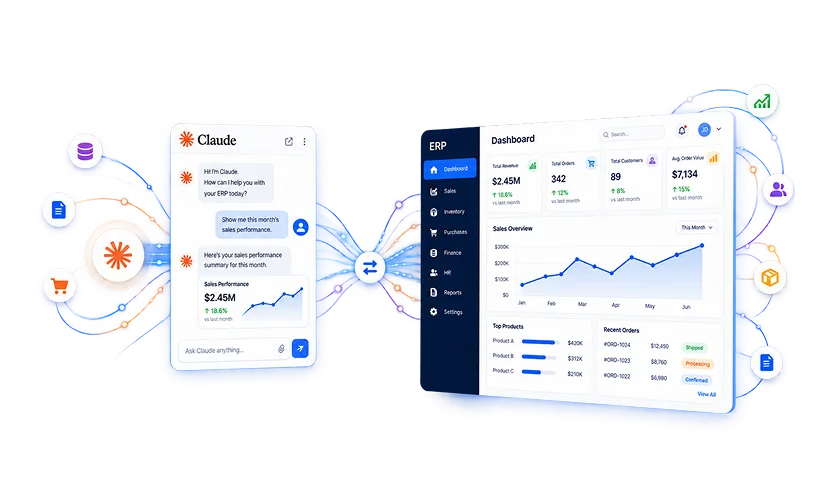
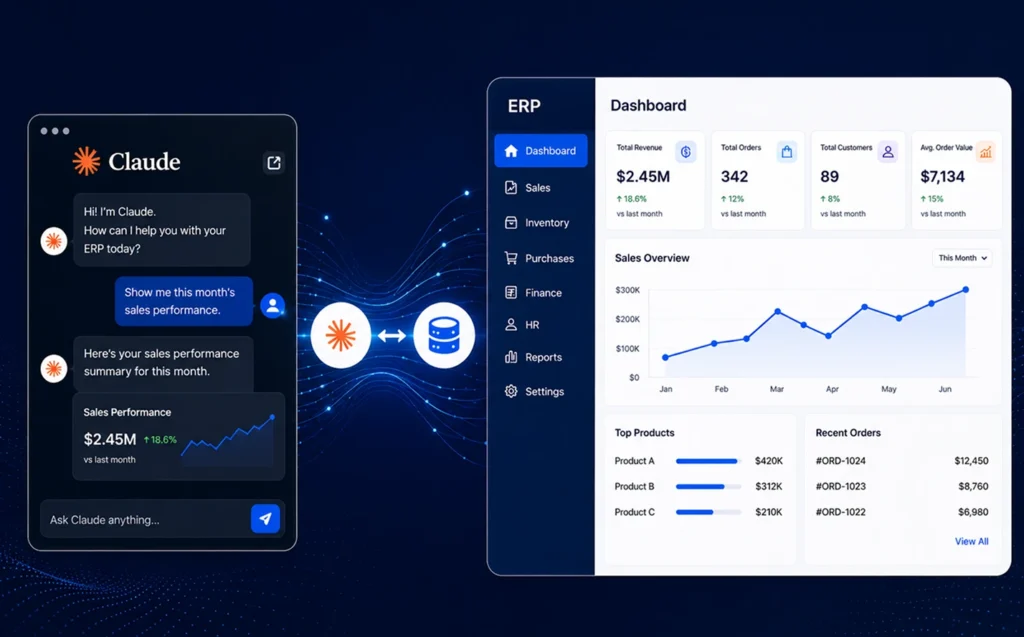
Rather than connecting an AI model directly to a production database, we built an MCP server exposing 43 read-only, schema-validated tools spanning sales, purchase, production, QC, inventory, CRM, and finance. Every request the AI makes passes through that single audited boundary. Nothing touches the ERP outside it, and nothing can write to it.
Management asks a question in plain English. Claude works out which tools to call, retrieves the data, and returns a written answer with charts and tables formatted in Indian-rupee conventions.
Smart Workflows: reports that build themselves
Ad-hoc answers solve half the problem. The other half is the recurring reports someone has to assemble by hand on a schedule.
With Smart Workflows, a user describes the report they want in plain English. Claude generates a deterministic tool-call script. The user reviews and approves it. From then on, it runs automatically on a schedule.
29 recurring management reports now run this way, daily, twice-monthly, and monthly, each of which previously had to be built by hand from the ERP.

Two execution modes, because not every report is the same
Some reports are pure retrieval. Others need judgement. We built both paths:
SCRIPT: fully deterministic. Retrieve and render, with no model call at runtime. Routine reporting stays fast, cheap, and identical every time.
HYBRID: the numbers are deterministic, but reading them isn’t. Flagging at-risk accounts, summarising a week’s trend, suggesting reorder quantities. Here the tool calls replay deterministically, but Claude is invoked on every run to interpret that run’s fresh data and write the commentary. A judgement made once at design time would be stale by the second run.
Direct access from Claude
The same MCP server is exposed to claude.ai over OAuth 2.0, so Prima’s team can reach the identical governed toolset from Claude directly: same permissions, same audit boundary, no separate integration.
Results
- 1–2 days → minutes. Ad-hoc management reports that previously required an analyst are now answered conversationally.
- 29 recurring reports automated, replacing manual assembly across daily, twice-monthly, and monthly cycles.
- 43 production tools live across sales, purchase, production, QC, inventory, CRM, and finance.
- Three manufacturing units covered from a single interface.
- Delivered in approximately 4.5 months by a small TOPS team, built with Claude Code.
In the Client's Words
“We had all the data in our ERP but no fast way to ask it anything. With the Claude-based assistant TOPS built, I can ask a question in plain language and get the answer with a chart in minutes, and the reports I used to chase people for now arrive on their own.”
Tech stack


Have an ERP full of answers nobody can reach?
We build governed AI layers over enterprise systems — with the audit boundaries, deterministic execution, and human approval steps that production actually requires.
TOPS Infosolutions is a member of Anthropic’s Claude Partner Network.
View More Case Studies

Get in Touch
Our Offices

Follow us on


Subscribe Us
Get TOPS Infosolutions' latest articles straight to your inbox.


Copyright © 2026 TOPS Infosolutions Pvt Ltd. All Rights Reserved