












Quick Summary
Choosing a React JS development company in 2027 means looking past portfolios and hourly rates. This guide covers what to look for, the 10 questions to ask on the first call, and how to test a vendor with a short pilot before you sign.
- React 19, the React Compiler, and Server Components have changed what real React expertise looks like.
- The best vendors can explain when not to use a pattern, not just how to use it.
- Ask what happens to AI-generated code before it merges, and who owns it.
- A one-to-two-week pilot on a real backlog task is the most reliable way to compare vendors.
If your checklist for choosing a React JS development company still starts with the same parameters as five years ago, it’s time to level up. In 2027, just portfolio, hourly rate, and years in business is not enough.
React 19 is the baseline, Server Components force real architecture decisions, and a growing share of the code your vendor ships is written with AI assistance.
Those shifts don’t show up in a portfolio. Two companies can have equally polished case studies and still hand you very different codebases. It depends on how they make rendering decisions, how quickly they patch security issues, and who reviews AI-generated code before it merges.
This guide gives you an evaluated process built for those conditions. Check out what to look for, the questions to ask on the first call with a React JS development company, and how to test a vendor with a short pilot.
Why is choosing a React JS development company harder in 2027?
React is no longer a distinctive offering on its own. In the Stack Overflow 2026 Developer Survey, 41.5% of developers said they had worked with React in the past year, second only to Node.js.
AI coding tools are part of everyday delivery now, but the output isn’t always reliable. In the same survey, 69% of developers said plausible but wrong AI-generated code cost their team the most time, and 54% pointed to generated code that was hard to review. That makes review discipline a real quality signal.
React 19 is now the baseline
React 19 has been stable since December 2024, and the React Compiler has reached its 1.0 release, taking over most of the performance tuning teams used to write by hand. The React team has also deprecated Create React App and now steers new projects toward frameworks like Next.js. A vendor still proposing CRA-era setups is working from an old playbook.
React Server Components require architectural judgment
Server Components can cut the JavaScript shipped to the browser, but they change how the whole app is structured. According to the State of React 2025 results, about 15% of developers have used them, and only around a third of those report a positive experience. The right partner knows when not to use them, not just how.
AI-generated code changes what quality means
AI coding tools are part of everyday delivery now. The same Stack Overflow survey found Cursor (19.3%) and Claude Code (10%) already in regular use among professional developers in 2025. Faster output is only actually useful if a senior engineer is reviewing it before it merges. That makes review discipline a real quality signal.
What to look for in a React JS development Agency?
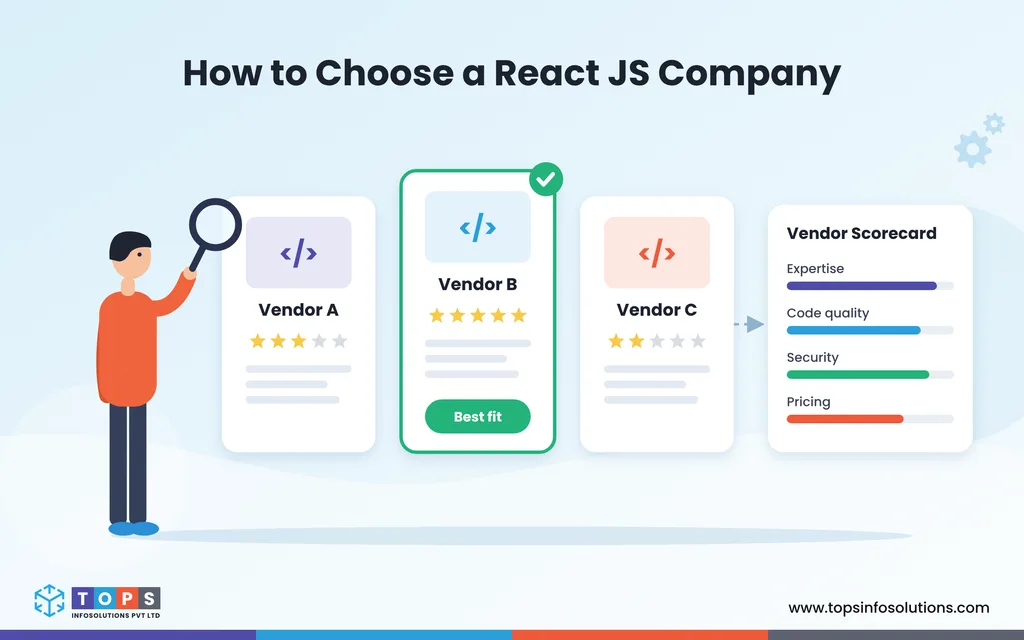
Score every vendor against the same short list of criteria. These six are the ones that actually predict how an engagement will go, and the next section gives you the questions to verify each one. Use this checklist to score every vendor against the same criteria.
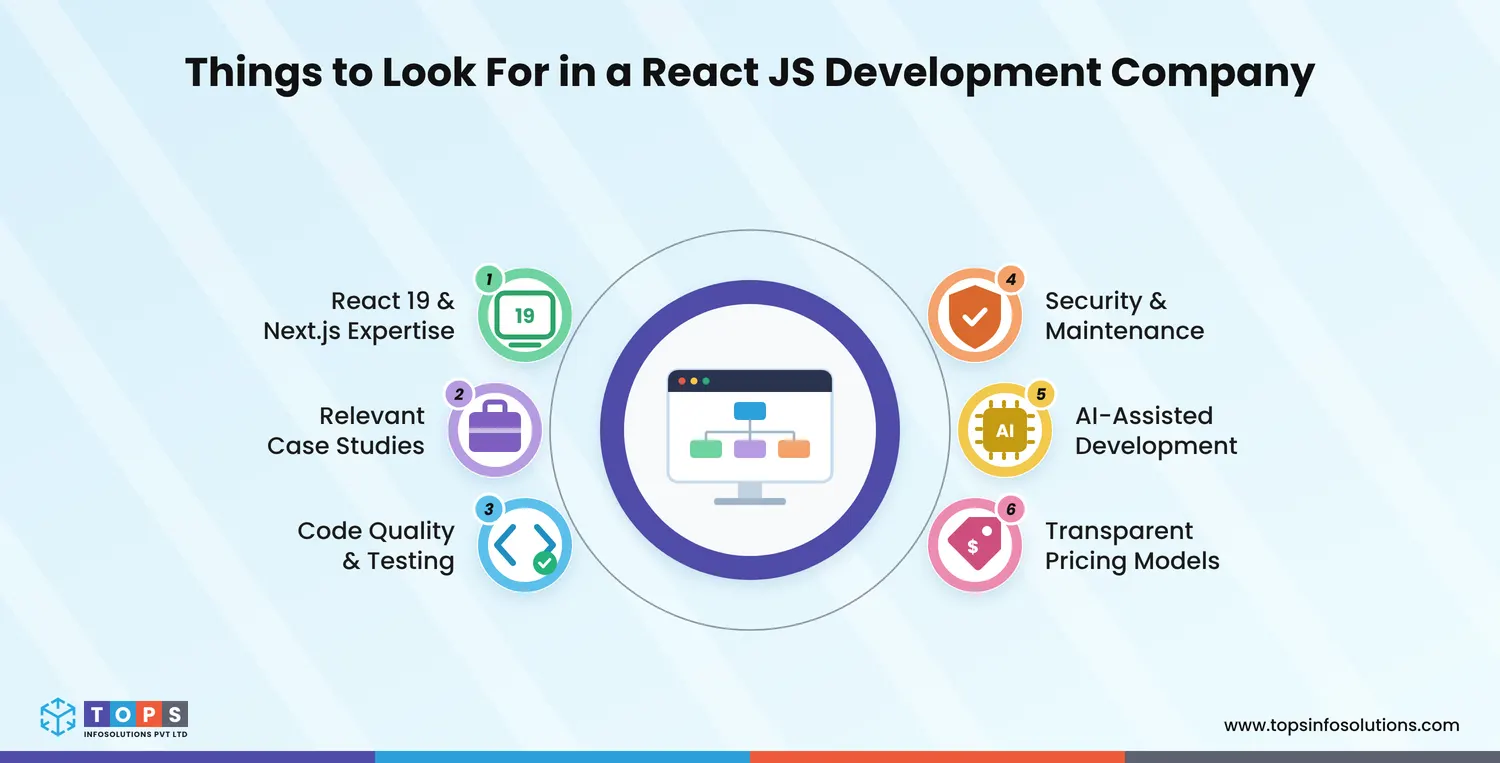
React 19 and Next.js expertise
This criterion is a no-brainer. Look for a React JS development company with current, hands-on experience with React 19, the React Compiler, and at least one production framework such as Next.js or React Router. The vendor should be able to explain why it would pick one setup over another for your product, not default to whatever it used on the last project.
Relevant portfolio and case studies
You’ll find a lot of React JS companies, but you need to match on scale and type of work rather than industry logos. A React app with heavy data, complex permissions, or real-time updates tells you more than a polished marketing site. For each case study, ask for the problem, the architecture decision, and the measurable outcome.
Code quality, TypeScript, and testing standards
Instead of having TypeScript, linting, code review, and automated tests as paid extras, check if they are defaults on every project. The testing needs to be added into the estimate instead of quietly left for later.
Security and long-term maintenance
React apps need regular dependency upgrades and fast responses to critical advisories. Look for a documented patching process and a clear answer on who maintains the app after launch.
AI-assisted development practices
Most vendors now list AI-assisted development as a service, so the label alone isn’t a differentiator. Check whether developers hold certifications for the AI tools they actually use and if the AI-generated code goes through senior review. Ensure that the contract states who owns it.
Engagement models and pricing transparency
A good vendor explains fixed-scope, time-and-materials, and dedicated-team options plainly, including what each one leaves out. Be wary of quotes that look low because testing, documentation, or post-launch support is missing.
What questions should you ask a React JS development company?
While shortlisting a React JS development company, use these questions on the first technical call. The script doesn’t need to be perfect. You just want to know whether the vendor reasons about trade-offs or recites a sales deck.
Questions about React architecture and expertise
- When would you not use React Server Components?
A strong vendor will name specific cases where Server Components add complexity without much benefit, such as highly interactive dashboards or apps behind a login where SEO doesn’t matter. It’s a big red flag if the answer is that they use them everywhere or haven’t used them yet. Because both suggest the decision isn’t being made project by project.
- How do you choose between Next.js, React Router, and a Vite SPA?
The answer should come from your rendering, SEO, and hosting needs. An experienced team will know this and ask you a few questions before recommending anything. If every client gets the same stack, or new work still starts on Create React App, the vendor is opting for their convenience and a one-size-fits-all approach.
- How do you handle state and data fetching in a large app?
Top React JS Development companies separate server data from UI state and can explain when they would use Server Components, a data-fetching library like TanStack Query, or a global store. Putting everything into one global store by default tends to make large apps slow and hard to change.
- What’s your TypeScript and testing baseline?
TypeScript in strict mode, unit and integration tests, and end-to-end tests on critical user flows should run automatically in CI on every project. If testing is described as “available on request,” expect it to be the first thing cut when deadlines tighten.
Questions about security and maintenance
- How quickly did you patch client apps after React2 Shell?
In December 2025, the React team disclosed a critical remote code execution flaw in React Server Components, rated CVSS 10.0 and later added to CISA’s catalog of actively exploited vulnerabilities.
A vendor that takes maintenance seriously can tell you how quickly it patched affected client apps, how it found them, and how it kept clients informed. If they haven’t heard of the vulnerability, that tells you how closely they follow the ecosystem after launch.
- What’s your dependency upgrade policy after launch?
Look for scheduled upgrades, automated vulnerability alerts, and a defined response window for critical patches, written into the support agreement. An answer like “We update when something breaks” usually means you hear about problems from your users first.
Questions about AI-assisted development
- What happens to AI-generated code before it merges?
A good answer names who reviews AI-assisted pull requests, which automated tests and checks run on every change, and what client data AI tools are allowed to access. A general reassurance that “our developers review everything” suggests there’s no defined process behind it.
- Does the contract assign IP for AI-assisted code to us?
The contract should assign ownership of all code, documentation, and any prompts or workflows built for your project to your company, in writing. If the agreement doesn’t mention AI-assisted work at all, ask for that clause before you sign.
Questions about team and code ownership
- Who exactly will work on our code, and can we interview them?
You should get named engineers with relevant React experience, the chance to interview them, and a clear plan for replacing anyone who leaves mid-project.
- If we ended the engagement tomorrow, what would we walk away with?
Ideally, the repository, CI/CD pipelines, and cloud accounts are in your name from day one, with documentation kept current as the project moves. If hosting, repos or deployment scripts live in the vendor’s accounts, switching partners later will be slow and expensive.
How do you test a React JS development firm before signing a contract?
A short pilot on real work tells you more than any proposal. It shows how the team writes code, communicates, and handles feedback before you commit to a long engagement.
How to scope a pilot project
Pick a real task from your backlog that takes one to two weeks, such as a feature with an API integration and a few screens. Give the vendor the same access and context your own developers would get, so the result reflects how they would actually work with you.
What to measure during the pilot
Read the pull requests themselves, looking at code structure, test coverage, and how the team responds to review comments. Also check whether the estimate held, and whether blockers were raised early or only surfaced at the demo.
How does TOPS approach React JS development projects?
We build React applications for product teams that need production-grade work, not just faster output. In one engagement, our team built a cloud product lifecycle management platform for fashion brands on React, Node.js, and AWS. It handles catalogs of 15,000+ SKUs and cut product listing time from weeks to minutes.
As a Claude Certified Services Partner, we use AI coding tools across delivery, with senior engineers reviewing AI-assisted code before it merges. We’re ISO 27001:2022 certified for information security, and testing and QA run alongside development rather than after it. Over 10+ years, that approach has supported 1,000+ projects for 700+ clients.
Whether you need a full product team or want to hire ReactJS developers to extend your own, including Next.js development for server-rendered apps, we’re happy to walk through how we’d approach your roadmap.
Frequently Asked Questions (FAQs)
Cost depends on the team’s location and seniority, the engagement model, and how clearly the scope is defined. Fixed-scope projects suit well-defined builds, while time-and-materials or dedicated teams suit evolving products.
Freelancers work well for small, clearly defined tasks. A development company makes more sense when you need continuity, code review, QA, and someone to cover if an engineer leaves. For a product you plan to grow over years, that coverage usually matters more than a lower hourly rate.
Next.js is a framework built on React, so a strong React company should be comfortable with it. A team with deep Next.js experience matters most when your product depends on server rendering, SEO-heavy pages, or complex routing.
With repository access, documentation, and a clear first task, an experienced team can usually ship small changes within the first week or two. Reaching full pace on a complex codebase typically takes a few sprints.
A solid proposal covers the scope and assumptions, the recommended architecture with reasons for the framework choice, and the named team members who will do the work. It should also lay out milestones, the testing approach, post-launch support terms and anything explicitly out of scope. If pricing appears without these details, ask for them before comparing quotes, because that’s usually where the real cost differences sit.
Yes, most offshore teams that work with US clients set a fixed daily overlap window for standups, reviews and quick decisions. Ask the vendor which hours they cover, who is available during that window, and how work is handed off in writing so nothing waits overnight. Clear async habits, like detailed pull request notes and daily updates, matter as much as the overlap itself.