














Choosing the right technology stack is an important step in building a reliable web application. However, the success of a project also depends on the developer’s ability to turn business requirements into secure, scalable, and maintainable software. If you are planning to build a new application or improve an existing one, hiring a skilled MEAN Stack developer can help you manage both frontend and backend development.
MEAN Stack development combines MongoDB, Express.js, Angular, and Node.js to build full-stack JavaScript applications. Before you hire a MEAN Stack developer, evaluate their technical expertise, practical experience, problem-solving abilities, and understanding of your project requirements.
This guide explains the essential skills to assess, questions to ask, and factors to consider before making a hiring decision.
What Is a MEAN Stack Developer?
A MEAN Stack developer is a full-stack software developer who works with four technologies to build web applications. Each technology serves a specific purpose within the application architecture.
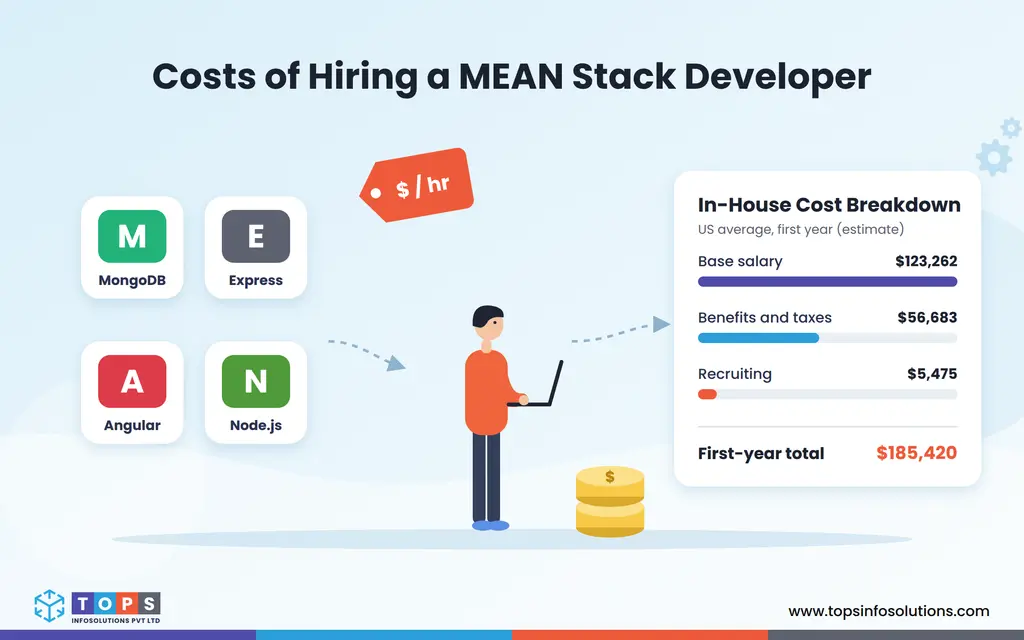
- MongoDB: A document-oriented database used to store and retrieve application data.
- Express.js: A Node.js web framework used to build APIs and manage server-side request handling.
- Angular: A frontend framework used to develop structured, interactive web interfaces.
- Node.js: A JavaScript runtime used to execute server-side application code.
Together, these technologies allow developers to work across the frontend, backend, and database layers of an application.
When hiring, remember that familiarity with all four technologies does not automatically guarantee production-level expertise. Candidates should also demonstrate how they design application architecture, manage data, handle errors, test code, and maintain security.
1. Evaluate Their JavaScript and TypeScript Knowledge
JavaScript is fundamental to MEAN Stack development. A developer should understand modern JavaScript features, asynchronous programming, promises, async/await, error handling, modules, and object-oriented or functional programming concepts where appropriate.
TypeScript is particularly important in modern Angular projects because it supports static typing and helps developers maintain larger codebases.
During the hiring process, evaluate whether the candidate can:
- Write readable, maintainable JavaScript and TypeScript.
- Handle asynchronous operations and API responses.
- Identify and resolve common programming errors.
- Use appropriate types, interfaces, and reusable components.
- Explain technical decisions using practical project examples.
2. Check Their Angular Frontend Development Skills
Angular is responsible for the user-facing layer of a MEAN application. A qualified developer should know how to create responsive interfaces, organize components, manage application state, and connect frontend components to backend APIs.
Look for practical experience with:
- Components, templates, services, and dependency injection.
- Routing, forms, validation, and API integration.
- RxJS and reactive programming concepts.
- TypeScript and reusable application architecture.
- Lazy loading, performance optimization, and testing.
- Accessibility, responsive design, and user experience.
Also, clarify whether the candidate has worked with modern Angular or legacy AngularJS. These technologies are different, and experience with one should not automatically be treated as expertise in the other.
3. Assess Node.js and Express.js Expertise
Node.js and Express.js power the server-side functionality of a MEAN application. Developers must be capable of building APIs, handling requests, managing errors, and implementing reliable business logic.
Before hiring, assess their knowledge of:
- REST API design and HTTP status codes.
- Express middleware and request validation.
- Authentication and authorization.
- Asynchronous operations and error handling.
- Logging, debugging, and API performance.
- API integration and automated testing.
For complex applications, ask how they would manage high request volumes, avoid blocking the Node.js event loop, and handle failures in external services.
The goal is to determine whether the developer can build a maintainable backend rather than simply create basic API endpoints.
4. Evaluate MongoDB and Database Design Skills
MongoDB stores application data in a flexible document format. However, effective database development requires more than basic CRUD operations.
A capable MEAN Stack developer should understand:
- Document and schema design.
- CRUD operations and aggregation pipelines.
- Indexing and query performance.
- Data validation and relationships between collections.
- Pagination and efficient data retrieval.
- Backup, recovery, and data consistency considerations.
5. Review Previous Projects and Relevant Experience
A developer’s previous work can help you understand how well their skills translate into real business applications.
Review projects that are relevant to your requirements, such as SaaS platforms, eCommerce applications, customer portals, dashboards, enterprise systems, or real-time applications.
During the discussion, ask:
- What was the developer’s specific contribution?
- Which technologies and architectural decisions did they use?
- What technical challenges did they encounter?
- How did they improve application performance or reliability?
- How did they test, deploy, and maintain the application?
Focus on individual contributions rather than assuming that every accomplishment listed in a team project was completed by the candidate.
Ask to see work that resembles what you are building. A developer who has shipped a custom order management system has solved a different set of problems to one whose experience is in loan management and financial workflows, both are valuable, but only one of them maps to your project. What matters is not the finished screens. It is whether they can explain the decisions behind them: why the data was structured that way, what they would change now, and what broke along the way.
6. Check Security and Application Performance Knowledge
Security and performance should be considered from the beginning of development, not only after an application is deployed.
A MEAN Stack developer should understand input validation, access control, secure authentication, dependency management, and the risks associated with exposing sensitive information.
Evaluate their knowledge of:
- Authentication and role-based authorization.
- Secure handling of credentials and application secrets.
- Protection against injection and cross-site scripting.
- CORS configuration, rate limiting, and API access controls.
- Database query optimization and caching where appropriate.
- Error monitoring, performance testing, and troubleshooting.
For applications handling personal, financial, or other sensitive information, assess whether the developer understands the additional security and compliance requirements relevant to your industry.
7. Assess Testing, Debugging, and Code Quality
Developers should be able to identify defects before they reach production and maintain code that other team members can understand.
Look for experience with unit tests, integration tests, API tests, and end-to-end testing where appropriate. Also evaluate their use of Git, pull requests, code reviews, documentation, and continuous integration workflows.
A practical coding assignment can reveal how candidates structure a solution, handle edge cases, and explain trade-offs. Keep the assignment relevant to the actual role and avoid relying solely on timed algorithm tests.
8. Evaluate Communication and Team Collaboration
Technical skills are only one part of successful software delivery. Developers must also communicate clearly with project managers, designers, QA engineers, and business stakeholders.
A good candidate should be able to:
- Clarify requirements before beginning development.
- Explain technical limitations in understandable language.
- Estimate tasks and communicate potential delays.
- Collaborate through code reviews and shared documentation.
- Accept feedback and discuss alternative solutions.
- Work independently while keeping the team informed.
These abilities are particularly important when hiring a dedicated developer who will work with an existing internal team. This weighs heaviest when you are adding someone to an existing team rather than handing over a defined project. If you are considering dedicated MEAN Stack developers who will work alongside your own engineers, communication habits will affect your delivery speed more than any single technical skill on this list.
Why Choose TOPS Infosolutions for MEAN Stack Development?
Selecting the right development partner can help you align technical decisions with your business objectives. TOPS Infosolutions provides MEAN Stack development services for businesses building web applications, APIs, and data-driven software solutions.
Before starting a project, define your application requirements, integration needs, security expectations, and long-term maintenance plans. This makes it easier to identify the right technical expertise and establish a clear development roadmap.
Whether you need to extend an existing team or develop a new application, discuss your requirements with the TOPS Infosolutions team to determine the most suitable engagement approach.
Frequently Asked Questions
Rates vary by region, seniority and engagement model, so a published figure is rarely useful. Scope clarity, number of third-party integrations, real-time requirements and whether DevOps is included move the total more than hourly rate does.
Yes, for applications with structured interfaces, evolving data models, or real-time requirements. It is a weaker choice when the data is genuinely relational and transactional integrity matters, where a relational database would serve better.
The difference is the frontend framework. MEAN uses Angular; MERN uses React. MongoDB, Express.js and Node.js are common to both, so the backend and database skills transfer directly between them.
Angular is the more opinionated of the two, which helps on large applications and larger teams because it settles more decisions for you. React is more flexible and draws on a bigger hiring pool. We work through the decision in more depth in when to choose MEAN or MERN, and our MERN Stack development services page covers that stack on its own terms.
Sometimes, but it should not be assumed. Deployment pipelines, container orchestration and cloud infrastructure are a separate specialism, and teams often discover the gap after development is complete. Confirm it explicitly before scoping. Where a project needs both, it is usually cleaner to scope the engineering and the DevOps work separately rather than assuming one person covers the whole span.
A MEAN Stack developer should understand MongoDB, Express.js, Angular, and Node.js, along with JavaScript, TypeScript, REST APIs, database design, testing, Git, security, and application performance.
Consider MEAN Stack when your project benefits from a JavaScript-based full-stack architecture and Angular’s structured frontend capabilities. Evaluate the stack against your requirements, integrations, team expertise, security needs, and long-term maintenance plans before choosing it.