




































Quick Summary
-
- Retrieval is usually the bottleneck. Hybrid search, reranking, and contextual chunking fix many wrong answers before any new architecture is needed.
- Agentic RAG adds a retrieve, check, and retry loop for multi-step questions, at the price of more model calls and higher latency.
- RAG vs GraphRAG comes down to the shape of the question. GraphRAG earns its cost on questions that span a whole collection, while standard RAG stays competitive on single-fact lookups.
- Adaptive RAG routes each question to the cheapest approach that can answer it.
- Add one technique at a time, and let retrieval metrics on your own test set justify each step up in complexity.
If you’ve already worked with RAG-as-a-service, you’d know there are more layers to it. The RAG vs GraphRAG or Agentic RAG debate usually starts after you notice issues in your pilot.
The uncomfortable truth is that retrieval is often the weak link, not the model. If the right passages never reach the model, no architecture layered on top can fix the answer.
That changes the question. You need to know the type of failure and how you can use different types of RAG to solve the problem.
Both agentic RAG and GraphRAG are now practical options, which makes the choice harder, not easier.
This blog walks through what to fix first, what agentic RAG, GraphRAG, and adaptive RAG each change, and how to choose without overbuilding.
How to improve RAG accuracy before changing architecture
Most retrieval failures trace back to a few gaps in the basic pipeline. Closing them is typically cheaper and simpler than adding agents or a graph, and it shows how much of the problem is left.
Before opting for other options, try:
- Hybrid search: Embeddings match meaning but can miss exact terms such as product codes, ticker symbols, or error IDs. Pairing them with keyword search and merging the results covers both.
- Reranking: The first pass returns many loosely relevant chunks. A reranker rescores them against the question and passes only the best to the model.
- Contextual chunking: A chunk often loses its subject once it is split from its document. Adding a short, model-written note about where it came from before indexing restores that context.
Before deciding anything else, run these fixes against a fixed set of real user questions. The failures that remain are the ones an architecture change can actually address, which is where agentic RAG and GraphRAG come in.
Agentic RAG: the retrieve, check, retry loop
Agentic RAG changes how retrieval runs, not what is stored. The pipeline stops being a single pass and becomes a self-correcting process.
What is agentic RAG?
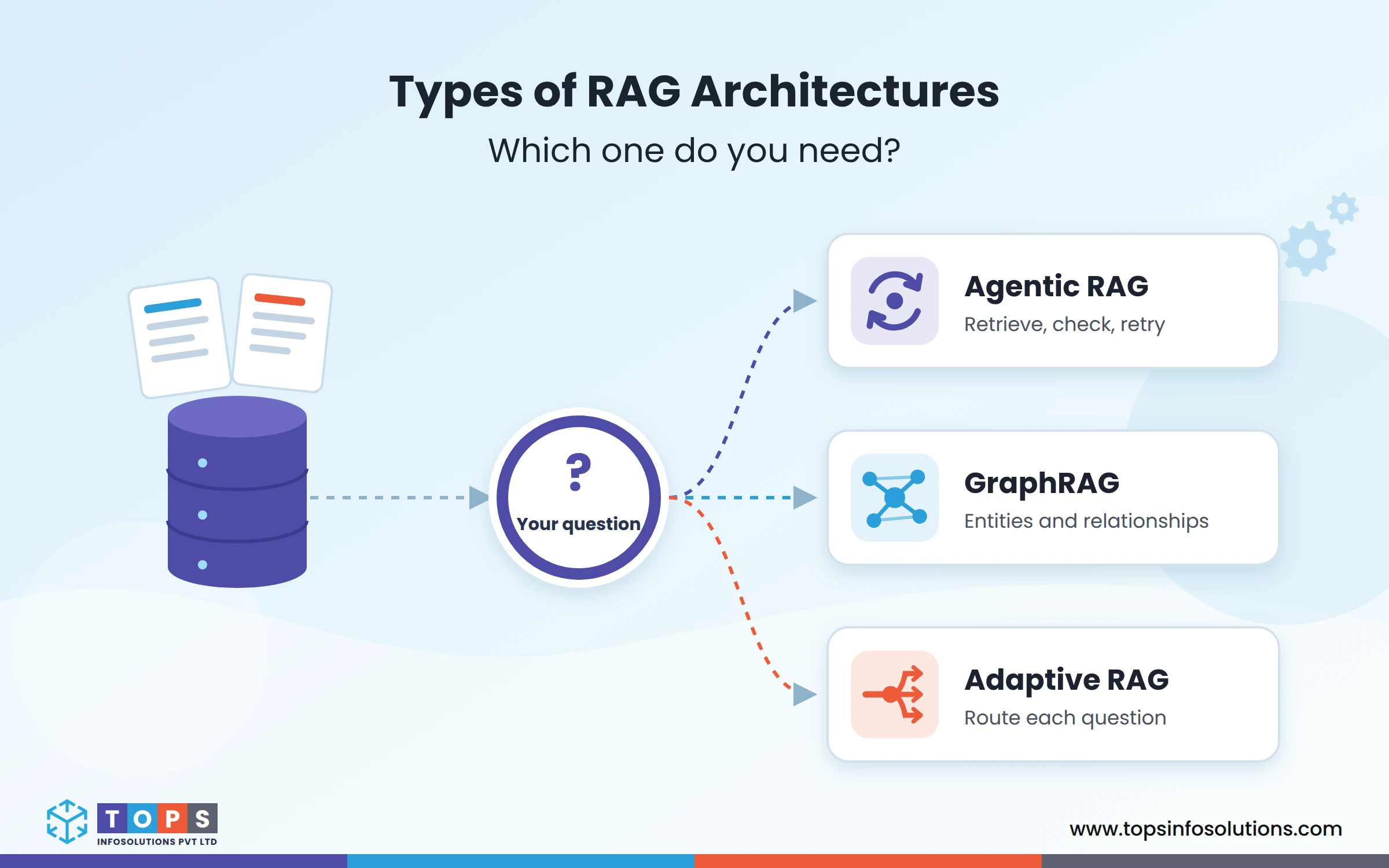
Standard RAG retrieves once and answers. RAG with agentic AI puts an agent in charge. It plans the search, retrieves results, checks whether they actually answer the question, and searches again if they don’t. It can also choose between tools, such as a document index, a database, or a web search. One survey of agentic RAG groups these abilities into four patterns: reflection, planning, tool use, and multi-agent collaboration.
Pros and cons
Pros
- Recovers from a weak first search instead of answering from poor context
- Breaks multi-step questions into smaller searches
- Pulls from several sources in a single answer
Cons
- More model calls per question, which means higher cost and slower responses
- Harder to debug, because each run can take a different path
- Response time varies with how many retries a question triggers
When to use it
Use agentic AI workflow when questions need several steps or several sources. A request like “compare the renewal terms in these three contracts and highlight any that conflict with our policy” fits. A single-fact lookup does not, and if most of your traffic looks like that, the loop adds cost without adding accuracy. Fix basic retrieval first, since an agent retrying against a weak index only fails in more steps.
GraphRAG: local questions and global questions
The choice between standard RAG and GraphRAG mostly comes down to the shape of the question. Microsoft Research, which developed GraphRAG, separates local questions from global ones, and that split is the clearest way to decide.
What is GraphRAG?
Standard RAG finds chunks of text that resemble the question. GraphRAG first maps your material, like the entities in your documents, such as people, products, contracts, and policies, and how they relate to each other. It then uses that map to answer questions, so it can link facts that live in different documents and summarize themes across a whole collection.
Local questions have answers sitting in a specific passage. “When does this policy take effect?” is one, and standard RAG handles it well. Global questions have no single passage to retrieve. “What are the main risks across all our vendor agreements?” is one, and it is what GraphRAG is built for.
Pros and cons
Pros
- Answers questions that span many documents
- Follows relationships across sources, linking facts that no single passage contains
- Summarizes themes across an entire collection
Cons
- Building the graph takes extra model processing before any question is asked
- More moving parts to maintain, especially as documents change
- Little gain on simple lookups, where the extra structure can add noise
When to use GraphRAG
Use GraphRAG when your users need synthesis across many documents or relationships. Compliance reviews, research synthesis, and due diligence over a large document set are typical fits. A hospital asking which internal policies conflict with an updated payer rule is one example of a question that spans many documents, and the guide to RAG in healthcare covers the policy and compliance use cases behind it.
Adaptive RAG: route each question to the right approach
Adaptive RAG answers the “which is better?” question by refusing to pick one. Instead of committing to a single pipeline, it decides for each question.
What is Adaptive RAG?
A router sits in front of your retrieval and judges every incoming question. Simple lookups go to a fast, low-cost pipeline. Multi-step questions go to an agentic loop. Questions about relationships or themes across a collection go to GraphRAG. The idea builds on research into adapting retrieval to question complexity. The router can be a short model prompt that labels each question, or a small trained classifier.
Pros and cons
Pros
- Simple questions stay fast and cheap
- Costly techniques run only where they earn their keep
- New capabilities can be added one route at a time, without rebuilding the pipeline
Cons
- A wrong routing decision sends a question down the wrong path
- The router is one more component that needs its own testing and monitoring
- It needs a realistic sample of your users’ questions to tune well
When to use it
Use adaptive RAG when your traffic is a mix: mostly quick lookups, with a steady share of harder questions. If everything your users ask looks alike, one well-tuned pipeline is simpler and easier to run. A sensible path is to start with the basics, log which questions fail, and add a route only for the failure type you actually see.
RAG vs GraphRAG vs agentic RAG
Each approach fixes a different failure and charges a different price for it. Read the table from top to bottom as an order of escalation: start with the baseline and move down only when a specific failure justifies it.
| RAG Type | What It Changes | Best For | Latency and Cost | Main Risk | Skip It When |
|---|---|---|---|---|---|
| Advanced RAG | Quality of a single retrieval pass | Direct lookups and most production assistants | Low to moderate | Cannot recover from a weak first search or link facts across documents | Questions routinely need several steps or cross-document synthesis |
| Agentic RAG | Retrieval becomes a loop that plans, checks, and retries | Multi-step questions and answers drawn from several sources | Higher, and varies with the number of retries | Slower responses, harder debugging, and costs that grow with usage | Most traffic is single-fact lookups |
| GraphRAG | What is retrieved: relationships and themes instead of similar chunks | Questions spanning many documents or a whole collection | Extra up-front processing to build the graph | Build and upkeep effort, with little gain on simple lookups | Most questions are direct lookups |
| Adaptive RAG | Which pipeline handles each question | Mixed traffic of easy and hard questions | Low for most questions, higher only on routed ones | Misrouted questions and one more component to monitor | All your questions look alike |
How to choose an enterprise RAG architecture
The right architecture is the simplest one that fixes the failures your users actually hit. A short decision path keeps the choice tied to evidence instead of trends.
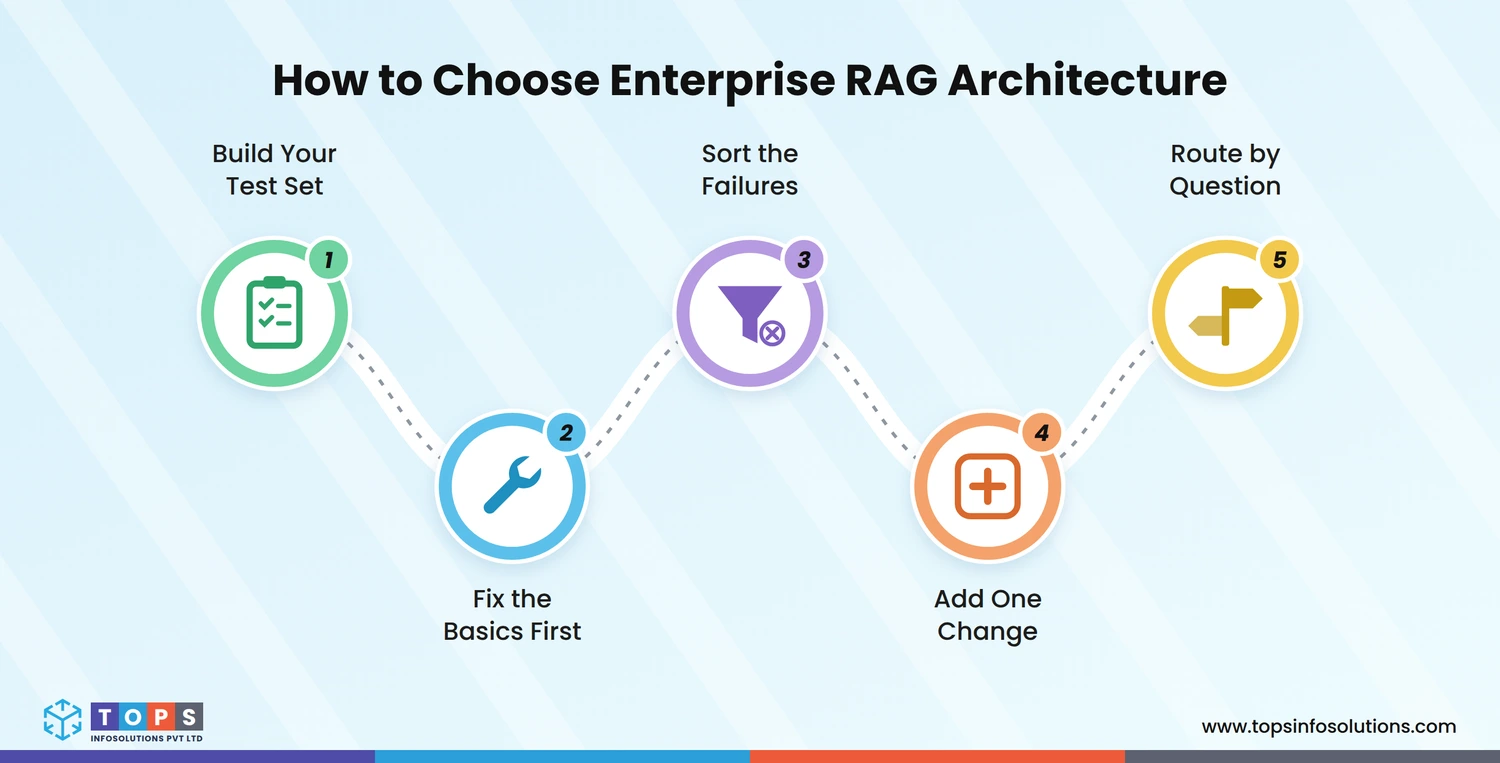
Build a test set
Collect real user questions from support tickets, search logs, or internal requests, and pair each with the passage that should answer it. Include the hard ones, since easy questions hide problems. Record your current results before changing anything, so every later change has a baseline to beat.
Apply the basics
Add hybrid search, reranking, and contextual chunking, ideally one at a time so you can see which one helps. Then run the test set again.
Sort what still fails
Label each failure by type. If the wrong passages were retrieved, return to the basics. If the right passages were retrieved but the answer was wrong, the problem sits in generation, not architecture. If the right passages were retrieved but the answer was wrong, the problem sits in generation, not architecture. Prompt changes or fine-tuning may be the better fix.
Add one change at a time
Compare each against the baseline on answer quality, cost, and response time, and keep it only if the gain justifies the extra cost. Rerun the same test set each time so results stay comparable.
Route when the mix demands it
If both failure types appear alongside plenty of easy questions, add a router so only the hard ones pay for the heavier pipeline. Start simple, such as a prompt that labels each question, and review its mistakes regularly.
Measurement makes each step defensible. Ensure that you track retrieval and answers separately. At the retrieval stage, look at the accuracy of the context and recall.
At the answer stage, look at faithfulness (does the answer stay within the retrieved context?). When quality drops, check retrieval first. If the right passages never reach the model, changing the prompt or the model will not help.
Enterprise generative AI deployments add a few more checks. You need to track cost per question and response time by stage, since those two numbers usually decide whether a technique survives in production. Confirm that retrieval respects who is allowed to see which documents. And plan for change: documents get updated, and every index, especially a graph, has to be refreshed when they do.
Wrapping Up
Standard RAG with strong retrieval handles most questions. Agentic RAG earns its cost on multi-step ones, GraphRAG on questions that span a whole collection, and adaptive RAG lets you use each where it fits. The order matters more than the choice: fix retrieval, sort what still fails, add one technique at a time, and let your own test results decide.
That discipline is also where many teams want a second pair of hands, because it combines retrieval tuning, evaluation, and architecture decisions in one project. At TOPS, our RAG AI development work follows that same sequence: measure first, and add agents or graphs only where the results justify them. If your assistant is answering from the wrong documents, that is usually the best place to start.
Frequently Asked Questions (FAQs)
It depends on the question. GraphRAG is stronger on questions that span many documents, while standard RAG matches or beats it on simple lookups and costs less to run. Neither wins across the board.
Standard RAG retrieves similar text once and answers. Agentic RAG adds a loop that plans, checks the results, and retries. GraphRAG maps the entities and relationships in your documents and retrieves from that map. Each changes a different part of the pipeline.
Use it when questions need several steps or sources and a single pass keeps missing. If most questions are single-fact lookups, or basic retrieval is still weak, the loop adds cost without fixing accuracy.
Generally, yes. Each check and retry is another model call, so cost and response time rise and vary by question. Compare both against answer quality before adopting it, and route only the hard questions to it.
Not one you build yourself. GraphRAG tools extract entities and relationships from your documents to create the graph. Budget for that processing and for refreshing the graph as your documents change.
Start with retrieval: hybrid search, reranking, and contextual chunking. Test each change against a fixed set of real questions, one at a time. In many systems, the model was never the weak point.
Check what was retrieved before judging the answer. If the right passages are missing or buried, retrieval is the problem. If they are present but the answer is still wrong, look at the prompt or the model. Tracking context precision and recall on a test set makes this routine.